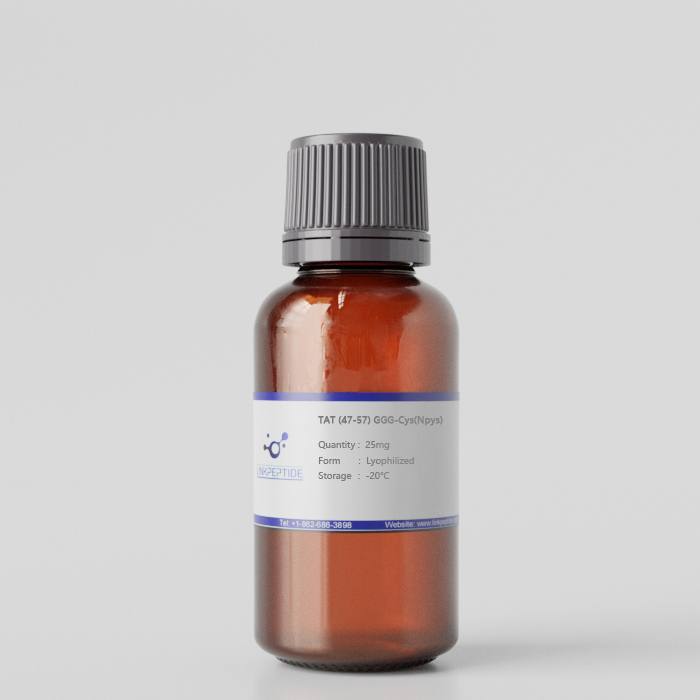
Product Name: TAT (47-57) GGG-Cys(Npys)
Sequence One Letter Code: YGRKKRRQRRRGGG-C(Npys)-NH2
Sequence Three Letter Code: H-Tyr-Gly-Arg-Lys-Lys-Arg-Arg-Gln-Arg-Arg-Arg-Gly-Gly-Gly-Cys(NPYS)-NH2
Chemical Formula:C78H135N39O19S2
Molecular Weight: 1987.3
Purity: 95%
Form: Lyophilized
Storage Conditions: - 20 °C
Research Area: Cell Penetrating Peptides
Source / Species: HIV
Conjugation: Unconjugated
Code Nacres: NA.26
Application: TAT (47–57) GGG-Cys(Npys) is a modified version of the HIV-1 TAT protein transduction domain designed for versatile conjugation and intracellular delivery applications. The arginine-rich TAT (47–57) sequence enables efficient membrane translocation and facilitates the transport of attached biomolecules into cells. A flexible glycine-glycine-glycine (GGG) spacer is incorporated to improve structural flexibility and reduce steric hindrance during conjugation. The activated Cys(Npys) residue allows selective thiol-based coupling reactions through disulfide exchange, enabling rapid attachment to thiol-containing compounds. In addition, the free N-terminus supports further functionalization strategies. This peptide is widely used as a cell-penetrating carrier in studies involving biomolecule delivery, conjugation chemistry, and investigations of membrane translocation mechanisms.
Current Research: Cell-penetrating peptides (CPPs) are short peptide sequences capable of crossing cellular membranes and transporting a wide range of biomolecules into cells. Among the most extensively studied CPPs is TAT (47–57), derived from the protein transduction domain of the HIV-1 trans-activator of transcription (TAT) protein. This arginine-rich sequence is widely used in biochemical and biomedical research because of its strong ability to facilitate cellular uptake of attached cargo molecules. TAT (47–57) GGG-Cys(Npys) is a modified form of this peptide designed to support efficient intracellular delivery and flexible conjugation chemistry. In addition to the membrane-penetrating TAT sequence, the peptide includes a glycine-glycine-glycine (GGG) spacer and an Npys-activated cysteine residue, both of which enhance its versatility as a carrier molecule. These structural features enable selective thiol-based coupling reactions and improve accessibility for cargo attachment, making the peptide particularly useful in studies involving biomolecule transport and intracellular targeting. The TAT (47–57) Protein Transduction Domain The TAT (47–57) sequence represents the minimal protein transduction domain (PTD) of the HIV-1 TAT protein. This short peptide contains multiple positively charged arginine and lysine residues, which promote strong electrostatic interactions with negatively charged components of the cell membrane. These interactions enable the peptide to penetrate cellular membranes through mechanisms that may include: Direct membrane translocation Endocytosis-mediated uptake Macropinocytosis pathways Because of this capability, the TAT peptide has become one of the most widely used CPPs for transporting proteins, peptides, nucleic acids, nanoparticles, and other bioactive molecules into cells. Role of the GGG Spacer In the TAT (47–57) GGG-Cys(Npys) construct, a glycine-glycine-glycine (GGG) spacer is inserted between the TAT sequence and the reactive cysteine residue. Glycine residues are commonly used as spacers in peptide design because they provide high conformational flexibility. The GGG spacer serves several important functions: Reduces steric hindrance between the TAT carrier and attached cargo Improves structural flexibility during conjugation Enhances accessibility of the reactive cysteine residue Supports efficient interaction between the peptide and its cargo By separating the TAT sequence from the conjugation site, the spacer helps preserve the membrane-penetrating activity of the peptide while allowing efficient attachment of target molecules. Npys-Activated Cysteine for Thiol-Specific Conjugation A key feature of this peptide is the presence of Cys(Npys), a cysteine residue protected with an Npys (3-nitro-2-pyridinesulfenyl) activating group. This modification creates an activated disulfide intermediate that enables rapid and selective conjugation with thiol-containing molecules. The Npys group supports disulfide exchange reactions, allowing the peptide to form disulfide bonds with cysteine residues present in proteins, peptides, or other thiol-containing compounds. This reaction is particularly useful in biochemical applications because it occurs under mild conditions compatible with sensitive biomolecules. Advantages of the Npys activation include: Selective thiol-specific coupling Rapid and efficient disulfide exchange reactions Compatibility with biological systems Formation of reversible disulfide linkages These properties make the peptide an effective platform for constructing CPP–cargo conjugates. Flexible Functionalization Through the N-Terminus Another useful design feature of TAT (47–57) GGG-Cys(Npys) is the free N-terminus, which allows additional functionalization if needed. Researchers can attach labeling groups, affinity tags, or other molecular modifications to the N-terminal region without interfering with the cysteine-based conjugation site. This flexibility allows the peptide to be adapted for a variety of experimental configurations, including imaging probes or multi-component delivery constructs. Applications in Biomolecule Delivery Because of its strong membrane-penetrating capability and flexible conjugation chemistry, TAT (47–57) GGG-Cys(Npys) is widely used in studies focused on intracellular delivery systems. By attaching experimental cargo molecules to the peptide, researchers can transport these molecules across cellular membranes. Typical cargo types include: Peptides and proteins Nucleic acids such as DNA or RNA Fluorescent probes and imaging agents Enzyme inhibitors or signaling molecules These systems allow scientists to analyze how macromolecules behave within cells and evaluate methods for improving intracellular transport. Investigating Membrane Translocation Mechanisms In addition to delivery applications, the peptide is frequently used in experiments designed to understand cellular uptake and membrane translocation mechanisms. Researchers can attach fluorescent or functional probes to the peptide and observe how they enter cells and distribute within intracellular compartments. Such studies help clarify: Cellular uptake pathways of CPPs Intracellular trafficking of peptide–cargo complexes Interactions between peptides and cellular membranes Mechanisms governing macromolecule transport across membranes These insights are valuable for understanding how peptide-based carriers function in biological systems. Conclusion TAT (47–57) GGG-Cys(Npys) is a multifunctional peptide derived from the HIV-1 TAT protein transduction domain and engineered to support efficient intracellular delivery and selective conjugation chemistry. The arginine-rich TAT sequence enables membrane penetration, while the GGG spacer improves flexibility and reduces steric interference during cargo attachment. The activated Cys(Npys) residue allows rapid thiol-specific conjugation through disulfide exchange reactions. Together, these features make the peptide a versatile tool for biomolecule delivery, conjugation chemistry, and studies of membrane translocation mechanisms, supporting a wide range of research applications in cell biology and biomedical science.
Get a Quote
 LinkPeptide