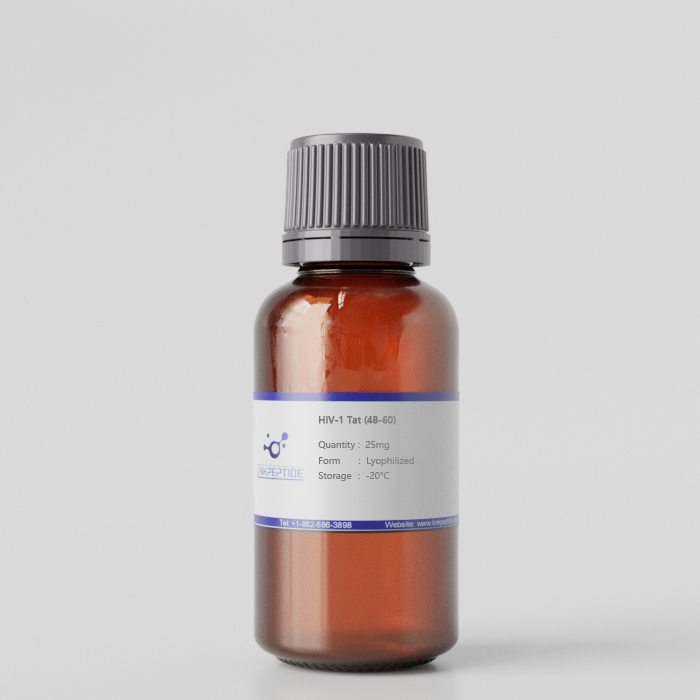
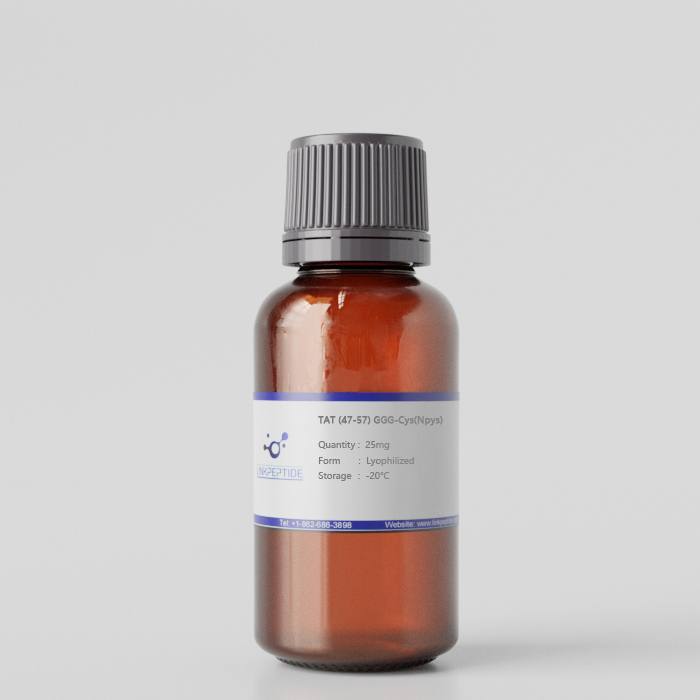
Product Name: HIV-1 Tat (48-60)
Sequence One Letter Code: GRKKRRQRRRPPQ
Sequence Three Letter Code: H-Gly-Arg-Lys-Lys-Arg-Arg-Gln-Arg-Arg-Arg-Pro-Pro-Gln-OH
Chemical Formula:C70H131N35O16
Molecular Weight: 1719.1
Purity: 95%
Form: Lyophilized
Storage Conditions: - 20 °C
Research Area: Cell Penetrating Peptides
Source / Species: HIV
Conjugation: Unconjugated
Code Nacres: NA.26
Application: HIV-1 Tat (48–60) is an arginine-rich cell-penetrating peptide derived from residues 48–60 of the HIV-1 Tat protein. This sequence efficiently translocates across cellular membranes without significant membrane disruption, enabling intracellular delivery of diverse cargos. Tat (48–60) has been extensively used to transport peptides, proteins, nucleic acids, nanoparticles, and other macromolecules into living cells. It serves as a versatile tool for studying cellular uptake mechanisms, endosomal escape, and nonviral delivery strategies. The peptide supports applications in gene regulation, intracellular modulation of signaling pathways, and development of targeted delivery platforms.
Current Research: HIV-1 Tat (48–60) is a short, arginine-rich peptide derived from the transactivation domain of the human immunodeficiency virus type 1 (HIV-1) Tat protein. Encompassing residues 48–60, this sequence contains a high density of basic amino acids that confer potent cell-penetrating capability. As one of the earliest and most extensively characterized cell-penetrating peptides (CPPs), Tat (48–60) has become a foundational tool for delivering biologically active cargos into living cells without the need for viral vectors or membrane-disrupting agents. The membrane-translocating capacity of Tat (48–60) is primarily attributed to its cluster of arginine and lysine residues. The guanidinium groups of arginine side chains form multivalent electrostatic and hydrogen-bonding interactions with negatively charged cell surface components, including phospholipid headgroups and heparan sulfate proteoglycans. These interactions promote initial membrane association and trigger internalization via energy-dependent endocytic pathways such as macropinocytosis and clathrin-mediated uptake. Under certain conditions, direct translocation across lipid bilayers has also been proposed. Importantly, Tat-mediated uptake occurs without substantial membrane disruption, preserving cellular integrity. Tat (48–60) is widely employed as a delivery vector for diverse macromolecules. Covalent fusion or noncovalent complexation enables intracellular transport of peptides, full-length proteins, nucleic acids, nanoparticles, and imaging probes. In protein delivery applications, Tat fusion constructs facilitate rapid intracellular access of enzymes, transcription factors, or signaling modulators, allowing functional studies without genetic transfection. In nucleic acid delivery, Tat-conjugated oligonucleotides or siRNA molecules support gene silencing and modulation of transcriptional networks in cultured cells and experimental models. The peptide also serves as a platform for investigating cellular uptake mechanisms. Because Tat (48–60) is well characterized and reproducibly internalized across numerous cell types, it provides a standardized model for studying endocytosis, intracellular trafficking, and endosomal escape. Fluorescent labeling of Tat-conjugated cargos allows quantitative analysis of uptake kinetics and subcellular distribution using microscopy and flow cytometry. Such studies have contributed significantly to understanding how arginine-rich peptides interact with membranes and how cargo size, linker chemistry, and peptide concentration influence delivery efficiency. A major focus in Tat-based delivery research is overcoming endosomal entrapment. While Tat facilitates efficient internalization, a portion of delivered cargo may remain sequestered within endosomal compartments. Strategies such as incorporation of endosomolytic sequences, pH-responsive linkers, or fusogenic peptides are frequently evaluated in combination with Tat (48–60) to enhance cytosolic release. These approaches inform broader efforts to optimize nonviral delivery platforms for therapeutic applications. Tat (48–60) has also been used to modulate intracellular signaling pathways directly. By delivering inhibitory peptides or dominant-negative protein fragments, researchers can acutely interfere with protein–protein interactions and kinase activity. This enables temporal control over signaling cascades in studies of apoptosis, inflammation, and cell cycle regulation. Compared with genetic manipulation, Tat-mediated delivery provides rapid and reversible modulation of intracellular targets. In translational research, Tat (48–60) continues to influence the development of targeted delivery systems. Its modular structure allows fusion with targeting ligands or therapeutic cargos, forming multifunctional constructs for potential clinical application. Although challenges such as biodistribution and in vivo stability remain areas of active investigation, Tat-based systems have contributed significantly to the evolution of peptide-mediated transport technologies. In summary, HIV-1 Tat (48–60) is a prototypical arginine-rich cell-penetrating peptide that enables efficient intracellular delivery of a wide range of biomolecules. Its established uptake mechanisms, versatility in cargo conjugation, and compatibility with mechanistic studies make it an essential tool in cell biology, gene regulation research, and the development of nonviral therapeutic delivery strategies.
Get a Quote
 LinkPeptide