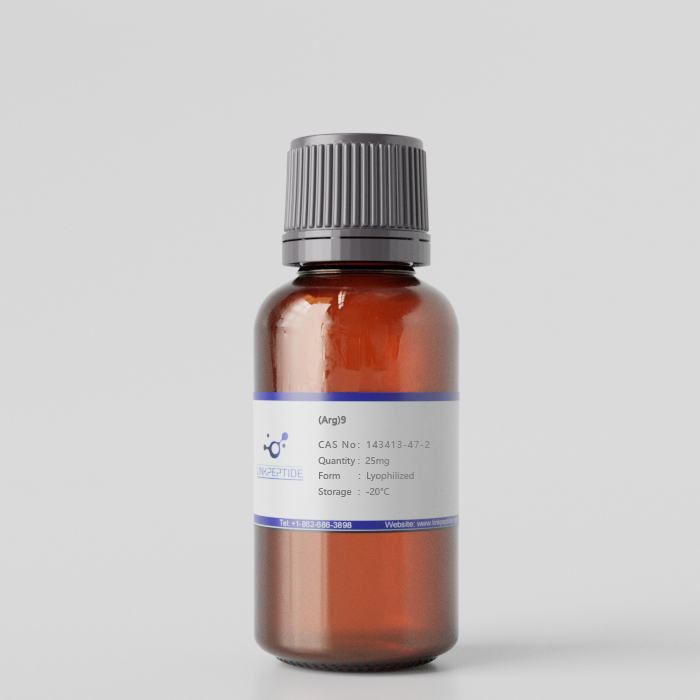
Product Name: (Arg)9 biotin labeled
Sequence One Letter Code: Biotin-LC-RRRRRRRRR-NH2
Sequence Three Letter Code: Biotin-LC-Arg-Arg-Arg-Arg-Arg-Arg-Arg-Arg-Arg-NH2
Molecular Weight: 1762.2
Purity: 95%
Form: Lyophilized
Storage Conditions: - 20 °C
Research Area: Cell Penetrating Peptides
Source / Species: Synthetic construct
Conjugation: Conjugated
Conjugation Type: Biotins
Code Nacres: NA.26
Application: Biotin-(Arg)₉ is a synthetic cell-penetrating peptide composed of nine consecutive arginine residues with an N-terminal biotin modification. Polyarginine sequences efficiently traverse eukaryotic cell membranes via energy-dependent and independent uptake pathways, making them widely used delivery vectors for proteins, peptides, nucleic acids, and nanoparticles. The biotin tag enables affinity-based detection, pull-down assays, and intracellular tracking using streptavidin-based systems. This peptide is commonly applied in studies of membrane translocation mechanisms, endocytic uptake pathways, and intracellular cargo delivery. It supports research focused on nonviral delivery strategies, therapeutic transport optimization, and mechanistic analysis of arginine-rich peptide–mediated cellular entry.
Current Research: Arginine-rich peptides represent a well-established class of cell-penetrating peptides (CPPs) capable of traversing eukaryotic cell membranes and facilitating intracellular cargo delivery. Among them, nona-arginine ((Arg)₉) is one of the most extensively characterized and efficient membrane-translocating sequences. Biotin-(Arg)₉ is a synthetic construct consisting of nine consecutive arginine residues bearing an N-terminal biotin modification, combining robust cellular uptake capability with affinity-based detection functionality. This dual design makes it a versatile tool for mechanistic studies of membrane translocation and nonviral delivery strategies. The membrane permeability of polyarginine peptides is largely attributed to the guanidinium groups of arginine side chains. These positively charged moieties form bidentate hydrogen bonds with negatively charged components of the plasma membrane, including phospholipid headgroups, sulfated proteoglycans, and glycosaminoglycans. The high local charge density of (Arg)₉ promotes strong electrostatic interactions that facilitate initial membrane binding. Subsequent internalization can occur through multiple pathways, including macropinocytosis, clathrin-mediated endocytosis, caveolin-dependent uptake, and, under certain conditions, direct translocation across the lipid bilayer. The precise mechanism of entry often depends on peptide concentration, cell type, temperature, and cargo size. Energy-dependent endocytic pathways predominate under physiological conditions, whereas direct membrane translocation may contribute at higher concentrations or in specific lipid environments. Biotin-(Arg)₉ supports systematic investigation of these uptake mechanisms. By applying pharmacological inhibitors or temperature shifts, researchers can delineate the relative contributions of distinct internalization routes and characterize endosomal trafficking dynamics. The N-terminal biotin modification confers additional experimental utility. Biotin binds streptavidin and avidin with extremely high affinity, enabling robust affinity capture and detection. In pull-down assays, Biotin-(Arg)₉ can be used to isolate interacting membrane components or intracellular binding partners following cellular uptake. When combined with fluorescently labeled streptavidin, the peptide facilitates visualization of intracellular distribution and trafficking using fluorescence microscopy or flow cytometry. This feature supports quantitative analysis of uptake efficiency and subcellular localization. Biotin-(Arg)₉ is widely employed as a delivery vector for diverse cargos, including proteins, peptides, nucleic acids, and nanoparticles. Conjugation strategies may involve covalent linkage or electrostatic complex formation, depending on the cargo. In nucleic acid delivery, polyarginine sequences enhance cellular uptake of siRNA, antisense oligonucleotides, and plasmid DNA. In protein delivery applications, (Arg)₉-mediated transport allows functional enzymes or regulatory proteins to enter cells without genetic manipulation. The biotin tag further enables tracking of conjugates and confirmation of intracellular accumulation. In studies of intracellular trafficking, Biotin-(Arg)₉ provides a means to monitor endosomal escape and cytosolic release. Because many CPP-based delivery systems are limited by endosomal entrapment, assessing colocalization with endosomal markers is essential. Streptavidin-based imaging approaches allow visualization of peptide distribution relative to lysosomal or early endosomal compartments, informing strategies to enhance cytosolic delivery efficiency. The peptide also supports development of nonviral therapeutic delivery platforms. Compared with viral vectors, CPP-based systems offer lower immunogenicity and simplified production. Biotin-(Arg)₉ serves as a model scaffold for optimizing arginine-rich transporters with improved stability, reduced toxicity, and enhanced target specificity. Modifications such as linker incorporation, PEGylation, or targeting ligand conjugation can be evaluated using this defined polycationic backbone. From a mechanistic perspective, Biotin-(Arg)₉ contributes to understanding how arginine-rich sequences interact with membranes at the molecular level. Biophysical techniques such as circular dichroism spectroscopy, fluorescence quenching assays, and lipid vesicle leakage studies help clarify how guanidinium–phosphate interactions and membrane curvature effects influence translocation efficiency. In summary, Biotin-(Arg)₉ integrates the high-efficiency cellular uptake properties of nona-arginine with a biotin affinity handle for detection and capture. It is broadly applied in studies of membrane translocation mechanisms, intracellular trafficking, and cargo delivery optimization. As research continues to refine nonviral transport strategies, this peptide remains a foundational tool for mechanistic analysis and development of arginine-rich delivery systems.
Get a Quote
 LinkPeptide