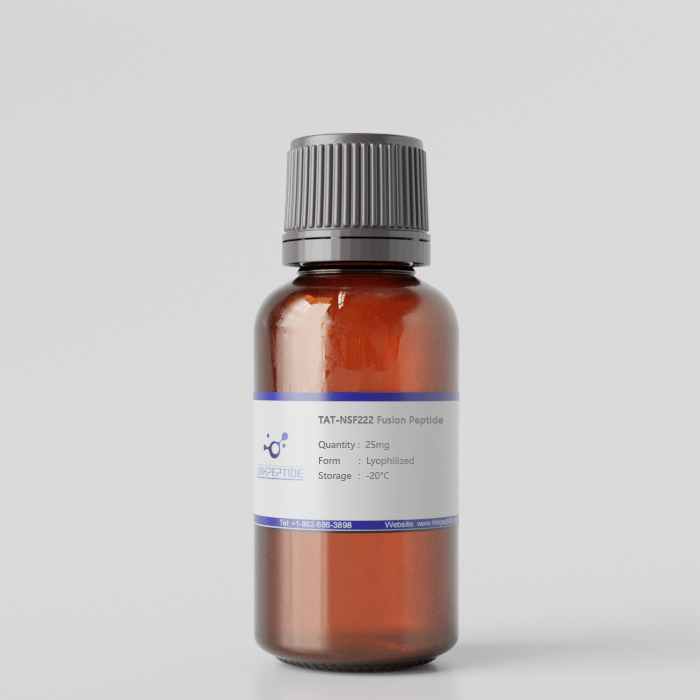
Product Name: TAT-NSF222 Fusion Peptide
Sequence One Letter Code: YGRKKRRQRRR-GGG-LDKEFNSIFRRAFASRVFPPE
Sequence Three Letter Code: H-Tyr-Gly-Arg-Lys-Lys-Arg-Arg-Gln-Arg-Arg-Arg-Gly-Gly-Gly-Leu-Asp-Lys-Glu-Phe-Asn-Ser-Ile-Phe-Arg-Arg-Ala-Phe-Ala-Ser-Arg-Val-Phe-Pro-Pro-Glu-OH
Molecular Weight: 4240.1
Purity: 95%
Form: Lyophilized
Storage Conditions: - 20 °C
Research Area: Cancer Disease Research
Source / Species: HIV
Conjugation: Unconjugated
Code Nacres: NA.26
Application: TAT-NSF222 Fusion Peptide consists of residues 222–243 of N-ethylmaleimide-sensitive factor (NSF) linked to the HIV-1 TAT cell-penetrating domain via a glycine spacer. The NSF fragment lies adjacent to the Walker A motif within the D1 ATPase domain and is critical for ATP hydrolysis and vesicle fusion processes. The TAT sequence enables efficient cellular uptake, permitting intracellular modulation of NSF activity. This peptide has been shown to inhibit NSF ATPase function and is used to investigate vesicle trafficking, SNARE complex disassembly, and membrane fusion events. It supports research on ATPase-dependent cellular processes and intracellular transport mechanisms.
Current Research: N-ethylmaleimide-sensitive factor (NSF) is an essential AAA+ ATPase that drives membrane trafficking through ATP-dependent disassembly of SNARE complexes. Following vesicle fusion, cis-SNARE complexes must be disassembled to recycle SNARE proteins for subsequent rounds of membrane fusion. NSF, in cooperation with α-SNAP, binds assembled SNARE complexes and utilizes ATP hydrolysis within its D1 ATPase domain to catalyze their disassembly. Disruption of NSF function therefore has direct consequences for vesicle trafficking, neurotransmitter release, endocytosis, and exocytotic membrane dynamics. The TAT-NSF222 fusion peptide is a synthetic, cell-permeable construct designed to modulate NSF activity intracellularly. It consists of residues 222–243 of NSF fused via a glycine spacer to the HIV-1 TAT protein transduction domain. The NSF-derived segment lies adjacent to the Walker A motif within the D1 ATPase domain, a region critical for nucleotide binding and hydrolysis. By incorporating this regulatory fragment into a membrane-transducing format, the peptide provides a targeted approach to perturb NSF ATPase function in living cells. The TAT sequence, derived from the HIV-1 transactivator of transcription protein, is a well-established cell-penetrating peptide (CPP). Rich in basic residues, it facilitates efficient translocation across the plasma membrane via endocytic and direct transduction pathways. Fusion of the TAT domain to the NSF222 fragment enables rapid intracellular delivery without the need for transfection reagents or genetic manipulation. This approach allows temporal control over NSF inhibition, which is particularly valuable when studying essential ATPase-dependent processes that cannot be chronically suppressed without compromising cell viability. Functionally, the NSF222 segment is positioned near structural elements required for ATP binding and hydrolysis in the D1 domain. Introduction of this peptide into cells has been shown to inhibit NSF ATPase activity, likely by interfering with conformational changes necessary for catalytic cycling or SNARE complex engagement. Because NSF operates as a hexameric ATPase, even partial perturbation of its activity can significantly affect SNARE disassembly efficiency. In cellular systems, treatment with TAT-NSF222 leads to accumulation of assembled SNARE complexes and disruption of vesicle trafficking pathways. This phenotype provides a powerful experimental tool for dissecting NSF-dependent mechanisms in both neuronal and non-neuronal contexts. In neurons, NSF activity is essential for synaptic vesicle recycling and sustained neurotransmission. Acute inhibition using TAT-NSF222 allows researchers to examine the role of ATP hydrolysis in synaptic function without permanently altering protein expression levels. In endocrine and epithelial cells, the peptide supports investigation of regulated secretion, receptor recycling, and membrane turnover. The fusion peptide is also valuable in mechanistic studies of membrane fusion. SNARE-mediated membrane fusion requires coordinated assembly and disassembly cycles. By selectively inhibiting NSF ATPase activity, investigators can differentiate between fusion steps that depend on SNARE complex formation and those requiring post-fusion disassembly. This distinction clarifies how ATPase-driven remodeling contributes to trafficking fidelity and vesicle pool maintenance. Beyond vesicular transport, NSF participates in additional ATPase-dependent processes, including regulation of certain ion channels and receptor trafficking. The TAT-NSF222 peptide enables exploration of these broader roles by providing an acute and reversible means of modulating NSF function. Because it acts intracellularly and does not require genetic modification, it is particularly suitable for short-term functional assays and time-resolved studies. In summary, the TAT-NSF222 fusion peptide integrates a functional NSF regulatory fragment with the HIV-1 TAT cell-penetrating domain to enable efficient intracellular delivery and targeted inhibition of NSF ATPase activity. By interfering with SNARE complex disassembly and vesicle trafficking, this peptide serves as a valuable research tool for studying membrane fusion, intracellular transport, and ATPase-driven cellular processes.
Get a Quote
 LinkPeptide