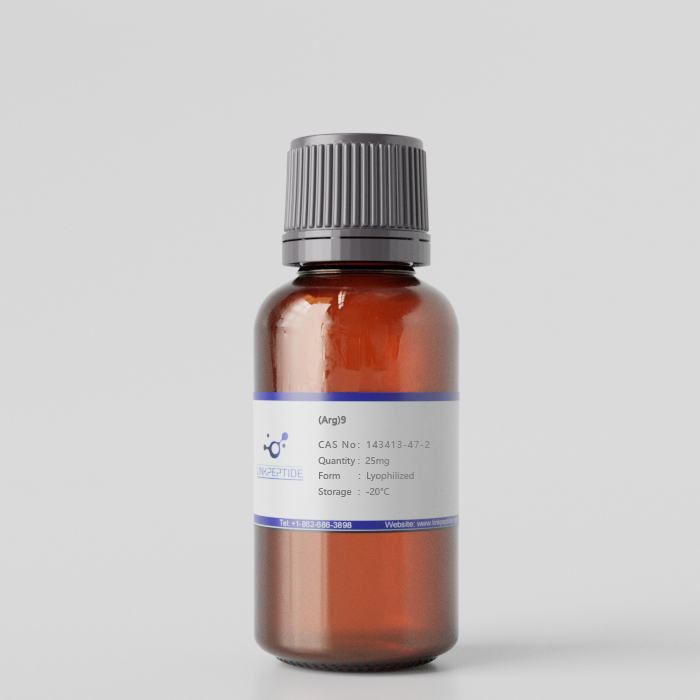
Product Name: (Arg)9
Sequence One Letter Code: RRRRRRRRR
Sequence Three Letter Code: H-Arg-Arg-Arg-Arg-Arg-Arg-Arg-Arg-Arg-OH
Cas No: 143413-47-2
Chemical Formula:C54H110N36O10
Molecular Weight: 1423.7 Purity: 95% Form: Lyophilized
Storage Conditions: - 20 °C
Research Area: Cell Penetrating Peptides
SMILES: C(C[C@@H](C(=O)N[C@@H](CCCN=C(N)N)C(=O)N[C@@H](CCCN=C(N)N)C(=O)N[C@@H](CCCN=C(N)N)C(=O)N[C@@H](CCCN=C(N)N)C(=O)N[C@@H](CCCN=C(N)N)C(=O)N[C@@H](CCCN=C(N)N)C(=O)N[C@@H](CCCN=C(N)N)C(=O)N[C@@H](CCCN=C(N)N)C(=O)O)N)CN=C(N)N
IUPAC: (2S)-2-[[(2S)-2-[[(2S)-2-[[(2S)-2-[[(2S)-2-[[(2S)-2-[[(2S)-2-[[(2S)-2-[[(2S)-2-amino-5-(diaminomethylideneamino)pentanoyl]amino]-5-(diaminomethylideneamino)pentanoyl]amino]-5-(diaminomethylideneamino)pentanoyl]amino]-5-(diaminomethylideneamino)pentanoyl]amino]-5-(diaminomethylideneamino)pentanoyl]amino]-5-(diaminomethylideneamino)pentanoyl]amino]-5-(diaminomethylideneamino)pentanoyl]amino]-5-(diaminomethylideneamino)pentanoyl]amino]-5-(diaminomethylideneamino)pentanoic acid
INCHIKEY: XUNKPNYCNUKOAU-VXJRNSOOSA-N
INCHI:
InChI=1S/C54H110N36O10/c55-28(10-1-19-74-46(56)57)37(91)83-29(11-2-20-75-47(58)59)38(92)84-30(12-3-21-76-48(60)61)39(93)85-31(13-4-22-77-49(62)63)40(94)86-32(14-5-23-78-50(64)65)41(95)87-33(15-6-24-79-51(66)67)42(96)88-34(16-7-25-80-52(68)69)43(97)89-35(17-8-26-81-53(70)71)44(98)90-36(45(99)100)18-9-27-82-54(72)73/h28-36H,1-27,55H2,(H,83,91)(H,84,92)(H,85,93)(H,86,94)(H,87,95)(H,88,96)(H,89,97)(H,90,98)(H,99,100)(H4,56,57,74)(H4,58,59,75)(H4,60,61,76)(H4,62,63,77)(H4,64,65,78)(H4,66,67,79)(H4,68,69,80)(H4,70,71,81)(H4,72,73,82)/t28-,29-,30-,31-,32-,33-,34-,35-,36-/m0/s1
Source / Species: Synthetic construct
Conjugation: Unconjugated
Code Nacres: NA.26
Application: (Arg)₉ is a polyarginine cell-penetrating peptide composed of nine arginine residues and is widely used as a delivery vector for biomolecules and therapeutic agents. The peptide carries a strong positive charge due to the guanidinium groups of arginine residues, enabling electrostatic interaction with negatively charged components of the cell membrane such as phospholipids and glycosaminoglycans. These interactions facilitate rapid cellular uptake and efficient intracellular transport of attached cargo molecules. Experimental evidence suggests that membrane translocation may involve transient pore formation and electrostatic membrane interactions. Because of its simplicity and high delivery efficiency, (Arg)₉ is commonly employed in studies of membrane transport, intracellular delivery of nucleic acids and proteins, and the development of peptide-based drug delivery systems in biomedical research.
Current Research: (Arg)₉, also known as nona-arginine, is a short polyarginine peptide composed of nine arginine residues. It belongs to a class of molecules known as cell-penetrating peptides (CPPs), which are capable of crossing cellular membranes and transporting a variety of biomolecules into living cells. Because of its simple structure and strong membrane translocation ability, (Arg)₉ has become one of the most widely used CPPs in studies of intracellular delivery and membrane transport mechanisms. The effectiveness of (Arg)₉ largely arises from the high positive charge density provided by the guanidinium groups present on each arginine residue. These positively charged functional groups enable strong interactions with negatively charged components of the cell surface, facilitating efficient cellular uptake of the peptide and its associated cargo molecules. Structural Features of Polyarginine Peptides Arginine-rich peptides are among the most effective CPPs due to the unique chemical properties of the guanidinium side chain. Each arginine residue contributes a positively charged group capable of forming multiple hydrogen bonds and electrostatic interactions. In the case of (Arg)₉, the peptide contains nine arginine residues arranged in sequence, generating a highly cationic structure. This strong positive charge allows the peptide to interact with negatively charged molecules present on cell membranes, including: Phospholipid head groups Proteoglycans Glycosaminoglycans (GAGs) These interactions play a critical role in the initial steps of cellular uptake. Interaction with the Cell Membrane Cell membranes contain several negatively charged components that can interact with cationic peptides such as (Arg)₉. Electrostatic attraction between the peptide and the membrane surface promotes initial adsorption to the plasma membrane, which can trigger subsequent internalization processes. Experimental studies have shown that arginine-rich peptides can associate with heparan sulfate proteoglycans and other membrane-associated molecules. These interactions help concentrate the peptide on the cell surface, increasing the likelihood of membrane translocation. Because of its strong electrostatic interactions, (Arg)₉ often demonstrates rapid and efficient cellular uptake across a variety of cell types. Mechanisms of Cellular Uptake Although the exact mechanisms of (Arg)₉ internalization are still under investigation, several pathways have been proposed based on experimental observations. Possible uptake mechanisms include: Direct membrane translocation Endocytosis-mediated internalization Macropinocytosis pathways Transient pore formation in the membrane The ability of guanidinium groups to form bidentate hydrogen bonds with phosphate groups on lipid membranes is believed to play a role in enabling these processes. In some experimental models, polyarginine peptides have been shown to induce temporary membrane perturbations that allow the peptide–cargo complex to enter the cell. Cargo Delivery Capabilities One of the most important properties of (Arg)₉ is its ability to function as a delivery vector for biomolecules. The peptide can be attached to various cargo molecules either through covalent linkage or electrostatic association, enabling their transport into cells. Common types of cargo delivered using (Arg)₉ include: Nucleic acids, such as DNA or RNA Proteins and enzymes Peptides Small bioactive molecules Fluorescent probes and imaging agents Because of its relatively small size and strong delivery capability, (Arg)₉ is frequently used in experimental systems designed to study intracellular trafficking and biomolecule transport. Applications in Membrane Transport Research (Arg)₉ has become a valuable tool for investigating membrane permeability and peptide-mediated transport mechanisms. By studying how this peptide interacts with cellular membranes, researchers can gain insight into the physical and biochemical processes that allow macromolecules to cross biological barriers. These studies often examine: Peptide–lipid membrane interactions Role of electrostatic forces in membrane translocation Structural requirements for effective CPP activity Intracellular trafficking of peptide–cargo complexes Understanding these mechanisms helps guide the development of improved delivery platforms for experimental and therapeutic applications. Role in Peptide-Based Delivery Systems Because of its strong membrane penetration capability and simple structure, (Arg)₉ has also been widely used in the development of peptide-based delivery technologies. Polyarginine peptides are often incorporated into experimental delivery systems designed to transport biological molecules into cells. Research applications include: Intracellular delivery of nucleic acid constructs Protein transduction experiments Development of experimental drug delivery platforms Imaging studies requiring intracellular probe delivery These approaches allow scientists to evaluate how peptide carriers can be used to improve cellular uptake of macromolecules. Conclusion (Arg)₉ is a polyarginine cell-penetrating peptide composed of nine arginine residues, widely recognized for its strong positive charge and efficient membrane translocation ability. The guanidinium groups present on each arginine residue enable electrostatic interactions with negatively charged components of the cell membrane, facilitating rapid cellular uptake. Due to its simplicity and high delivery efficiency, (Arg)₉ is commonly used in studies of membrane transport, intracellular biomolecule delivery, and peptide-based carrier systems. As research into cell-penetrating peptides continues to advance, nona-arginine remains an important experimental tool for understanding cellular uptake mechanisms and developing improved delivery strategies in biomedical research.
Get a Quote
 LinkPeptide