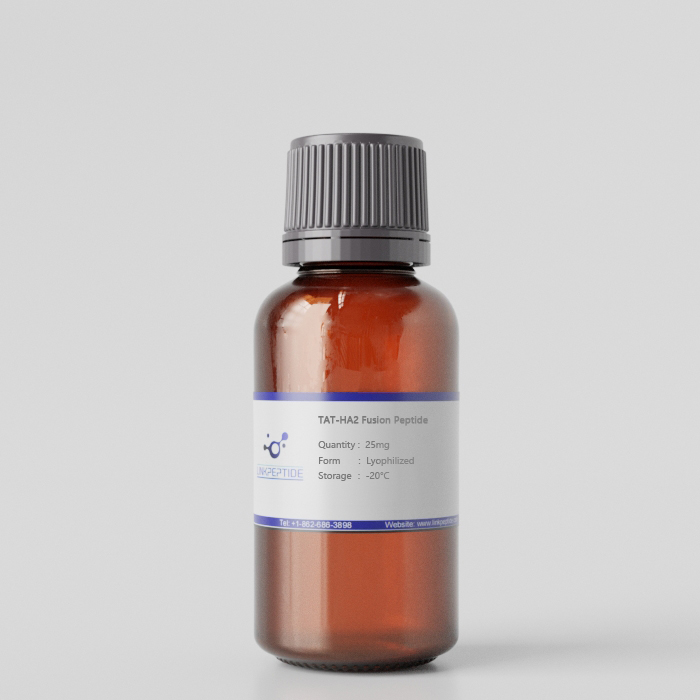
Product Name: TAT-HA2 Fusion Peptide
Sequence One Letter Code: RRRQRRKKRGGDIMGEWGNEIFGAIAGFLG
Sequence Three Letter Code: H-Arg-Arg-Arg-Gln-Arg-Arg-Lys-Lys-Arg-Gly-Gly-Asp-Ile-Met-Gly-Glu-Trp-Gly-Asn-Glu-Ile-Phe-Gly-Ala-Ile-Ala-Gly-Phe-Leu-Gly-OH
Chemical Formula:C149H243N53O39S1
Molecular Weight: 3433.2
Purity: 95%
Form: Lyophilized
Storage Conditions: - 20 °C
Research Area: Cell Penetrating Peptides
Source / Species: HIV, Influenza
Conjugation: Unconjugated
Code Nacres: NA.26
Application: TAT-HA2 Fusion Peptide combines the HIV-1 Tat cell-penetrating domain with the membrane-destabilizing N-terminal region of influenza A hemagglutinin (HA2). The Tat sequence facilitates efficient cellular uptake through lipid raft–dependent macropinocytosis, while the HA2 domain promotes endosomal escape via pH-triggered membrane destabilization. Together, these functional domains enable effective cytosolic delivery of diverse macromolecular cargos. TAT-HA2 is widely utilized in drug delivery and intracellular transport research for the delivery of peptides, proteins, and nucleic acids. It also serves as a model system for investigating endosomal escape mechanisms and improving the efficiency of nonviral delivery platforms.
Current Research: Efficient intracellular delivery of macromolecules remains a major challenge in modern biotechnology and therapeutic development. Large biomolecules such as proteins, peptides, and nucleic acids often face significant barriers when entering cells, including membrane impermeability and endosomal trapping. To address these obstacles, researchers have developed fusion peptides that combine cell-penetrating domains with membrane-active sequences. One such example is the TAT-HA2 fusion peptide, which integrates the HIV-1 Tat cell-penetrating peptide (CPP) with the membrane-destabilizing N-terminal region of influenza A hemagglutinin subunit HA2. This dual-functional design enables efficient cellular uptake followed by enhanced endosomal escape, making the peptide an important tool in intracellular delivery research. A central focus of current research involves understanding the mechanism of cellular uptake mediated by the Tat domain. The Tat peptide, derived from the transactivator of transcription (Tat) protein of HIV-1, is one of the most widely studied CPPs. It is rich in positively charged residues that interact with negatively charged components of the cell membrane, including glycosaminoglycans and phospholipids. These interactions trigger lipid raft–dependent macropinocytosis, allowing the peptide and its associated cargo to be internalized into endocytic vesicles. Because this mechanism can accommodate a wide variety of cargos, Tat-based peptides are frequently used in research exploring intracellular transport strategies. While CPP-mediated uptake allows entry into the cell, a major limitation of many delivery systems is endosomal entrapment, in which internalized molecules remain confined within endosomes and are ultimately degraded in lysosomes. The HA2 domain of influenza hemagglutinin addresses this limitation by promoting endosomal escape. HA2 undergoes a structural transition in response to the acidic environment of the endosome. This conformational change exposes hydrophobic residues that insert into the endosomal membrane, leading to membrane destabilization and transient pore formation. By incorporating the HA2 sequence, the TAT-HA2 fusion peptide enables cargo molecules to escape from endosomes into the cytosol before lysosomal degradation occurs. Current research frequently uses TAT-HA2 as a model platform for studying intracellular delivery mechanisms. In experimental systems, the peptide is conjugated to or co-delivered with a variety of cargos, including recombinant proteins, peptide therapeutics, plasmid DNA, and small interfering RNA (siRNA). These studies help evaluate how delivery efficiency depends on peptide sequence, cargo type, and cellular context. Insights gained from such experiments are guiding the development of more efficient delivery strategies for therapeutic macromolecules. Another important area of investigation involves nonviral gene delivery systems. Viral vectors can achieve high delivery efficiency but raise concerns related to immunogenicity, safety, and production complexity. Nonviral delivery approaches using peptides, polymers, or nanoparticles are therefore being actively explored as alternatives. The TAT-HA2 fusion peptide is often incorporated into these systems to enhance intracellular transport and facilitate cytosolic release of nucleic acid cargos. For example, nanoparticles or lipid-based carriers functionalized with TAT-HA2 can improve transfection efficiency by combining cell penetration with endosomal disruption. Researchers are also examining the biophysical properties of membrane-active peptides such as HA2 in order to optimize delivery performance. Structural studies using spectroscopy and microscopy have shown that HA2 adopts amphipathic conformations that interact strongly with lipid bilayers under acidic conditions. Understanding these structural transitions helps guide the design of modified peptides with improved stability, selective membrane disruption, and reduced cytotoxicity. In addition, TAT-HA2 is used to study the cellular trafficking pathways involved in macromolecule delivery. By tracking fluorescently labeled cargo molecules delivered via TAT-HA2, scientists can observe the dynamics of endocytosis, endosomal maturation, and cytosolic release. These experiments provide valuable information about how delivery systems interact with intracellular transport pathways and how these pathways can be manipulated to improve therapeutic delivery. In summary, the TAT-HA2 fusion peptide represents an important tool in the development of intracellular delivery technologies. By combining the efficient cellular uptake properties of the Tat domain with the pH-responsive membrane-disrupting activity of the HA2 region, the peptide enables effective cytosolic transport of macromolecular cargos. Ongoing research continues to use this system to investigate endosomal escape mechanisms, optimize nonviral delivery platforms, and advance strategies for delivering therapeutic biomolecules into cells.
Get a Quote
 LinkPeptide