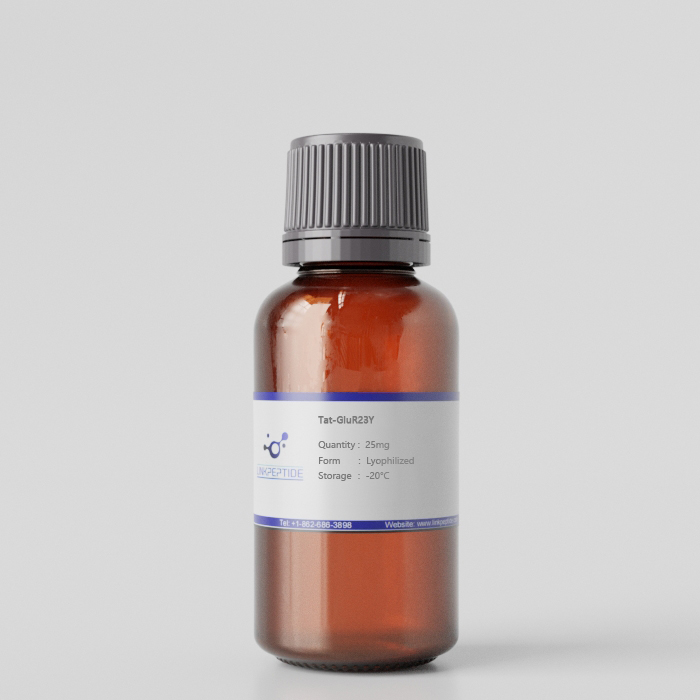
Product Name: Tat-GluR23Y
Sequence One Letter Code: YGRKKRRQRRRYKEGYNVYG
Sequence Three Letter Code: H-Tyr-Gly-Arg-Lys-Lys-Arg-Arg-Gln-Arg-Arg-Arg-Tyr-Lys-Glu-Gly-Tyr-Asn-Val-Tyr-Gly-OH
Chemical Formula:C115H185N43O29
Molecular Weight: 2634
Purity: 95%
Form: Lyophilized
Storage Conditions: - 20 °C
Research Area: Neurological Disease Research
Source / Species: HIV
Conjugation: Unconjugated
Code Nacres: NA.26
Application: Tat-GluR23Y is a synthetic cell-permeable peptide designed to inhibit phosphorylation-dependent endocytosis of AMPA receptors. The peptide contains a Tat cell-penetrating sequence that enables efficient intracellular delivery and a GluR2-derived segment that interferes with regulated AMPA receptor internalization. By blocking this process, Tat-GluR23Y prevents the induction of long-term depression (LTD), a form of synaptic plasticity involved in learning and memory. The peptide has been widely used in neuroscience research to study glutamatergic signaling and synaptic regulation in brain regions such as the nucleus accumbens and dorsal hippocampus. It supports investigations into mechanisms of synaptic plasticity, memory formation, and neurological disorders associated with altered AMPA receptor trafficking.
Current Research: Glutamatergic signaling is the primary excitatory neurotransmission system in the mammalian central nervous system. Central to this signaling network are AMPA receptors (AMPARs), which mediate fast synaptic transmission and play a crucial role in regulating synaptic strength. The dynamic trafficking of AMPA receptors in and out of synapses is a major mechanism underlying synaptic plasticity, the cellular process that supports learning and memory. Among the experimental tools used to study this phenomenon, Tat-GluR23Y has emerged as a widely utilized peptide for investigating phosphorylation-dependent AMPA receptor internalization and long-term depression (LTD). Tat-GluR23Y is a synthetic cell-permeable peptide engineered to selectively disrupt AMPA receptor endocytosis. The peptide incorporates two functional regions: a Tat cell-penetrating sequence and a GluR2-derived regulatory motif. Together, these elements allow the peptide to enter neurons efficiently and interfere with signaling pathways that control AMPA receptor trafficking. Structure and Design of Tat-GluR23Y The effectiveness of Tat-GluR23Y stems from its modular design. The N-terminal portion contains the Tat peptide sequence, derived from the HIV-1 transactivator of transcription protein. This short, positively charged sequence functions as a cell-penetrating peptide (CPP), enabling the synthetic construct to cross cell membranes and reach intracellular targets without the need for transfection reagents or viral vectors. The second functional region of the peptide originates from the GluR2 (also known as GluA2) subunit of AMPA receptors. This segment mimics a regulatory domain involved in receptor internalization. Within this region, the tyrosine residue substitution (3Y) plays an essential role in blocking phosphorylation-dependent signaling events that normally trigger receptor endocytosis. By competitively interfering with protein interactions required for AMPA receptor internalization, Tat-GluR23Y acts as a selective inhibitor of regulated AMPAR trafficking. Role in Long-Term Depression (LTD) Long-term depression (LTD) is a form of activity-dependent synaptic plasticity characterized by a persistent reduction in synaptic strength. One of the primary mechanisms underlying LTD is the removal of AMPA receptors from the postsynaptic membrane, which reduces excitatory synaptic transmission. Phosphorylation of the GluR2 cytoplasmic domain plays a key role in initiating this process. Once phosphorylated, the receptor interacts with endocytic machinery that facilitates its removal from the synapse. Tat-GluR23Y disrupts this sequence of events by preventing the phosphorylation-dependent internalization of AMPA receptors. As a result, the peptide effectively blocks LTD induction in neurons where AMPAR trafficking is required for synaptic weakening. This ability to selectively inhibit LTD makes Tat-GluR23Y an important experimental reagent for distinguishing between molecular mechanisms responsible for synaptic potentiation versus synaptic depression. Applications in Neuroscience Research Tat-GluR23Y has been widely adopted in neuroscience studies exploring the molecular basis of synaptic plasticity. Because it can be delivered directly to neurons and brain tissue, the peptide allows researchers to manipulate AMPA receptor trafficking in both in vitro and in vivo experimental systems. One important area of application involves the study of learning and memory mechanisms. Synaptic plasticity processes such as long-term potentiation (LTP) and LTD are thought to form the cellular foundation of memory formation. By selectively blocking LTD, Tat-GluR23Y helps researchers determine how synaptic weakening contributes to memory encoding and behavioral adaptation. The peptide has also been used extensively in studies focusing on specific brain regions involved in reward processing and memory. For example: Nucleus accumbens: Tat-GluR23Y has been used to investigate synaptic changes associated with addiction and reward-related learning. Dorsal hippocampus: The peptide is frequently employed to explore mechanisms of spatial memory and hippocampal-dependent learning. In these models, Tat-GluR23Y enables researchers to evaluate how altered AMPA receptor trafficking affects neuronal circuits and behavior. Relevance to Neurological Disorders Abnormal AMPA receptor trafficking has been implicated in numerous neurological and psychiatric conditions. Dysregulation of glutamatergic signaling can contribute to disorders such as addiction, depression, Alzheimer’s disease, and schizophrenia. Because Tat-GluR23Y selectively targets the molecular pathway responsible for AMPAR internalization, it serves as a valuable research tool for exploring how synaptic plasticity mechanisms are altered in disease states. Experimental findings obtained with this peptide have helped clarify how changes in receptor trafficking influence neural network stability and cognitive function. Advancing Research in Synaptic Regulation The study of synaptic plasticity continues to reveal new insights into how neural circuits adapt during learning, development, and disease. Tools that allow precise manipulation of receptor trafficking are therefore essential for advancing neuroscience research. Tat-GluR23Y provides a targeted approach for inhibiting phosphorylation-dependent AMPA receptor endocytosis, enabling controlled investigation of LTD-related signaling pathways. Through its ability to modulate synaptic receptor dynamics, this peptide remains an important reagent for researchers studying glutamatergic transmission, memory formation, and the molecular mechanisms underlying synaptic regulation.
Get a Quote
 LinkPeptide