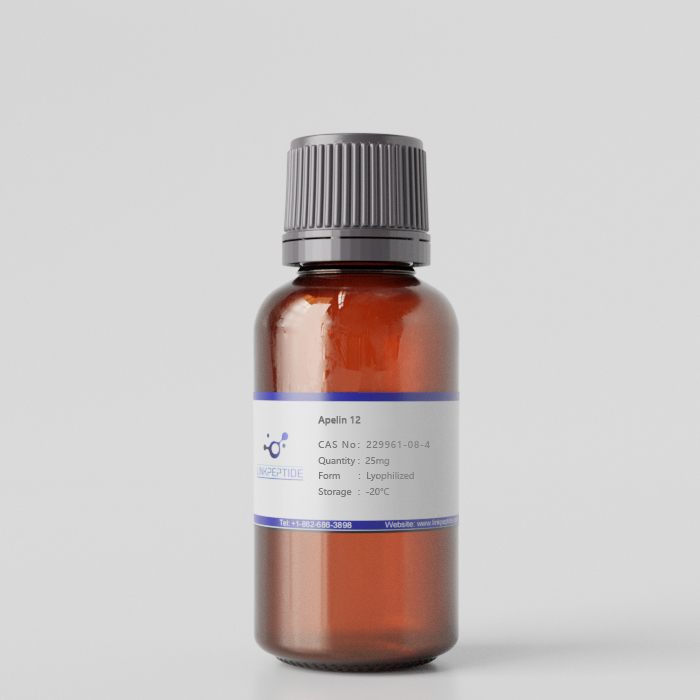
Product Name: Apelin 12
Sequence One Letter Code: RPRLSHKGPMPF
Sequence Three Letter Code: H-Arg-Pro-Arg-Leu-Ser-His-Lys-Gly-Pro-Met-Pro-Phe-OH
Cas No: 229961-08-4
Chemical Formula:C64H103N21O14S
Molecular Weight: 1422.8
Purity: 95%
Form: Lyophilized
Storage Conditions: - 20 °C
Research Area: Cardiovascular Disease Research
SMILES: CC(C)C[C@@H](C(=O)N[C@@H](CO)C(=O)N[C@@H](CC1=CN=CN1)C(=O)N[C@@H](CCCCN)C(=O)NCC(=O)N2CCC[C@H]2C(=O)N[C@@H](CCSC)C(=O)N3CCC[C@H]3C(=O)N[C@@H](CC4=CC=CC=C4)C(=O)O)NC(=O)[C@H](CCCN=C(N)N)NC(=O)[C@@H]5CCCN5C(=O)[C@H](CCCN=C(N)N)N
IUPAC: (2S)-2-[[(2S)-1-[(2S)-2-[[(2S)-1-[2-[[(2S)-6-amino-2-[[(2S)-2-[[(2S)-2-[[(2S)-2-[[(2S)-2-[[(2S)-1-[(2S)-2-amino-5-(diaminomethylideneamino)pentanoyl]pyrrolidine-2-carbonyl]amino]-5-(diaminomethylideneamino)pentanoyl]amino]-4-methylpentanoyl]amino]-3-hydroxypropanoyl]amino]-3-(1H-imidazol-5-yl)propanoyl]amino]hexanoyl]amino]acetyl]pyrrolidine-2-carbonyl]amino]-4-methylsulfanylbutanoyl]pyrrolidine-2-carbonyl]amino]-3-phenylpropanoic acid
INCHIKEY: KIODTAJAFBDDGP-TZIGXLGFSA-N
INCHI:
InChI=1S/C64H103N21O14S/c1-37(2)30-44(79-53(89)42(18-10-25-73-64(69)70)77-58(94)49-20-12-27-84(49)60(96)40(66)16-9-24-72-63(67)68)54(90)82-47(35-86)56(92)80-45(32-39-33-71-36-75-39)55(91)76-41(17-7-8-23-65)52(88)74-34-51(87)83-26-11-19-48(83)57(93)78-43(22-29-100-3)61(97)85-28-13-21-50(85)59(95)81-46(62(98)99)31-38-14-5-4-6-15-38/h4-6,14-15,33,36-37,40-50,86H,7-13,16-32,34-35,65-66H2,1-3H3,(H,71,75)(H,74,88)(H,76,91)(H,77,94)(H,78,93)(H,79,89)(H,80,92)(H,81,95)(H,82,90)(H,98,99)(H4,67,68,72)(H4,69,70,73)/t40-,41-,42-,43-,44-,45-,46-,47-,48-,49-,50-/m0/s1
Source / Species: human, mouse, bovine, rat
Conjugation: Unconjugated
Code Nacres: NA.26
Application: Apelin-12 is a potent bioactive fragment derived from the apelin precursor and functions as a high-affinity endogenous ligand for the APJ receptor, a G protein–coupled receptor involved in cardiovascular and metabolic regulation. This peptide plays an important role in cardiovascular physiology, particularly in the regulation of blood pressure through nitric oxide–dependent vasodilation mechanisms. In addition to its vascular effects, Apelin-12 has been shown to influence central feeding behavior by stimulating the secretion of cholecystokinin and modulating appetite regulation pathways. Because of its strong biological activity and receptor affinity, Apelin-12 is widely used in studies investigating apelin–APJ signaling, cardiovascular function, metabolic regulation, and neuroendocrine control of feeding behavior.
Current Research: Apelin-12 is a biologically active peptide fragment derived from the apelin precursor protein and serves as a high-affinity endogenous ligand for the APJ receptor (APLNR), a G protein–coupled receptor involved in numerous physiological processes. The apelin–APJ signaling system has attracted growing scientific attention because of its important roles in cardiovascular regulation, metabolic homeostasis, and neuroendocrine signaling. Among the various apelin-derived fragments, Apelin-12 is recognized for its strong receptor affinity and potent biological activity. Because of these properties, Apelin-12 is widely used as a research peptide in studies examining vascular function, blood pressure regulation, energy metabolism, and feeding behavior. The Apelin–APJ Signaling System The apelinergic system consists of the apelin peptide family and the APJ receptor, which is structurally related to the angiotensin receptor family within the G protein–coupled receptor (GPCR) superfamily. APJ receptors are expressed in many tissues, including the heart, vascular endothelium, central nervous system, adipose tissue, and gastrointestinal tract. Activation of APJ receptors by apelin peptides triggers intracellular signaling pathways that regulate a variety of physiological functions. These include: Regulation of vascular tone Modulation of cardiac contractility Control of fluid balance Participation in metabolic signaling Because of the widespread distribution of APJ receptors, apelin peptides play a central role in maintaining cardiovascular and metabolic homeostasis. Apelin-12 as an Active Peptide Fragment Apelin peptides are produced through enzymatic processing of a larger precursor protein. This processing generates several biologically active fragments, including apelin-36, apelin-17, apelin-13, and apelin-12. Among these forms, Apelin-12 retains the C-terminal region essential for receptor binding and activation, which is critical for interaction with the APJ receptor. Experimental studies have shown that Apelin-12 exhibits strong biological activity and can effectively stimulate APJ-mediated signaling pathways. Because of its relatively short sequence and high potency, Apelin-12 has become a useful tool for exploring structure–activity relationships within the apelin peptide family. Role in Cardiovascular Regulation One of the most important physiological roles of Apelin-12 involves cardiovascular regulation, particularly the control of vascular tone and blood pressure. Studies have demonstrated that apelin peptides can promote vasodilation, a process that widens blood vessels and improves blood flow. This effect is often mediated through nitric oxide–dependent signaling pathways in vascular endothelial cells. When APJ receptors are activated by Apelin-12, signaling cascades may stimulate nitric oxide production, leading to relaxation of vascular smooth muscle. Through these mechanisms, Apelin-12 has been investigated in studies focusing on: Regulation of blood pressure Vascular endothelial function Cardiovascular signaling pathways Mechanisms of vascular homeostasis These research areas are particularly relevant to understanding the molecular mechanisms that regulate circulatory physiology. Influence on Feeding Behavior and Neuroendocrine Signaling In addition to its cardiovascular effects, Apelin-12 has been studied for its potential involvement in central appetite regulation and feeding behavior. The peptide has been reported to influence neuroendocrine signaling pathways that regulate food intake. One proposed mechanism involves stimulation of cholecystokinin (CCK) secretion, a hormone that plays a role in digestive processes and appetite regulation. Through interactions with neuroendocrine pathways, Apelin-12 may contribute to signaling networks that influence satiety and energy balance. These observations have made the peptide of interest in studies exploring connections between metabolic signaling and the central nervous system. Applications in Metabolic and Cardiovascular Research Because Apelin-12 strongly activates the APJ receptor and participates in multiple physiological processes, it is widely used in experimental studies aimed at understanding apelin signaling pathways. Typical research applications include: Investigating APJ receptor activation and signaling mechanisms Studying vascular physiology and endothelial responses Exploring metabolic regulation and energy balance Examining neuroendocrine control of appetite and feeding These studies help clarify the diverse biological roles of the apelinergic system in both cardiovascular and metabolic regulation. Conclusion Apelin-12 is a potent bioactive peptide derived from the apelin precursor that functions as a high-affinity ligand of the APJ receptor. Through activation of the apelin–APJ signaling pathway, the peptide participates in important physiological processes including blood pressure regulation, nitric oxide–mediated vasodilation, metabolic signaling, and neuroendocrine control of feeding behavior. Due to its strong receptor affinity and broad biological activity, Apelin-12 remains an important research tool for studying cardiovascular physiology, metabolic regulation, and peptide-mediated signaling pathways within the apelinergic system.
Get a Quote
 LinkPeptide