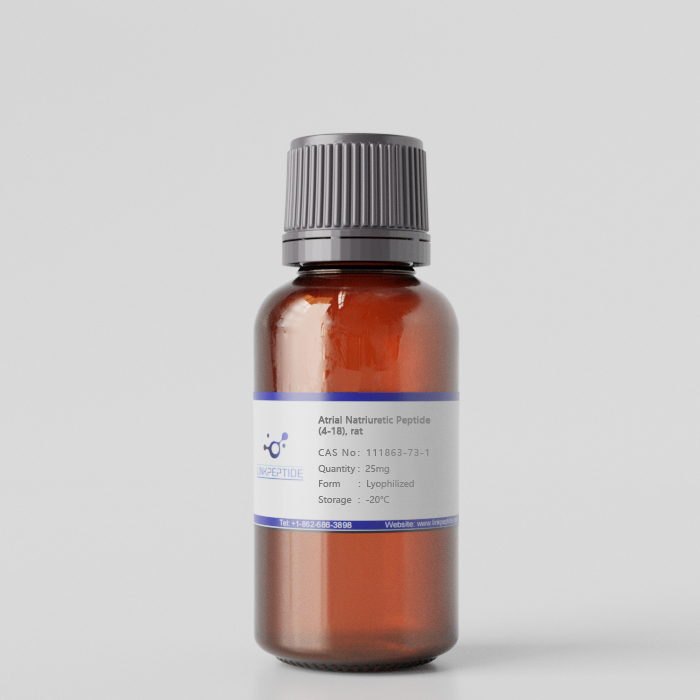
Product Name: Atrial Natriuretic Peptide (4-18), rat
Sequence One Letter Code: RSSCFGGRIDRIGAC-NH2 (Disulfide bridge 4-15)
Sequence Three Letter Code: H-Arg-Ser-Ser-Cys-Phe-Gly-Gly-Arg-Ile-Asp-Arg-Ile-Gly-Ala-Cys-NH2 (Disulfide bridge 4-15)
Cas No: 111863-73-1
Chemical Formula:C64H107N25O19S2
Molecular Weight: 1594.9
Purity: 95%
Form: Lyophilized
Storage Conditions: - 20 °C
Research Area: Cardiovascular Disease Research
SMILES: CC[C@H](C)[C@H]1C(=O)NCC(=O)N[C@H](C(=O)N[C@@H](CSSC[C@@H](C(=O)N[C@H](C(=O)NCC(=O)NCC(=O)N[C@H](C(=O)N[C@H](C(=O)N[C@H](C(=O)N[C@H](C(=O)N1)CCCN=C(N)N)CC(=O)O)[C@@H](C)CC)CCCN=C(N)N)CC2=CC=CC=C2)NC(=O)[C@@H](CO)NC(=O)[C@@H](CO)NC(=O)[C@@H](CCCN=C(N)N)N)C(=O)N)C
IUPAC: 2-[(4R,7S,13S,16S,19S,22S,25S,34S,37R)-37-[[(2R)-2-[[(2R)-2-[[(2R)-2-amino-5-(diaminomethylideneamino)pentanoyl]amino]-3-hydroxypropanoyl]amino]-3-hydroxypropanoyl]amino]-34-benzyl-13,22-bis[(2S)-butan-2-yl]-4-carbamoyl-16,25-bis[3-(diaminomethylideneamino)propyl]-7-methyl-6,9,12,15,18,21,24,27,30,33,36-undecaoxo-1,2-dithia-5,8,11,14,17,20,23,26,29,32,35-undecazacyclooctatriacont-19-yl]acetic acid
INCHIKEY: VDURFYRODPWWLV-GPMOFFLMSA-N
INCHI:
InChI=1S/C64H107N25O19S2/c1-6-31(3)48-60(107)78-26-45(93)79-33(5)51(98)86-42(50(66)97)29-109-110-30-43(87-58(105)41(28-91)85-57(104)40(27-90)84-52(99)35(65)16-11-19-73-62(67)68)59(106)82-38(22-34-14-9-8-10-15-34)53(100)77-24-44(92)76-25-46(94)80-36(17-12-20-74-63(69)70)54(101)89-49(32(4)7-2)61(108)83-39(23-47(95)96)56(103)81-37(55(102)88-48)18-13-21-75-64(71)72/h8-10,14-15,31-33,35-43,48-49,90-91H,6-7,11-13,16-30,65H2,1-5H3,(H2,66,97)(H,76,92)(H,77,100)(H,78,107)(H,79,93)(H,80,94)(H,81,103)(H,82,106)(H,83,108)(H,84,99)(H,85,104)(H,86,98)(H,87,105)(H,88,102)(H,89,101)(H,95,96)(H4,67,68,73)(H4,69,70,74)(H4,71,72,75)/t31-,32-,33-,35+,36-,37-,38-,39-,40+,41+,42-,43-,48-,49-/m0/s1
Source / Species: rat
Conjugation: Unconjugated
Code Nacres: NA.26
Application: Atrial Natriuretic Peptide (4–18), rat, is a synthetic fragment derived from the N-terminal region of ANP, a key regulator of cardiovascular homeostasis. This cysteine-containing peptide has been employed as a quantitative standard in mass spectrometry–based analytical workflows. Structurally related to C-ANP fragments that discriminate among natriuretic peptide receptor subtypes, it also supports receptor-binding and structure–activity investigations. The peptide is useful in cardiovascular research focused on natriuretic signaling pathways governing blood pressure, natriuresis, and fluid balance. Additionally, it provides a practical model substrate for peptide hormone analysis, redox chemistry studies, and method development in bioanalytical applications.
Current Research: Atrial natriuretic peptide (ANP) is a key cardiac hormone involved in the regulation of blood pressure, fluid balance, and electrolyte homeostasis. Secreted primarily by atrial cardiomyocytes in response to cardiac stretch, ANP exerts its physiological effects through natriuresis, vasodilation, and suppression of the renin–angiotensin–aldosterone system (RAAS). While the full-length peptide is responsible for endocrine signaling in vivo, shorter fragments derived from ANP have become valuable tools in cardiovascular and analytical research. Among these, Atrial Natriuretic Peptide (4–18), rat, a cysteine-containing fragment derived from the N-terminal region of the hormone, is widely used for mechanistic studies, receptor-binding investigations, and mass spectrometry–based method development. One prominent research application of ANP (4–18) involves its use as a quantitative reference standard in mass spectrometry workflows. Advances in proteomics and peptidomics have increased the need for reliable peptide standards that mimic the physicochemical properties of endogenous hormones. Because the ANP fragment contains structural elements similar to those present in native natriuretic peptides, it serves as a convenient model substrate for developing and validating analytical methods. Researchers frequently employ this peptide in liquid chromatography–mass spectrometry (LC–MS) and tandem mass spectrometry (LC–MS/MS) experiments to optimize detection sensitivity, fragmentation patterns, and quantitative calibration strategies. These approaches are particularly useful in studies examining circulating natriuretic peptide levels in cardiovascular disease. Current investigations also use ANP-derived fragments to explore structure–activity relationships within the natriuretic peptide family. Natriuretic peptides exert their biological effects primarily through three receptor subtypes: NPR-A (GC-A), NPR-B (GC-B), and NPR-C. While NPR-A and NPR-B are guanylyl cyclase–linked receptors that mediate intracellular cyclic GMP signaling, NPR-C functions largely as a clearance receptor that regulates peptide availability. Structural studies have shown that specific peptide fragments, including those related to C-ANP sequences, can selectively interact with certain receptor subtypes. In this context, the ANP (4–18) fragment provides a simplified molecular scaffold for examining how sequence features influence receptor binding and signaling selectivity. Another area of ongoing research involves the biochemical and redox properties of cysteine-containing peptide hormones. The presence of cysteine residues enables disulfide bond formation and redox-sensitive structural changes that can influence peptide stability and biological activity. Researchers use ANP-derived fragments as model systems to investigate oxidative modifications, disulfide exchange reactions, and folding behavior under physiological and experimental conditions. These studies contribute to a broader understanding of peptide hormone stability, which is particularly important for the development of peptide-based therapeutics and diagnostic assays. In cardiovascular research, natriuretic peptides remain central to studies of hypertension, heart failure, and cardiorenal syndrome. Circulating levels of ANP and related peptides are widely used as biomarkers for cardiac stress and ventricular dysfunction. Analytical methods optimized using fragments such as ANP (4–18) help improve the accuracy and reproducibility of peptide hormone quantification in clinical and experimental samples. By refining detection strategies, researchers can better evaluate changes in natriuretic signaling pathways during disease progression or therapeutic intervention. Additionally, the peptide serves as a practical tool in method development for peptide chemistry and bioanalytical assays. Its moderate length and defined structure make it suitable for evaluating chromatographic separation, peptide fragmentation behavior, and sample preparation techniques. These properties are particularly useful in laboratories developing new protocols for peptide detection, purification, or stability analysis. In summary, Atrial Natriuretic Peptide (4–18), rat is widely used as a model fragment in cardiovascular and analytical research. Its structural relationship to the natriuretic peptide family enables investigations into receptor binding, peptide hormone signaling, and redox chemistry, while its compatibility with modern analytical platforms makes it a valuable standard in mass spectrometry–based studies. Through these applications, the peptide contributes to ongoing efforts to understand natriuretic signaling pathways and improve analytical methods for studying cardiovascular biomarkers.
Get a Quote
 LinkPeptide

![[Orn5]-URP](https://www.linkpeptide.com/wp-content/uploads/2024/10/Orn5-URP-jpg-3.webp "[Orn5]-URP")
![[Pyr1]-Apelin-13](https://www.linkpeptide.com/wp-content/uploads/2024/10/Pyr1-Apelin-13-jpg-3.webp "[Pyr1]-Apelin-13")