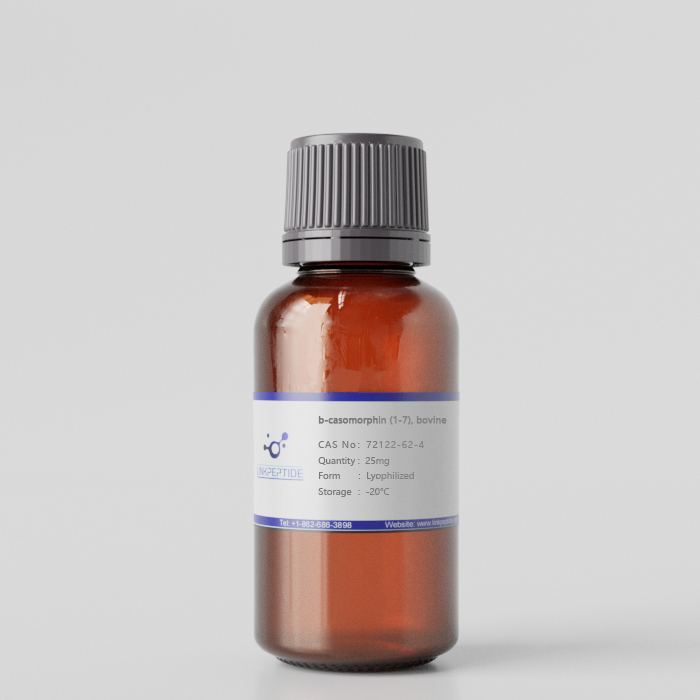
Product Name: b-casomorphin (1-7), bovine
Sequence One Letter Code: YPFPGPI
Sequence Three Letter Code: H-Tyr-Pro-Phe-Pro-Gly-Pro-Ile-OH
Cas No: 72122-62-4
Chemical Formula:C41H55N7O9
Molecular Weight: 790
Purity: 95%
Form: Lyophilized
Storage Conditions: - 20 °C
Research Area: Endocrinology Disease Research
SMILES: CC[C@H](C)[C@@H](C(=O)O)NC(=O)[C@@H]1CCCN1C(=O)CNC(=O)[C@@H]2CCCN2C(=O)[C@H](CC3=CC=CC=C3)NC(=O)[C@@H]4CCCN4C(=O)[C@H](CC5=CC=C(C=C5)O)N
IUPAC: (2S,3S)-2-[[(2S)-1-[2-[[(2S)-1-[(2S)-2-[[(2S)-1-[(2S)-2-amino-3-(4-hydroxyphenyl)propanoyl]pyrrolidine-2-carbonyl]amino]-3-phenylpropanoyl]pyrrolidine-2-carbonyl]amino]acetyl]pyrrolidine-2-carbonyl]amino]-3-methylpentanoic acid
INCHIKEY: RKYJTDSQXOMDAD-JKXTZXEVSA-N
INCHI:
InChI=1S/C41H55N7O9/c1-3-25(2)35(41(56)57)45-38(53)32-13-7-19-46(32)34(50)24-43-36(51)31-12-8-21-48(31)40(55)30(23-26-10-5-4-6-11-26)44-37(52)33-14-9-20-47(33)39(54)29(42)22-27-15-17-28(49)18-16-27/h4-6,10-11,15-18,25,29-33,35,49H,3,7-9,12-14,19-24,42H2,1-2H3,(H,43,51)(H,44,52)(H,45,53)(H,56,57)/t25-,29-,30-,31-,32-,33-,35-/m0/s1
Source / Species: Bovine
Conjugation: Unconjugated
Code Nacres: NA.26
Application: β-Casomorphin-7 is a bioactive opioid peptide derived from bovine β-casein and functions as a selective μ-opioid receptor agonist. The peptide contains a characteristic Tyr-Pro aromatic motif that contributes to receptor specificity, while its proline-rich sequence enhances structural stability and resistance to gastrointestinal enzymatic degradation. β-Casomorphin-7 has been shown to influence intestinal physiology by stimulating mucin secretion through neural pathways and opioid receptor activation. Due to these biological properties, the peptide is widely used in studies of gastrointestinal physiology, gut–brain signaling, and neuroendocrine regulation. Researchers also employ β-Casomorphin-7 in investigations of food-derived bioactive peptides and opioid-mediated signaling mechanisms, making it a valuable tool for understanding the physiological effects of dietary peptides on digestive and neural systems.
Current Research: β-Casomorphin-7 (BCM-7) is a naturally occurring bioactive peptide derived from the digestion of bovine β-casein, one of the major proteins present in milk. During gastrointestinal enzymatic processing, β-casein can be cleaved to generate several peptide fragments, including BCM-7, which consists of seven amino acids and displays opioid-like biological activity. Because of its ability to interact with μ-opioid receptors, β-Casomorphin-7 has become an important molecule for studying the physiological effects of food-derived peptides on the digestive system, neural signaling, and endocrine regulation. Over the past several decades, BCM-7 has attracted significant scientific interest due to its unique combination of dietary origin, receptor selectivity, and functional activity within the gut–brain axis. These properties have made it widely used in research focused on gastrointestinal physiology, neuroendocrine signaling, and the biological roles of peptides generated from food proteins. Origin and Structural Characteristics β-Casomorphin-7 is produced when β-casein undergoes enzymatic digestion during gastrointestinal processing. The resulting peptide contains a characteristic Tyr-Pro sequence motif, which is commonly found in opioid peptides and plays an important role in receptor recognition. The peptide also contains multiple proline residues, which contribute to several structural and functional features: Increased conformational stability Resistance to enzymatic degradation Improved persistence in the gastrointestinal environment Proline-rich sequences often limit the accessibility of peptide bonds to proteolytic enzymes, allowing BCM-7 to remain biologically active after digestion. This stability is one reason why food-derived peptides such as β-Casomorphin-7 are able to exert measurable physiological effects. Interaction with μ-Opioid Receptors A defining feature of β-Casomorphin-7 is its ability to act as a selective agonist of the μ-opioid receptor (MOR). μ-Opioid receptors belong to the G protein–coupled receptor (GPCR) family and play key roles in pain signaling, gastrointestinal motility, and neuroendocrine regulation. When BCM-7 interacts with μ-opioid receptors, it can initiate intracellular signaling pathways that influence several physiological processes. In experimental systems, activation of these receptors has been associated with changes in: Intestinal motility Secretory activity in the gastrointestinal tract Neural signaling between the gut and the central nervous system Because BCM-7 originates from a dietary protein yet interacts with opioid receptors, it provides an interesting model for studying how food-derived peptides can influence receptor-mediated signaling pathways. Effects on Gastrointestinal Physiology One area where β-Casomorphin-7 has been extensively studied is intestinal physiology. Research has shown that BCM-7 can influence digestive processes through its interaction with opioid receptors located in the gastrointestinal tract. Experimental studies suggest that β-Casomorphin-7 may stimulate mucin secretion in intestinal tissues, a process that contributes to the protective mucus barrier lining the gut. This effect is thought to occur through neural signaling pathways associated with opioid receptor activation. The ability of BCM-7 to influence mucosal secretions and intestinal signaling has made it a useful tool for investigating mechanisms involved in: Regulation of intestinal barrier function Neural control of digestive secretions Communication between the enteric nervous system and epithelial cells These processes are central to maintaining gastrointestinal homeostasis. Role in Gut–Brain Signaling Research The gut–brain axis represents a bidirectional communication network linking the gastrointestinal system with the central nervous system. Opioid receptors located in both the digestive tract and the nervous system contribute to signaling within this network. Because β-Casomorphin-7 interacts with μ-opioid receptors, it has been used in research exploring how dietary peptides influence gut–brain communication. Investigations in this area focus on understanding how signals originating in the digestive system can affect neural pathways involved in appetite regulation, gastrointestinal motility, and neuroendocrine responses. These studies provide insight into how components derived from food proteins may participate in broader physiological signaling networks. Applications in Food Peptide and Neuroendocrine Research Beyond gastrointestinal physiology, β-Casomorphin-7 is frequently used in studies examining bioactive peptides derived from dietary proteins. Researchers are increasingly interested in how peptides generated during digestion may influence biological processes through receptor-mediated mechanisms. BCM-7 has therefore become a valuable model peptide for investigating: Structure–activity relationships of food-derived opioid peptides Opioid receptor signaling in the digestive system Interactions between dietary components and neuroendocrine regulation Mechanisms underlying gut–brain communication These applications help expand our understanding of how naturally occurring peptides can participate in physiological signaling beyond their nutritional roles. Conclusion β-Casomorphin-7 is a bioactive opioid peptide generated from bovine β-casein during digestion and functions as a selective agonist of the μ-opioid receptor. Its structural features, including the Tyr-Pro aromatic motif and proline-rich sequence, contribute to receptor specificity and stability within the gastrointestinal environment. Because of its ability to influence intestinal physiology and interact with opioid signaling pathways, β-Casomorphin-7 has become an important tool in studies of gastrointestinal function, gut–brain signaling, and neuroendocrine regulation. As research into food-derived bioactive peptides continues to grow, BCM-7 remains a key model for exploring how dietary proteins can generate peptides with significant biological activity.
Get a Quote
 LinkPeptide