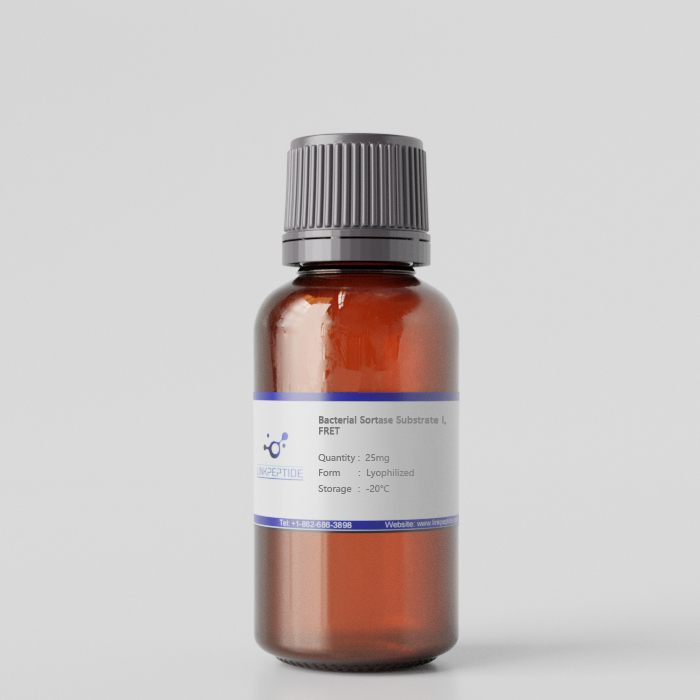
Product Name: Bacterial Sortase Substrate I, FRET
Sequence One Letter Code: DABCYL-LPETG-EDANS
Sequence Three Letter Code: DABCYL-Leu-Pro-Glu-Thr-Gly-EDANS
Molecular Weight: 1015.2
Purity: 95%
Form: Lyophilized
Storage Conditions: - 20 °C Protected from light
Research Area: peptide substrate
Source / Species: bacteria
Conjugation: Conjugated
Conjugation Type: Double dyes
Code Nacres: NA.26
Application: Bacterial Sortase Substrate I, FRET is a synthetic peptide containing the canonical LPXTG sorting motif recognized by sortase enzymes in Gram-positive bacteria. Sortases cleave surface proteins at this motif and catalyze covalent attachment to the peptidoglycan cell wall, a process essential for bacterial adhesion and virulence. This substrate incorporates a fluorescence resonance energy transfer (FRET) reporter pair, enabling real-time monitoring of enzymatic cleavage through fluorescence signal changes. The peptide is suitable for quantitative sortase activity assays, enzyme kinetics studies, and inhibitor screening. It supports research focused on bacterial surface protein assembly, virulence mechanisms, and development of antimicrobial agents targeting sortase-mediated pathways.
Current Research: Bacterial Sortase Substrate I, FRET is a synthetic fluorogenic peptide designed around the canonical LPXTG sorting motif recognized by sortase enzymes in Gram-positive bacteria. Sortases are membrane-anchored transpeptidases that play a central role in anchoring surface proteins to the peptidoglycan cell wall. By recognizing and cleaving the LPXTG motif within secreted precursor proteins, sortases enable covalent attachment of virulence factors involved in adhesion, immune evasion, and biofilm formation. Mechanistically, sortase A—the prototypical and most widely studied enzyme—recognizes the LPXTG sequence and cleaves between the threonine (T) and glycine (G) residues. This cleavage generates an acyl-enzyme intermediate at the threonine carboxyl group. The intermediate is subsequently resolved through nucleophilic attack by the amino group of the pentaglycine crossbridge (or equivalent peptidoglycan component), resulting in covalent linkage of the protein to the bacterial cell wall. This anchoring process is critical for proper display of adhesins, pili subunits, and other virulence-associated surface proteins in organisms such as Staphylococcus aureus, Streptococcus species, and Listeria monocytogenes. The FRET-based design of this substrate incorporates a fluorescence resonance energy transfer pair—typically a donor fluorophore and an acceptor quencher—flanking the LPXTG motif. In the intact peptide, proximity of the donor and quencher suppresses fluorescence. Upon sortase-mediated cleavage at the LPXTG site, the fluorophore and quencher are separated, leading to an increase in fluorescence signal. This configuration enables continuous, real-time monitoring of enzymatic activity without the need for secondary detection steps. Bacterial Sortase Substrate I, FRET is widely used in quantitative activity assays. The fluorescence readout allows precise measurement of reaction kinetics, including determination of Km, kcat, and catalytic efficiency under defined conditions. The assay format is adaptable to microplate-based high-throughput screening, making it particularly valuable for identifying small-molecule inhibitors of sortase activity. In antimicrobial research, sortase enzymes are considered attractive therapeutic targets because they are essential for virulence but not for bacterial viability in many species. Inhibiting sortase function can impair surface protein anchoring and attenuate pathogenicity without directly exerting bactericidal pressure, potentially reducing selective pressure for resistance. The FRET substrate supports inhibitor screening campaigns by enabling rapid assessment of compound efficacy through changes in fluorescence intensity. Beyond drug discovery, this substrate facilitates mechanistic studies of sortase substrate specificity and motif recognition. Variations in the X position within the LPXTG motif can be tested to evaluate sequence preferences and catalytic efficiency. Comparative studies among different sortase isoforms (e.g., sortase A versus sortase B or pilus-specific sortases) can also be conducted using tailored substrate variants. Methodologically, fluorescence is monitored at excitation and emission wavelengths appropriate for the chosen FRET pair, allowing sensitive detection of cleavage events over time. The continuous assay format improves reproducibility and supports kinetic modeling of enzyme behavior. Overall, Bacterial Sortase Substrate I, FRET is a sensitive and quantitative tool for studying sortase-mediated cleavage of the LPXTG motif. It enables detailed investigation of enzyme kinetics, substrate specificity, and inhibitor development, supporting research into bacterial surface protein assembly, virulence mechanisms, and antimicrobial strategies targeting sortase-dependent pathways.
Get a Quote
 LinkPeptide

![CDK1 Substrate [HATPPKKKRK]](https://www.linkpeptide.com/wp-content/uploads/2026/05/CDK1-Substrate-HATPPKKKRK.jpg "CDK1 Substrate [HATPPKKKRK]")