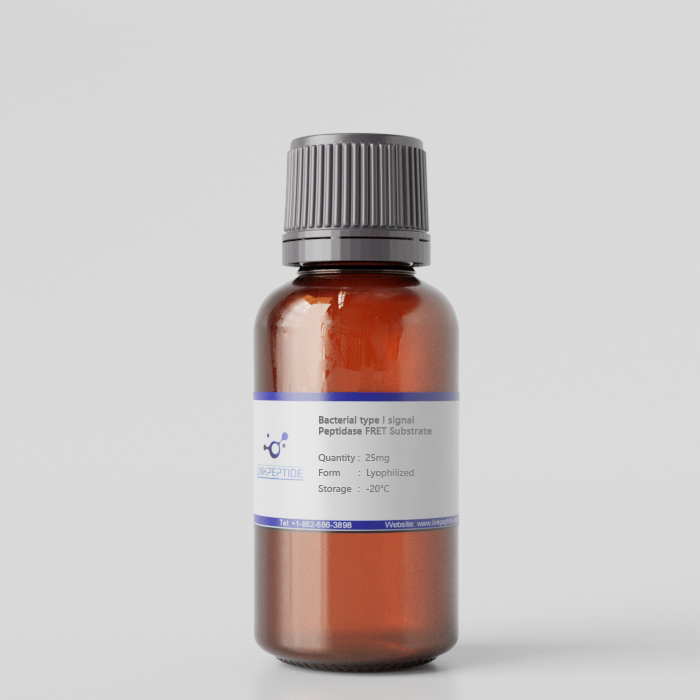
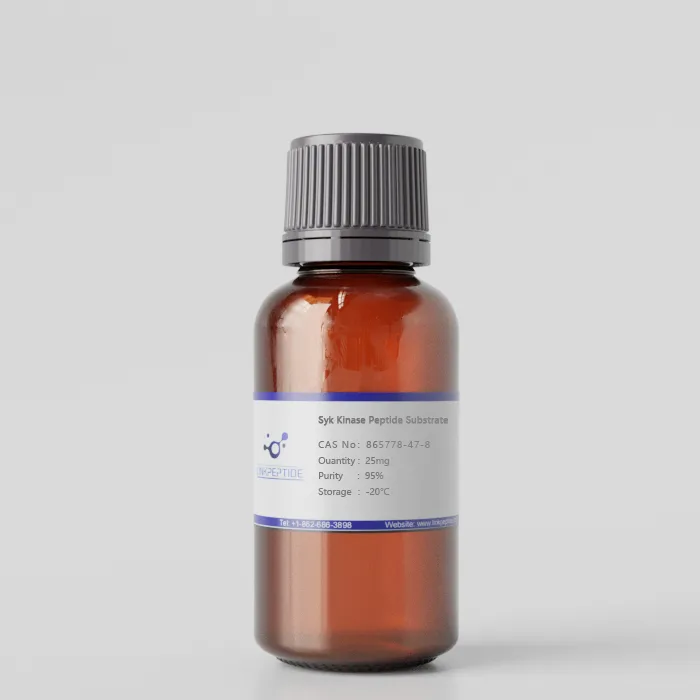
Product Name: Bacterial type I signal Peptidase FRET Substrate
Sequence One Letter Code: Dabcyl-AGHDAHASET-Edans
Sequence Three Letter Code: Dabcyl-Ala-Gly-His-Asp-Ala-His-Ala-Ser-Glu-Thr-Edans
Chemical Formula:C66H84N19O21S1
Molecular Weight: 1494.6
Purity: 95%
Form: Lyophilized
Storage Conditions: - 20 °C Protected from light
Research Area: peptide substrate
Source / Species: bacteria
Conjugation: Conjugated
Conjugation Type: Double dyes
Code Nacres: NA.26
Application: This peptide is a fluorogenic substrate designed for bacterial type I signal peptidase (SPase I), incorporating an EDANS/DABCYL fluorescence resonance energy transfer (FRET) pair for real-time enzymatic monitoring. The sequence contains a cleavage site derived from the C-terminal region of the Staphylococcus epidermidis pre-SceD protein. In its intact form, fluorescence from EDANS is quenched by DABCYL; upon proteolytic cleavage by SPase I, the fluorophore is released from quenching, resulting in increased fluorescence intensity. This substrate enables sensitive kinetic measurements of SPase I activity and is well suited for inhibitor screening and mechanistic studies. It supports antibacterial drug discovery efforts targeting bacterial protein secretion and signal peptide processing pathways.
Current Research: Antibiotic resistance continues to threaten global health, creating an urgent need for new antibacterial strategies that target essential bacterial pathways. Among these, the bacterial protein secretion system has emerged as a promising drug target. A key enzyme in this pathway is Type I signal peptidase (SPase I), which processes secretory proteins by cleaving signal peptides during protein export across the cytoplasmic membrane. Because this enzyme is essential for bacterial viability and absent in mammalian cells, SPase I has become an attractive target for next-generation antibacterial agents. To accelerate drug discovery efforts, researchers increasingly rely on fluorogenic substrates that enable real-time monitoring of SPase I activity. One such tool is a FRET-based peptide substrate incorporating an EDANS/DABCYL fluorescence pair, designed specifically for sensitive enzymatic assays. Signal Peptidase I as a Drug Target In bacteria, many proteins destined for secretion or membrane localization are synthesized as precursor proteins containing an N-terminal signal peptide. These precursor proteins are transported across the cytoplasmic membrane through the Sec translocation pathway. During or after translocation, SPase I cleaves the signal peptide, releasing the mature protein into the periplasm or extracellular environment. This processing step is crucial for bacterial survival because many secreted proteins are involved in cell wall synthesis, nutrient acquisition, and virulence. Given its essential role, SPase I has long been recognized as a high-value antibacterial target. Natural products such as arylomycins have demonstrated that SPase I inhibition can effectively suppress bacterial growth. However, identifying and optimizing inhibitors requires reliable biochemical assays capable of accurately measuring enzymatic activity. Fluorogenic peptide substrates have therefore become indispensable tools for studying SPase I kinetics and screening potential inhibitors. FRET-Based Fluorogenic Substrates Fluorescence resonance energy transfer (FRET) substrates offer a powerful method for monitoring protease activity in real time. In these systems, a fluorophore and a quencher are placed within the same peptide sequence. When the peptide remains intact, the quencher suppresses fluorescence emission from the fluorophore. Once the target enzyme cleaves the peptide, the fluorophore and quencher separate, leading to a measurable increase in fluorescence intensity. The peptide substrate described here incorporates the well-established EDANS/DABCYL FRET pair. EDANS functions as the fluorescence donor, while DABCYL acts as a dark quencher. In the intact peptide, EDANS fluorescence is effectively quenched by DABCYL through resonance energy transfer. Cleavage by SPase I disrupts this interaction, producing a strong fluorescent signal proportional to enzymatic activity. This design enables highly sensitive detection of proteolytic events in real time. Sequence Design Based on Staphylococcus epidermidis Pre-SceD A critical aspect of designing an effective SPase I substrate is selecting an appropriate cleavage sequence. The substrate described here incorporates a cleavage site derived from the C-terminal region of the Staphylococcus epidermidis pre-SceD protein, a natural substrate processed by bacterial signal peptidase. Using a physiologically relevant sequence improves the likelihood that the substrate will be efficiently recognized and cleaved by SPase I enzymes from multiple bacterial species. This biologically informed design enhances assay reliability and provides a closer representation of native signal peptide processing. As a result, the substrate is well suited for mechanistic studies examining substrate recognition, cleavage specificity, and catalytic efficiency of SPase I. Applications in Enzyme Kinetics and Inhibitor Screening Fluorogenic SPase I substrates provide several advantages for biochemical research. First, they enable continuous kinetic measurements, allowing researchers to monitor enzyme activity without stopping the reaction. This capability supports accurate determination of kinetic parameters such as Km, Vmax, and catalytic efficiency. Second, the strong fluorescence signal generated upon cleavage allows for high-throughput screening (HTS) of potential inhibitors. In drug discovery programs, large libraries of small molecules can be rapidly evaluated for their ability to suppress SPase I activity. Because fluorescence intensity directly correlates with enzyme activity, inhibitors can be easily identified through reductions in signal. Additionally, FRET substrates are valuable for mechanistic investigations. Researchers can use them to explore enzyme specificity, evaluate mutant enzymes, and study how different compounds interact with the catalytic site. These insights are critical for guiding medicinal chemistry efforts aimed at developing potent SPase I inhibitors. Enabling Next-Generation Antibacterial Discovery As antibiotic resistance continues to expand, targeting bacterial secretion systems represents a promising avenue for therapeutic innovation. Signal peptidase I remains one of the most compelling targets within this pathway due to its essential biological role and druggability. Fluorogenic peptide substrates incorporating EDANS/DABCYL FRET technology provide researchers with a powerful analytical tool for investigating this enzyme. By enabling real-time activity monitoring, sensitive kinetic measurements, and efficient inhibitor screening, these substrates play a critical role in advancing antibacterial drug discovery efforts. Continued development of such biochemical tools will help accelerate the identification of novel therapeutics that disrupt bacterial protein secretion and ultimately combat antibiotic-resistant infections.
Get a Quote
 LinkPeptide