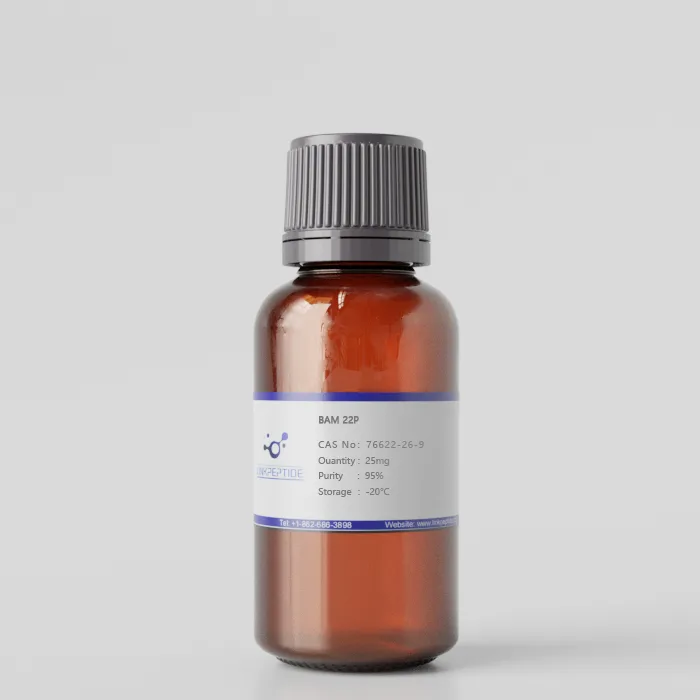
Product Name:BAM 22P
Synonyms:DTXSID40227451
CAS No:76622-26-9
Purity:95%
Molar Mass:2839.2
Chemical Formula:C130H184N38O31S2
Storage:Store at -20 degrees Celsius
Sequence:YGGFMRRVGRPEWWMDYQKRYG
Application:
BAM 22P is a bioactive peptide known for its potent analgesic properties and role in modulating nociception. As a derivative of the bovine adrenal medulla, this peptide interacts with opioid receptors, making it a valuable tool for research into pain mechanisms and the development of new analgesics. BAM 22P is particularly significant in studies focusing on chronic pain, inflammation, and the central nervous system. With its high purity and stability, BAM 22P provides reliable results, ensuring consistent performance in experimental applications aimed at understanding and mitigating pain.
Current Research:
Bovine adrenal medulla docosapeptide (BAM-22P) is a 22-amino-acid peptide derived from the proenkephalin A gene, predominantly expressed in the adrenal medulla. It functions as a potent endogenous agonist for both opioid receptors and the sensory neuron-specific receptor (SNSR), also known as MAS-related G protein-coupled receptor X1 (MRGPRX1).
As an opioid receptor agonist, BAM-22P exhibits significant affinity for ??- and ??-opioid receptors, leading to antinociceptive effects mediated through these pathways. Additionally, BAM-22P activates MRGPRX1, with EC?? values of 13 and 16 nM for human SNSR3 and SNSR4, respectively. This activation contributes to its role in modulating pain perception and inducing pruritic responses.
In vivo studies have demonstrated that BAM-22P produces both opioid and non-opioid receptor-mediated antinociceptive effects. Its interaction with MRGPRX1 has been implicated in pruritic responses, suggesting a role in itch sensation. Furthermore, elevated plasma levels of BAM-22P have been observed in conditions such as acute cholestasis, indicating its potential involvement in the pathophysiology of certain diseases.
The dual activity of BAM-22P on opioid receptors and MRGPRX1 positions it as a significant modulator of sensory neuron functions, with implications for pain management and the understanding of pruritic mechanisms. Ongoing research continues to explore its therapeutic potential and the broader physiological roles of proenkephalin-derived peptides.
Reference:
Get a Quote
 LinkPeptide