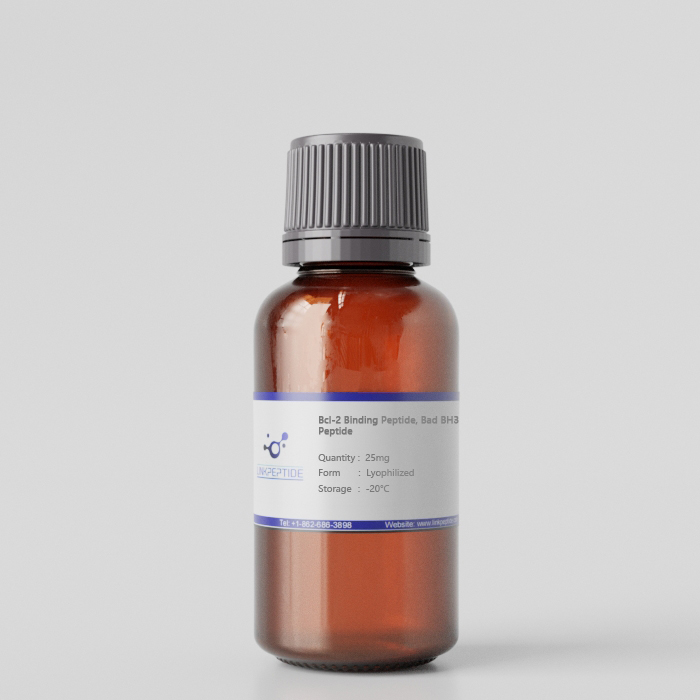
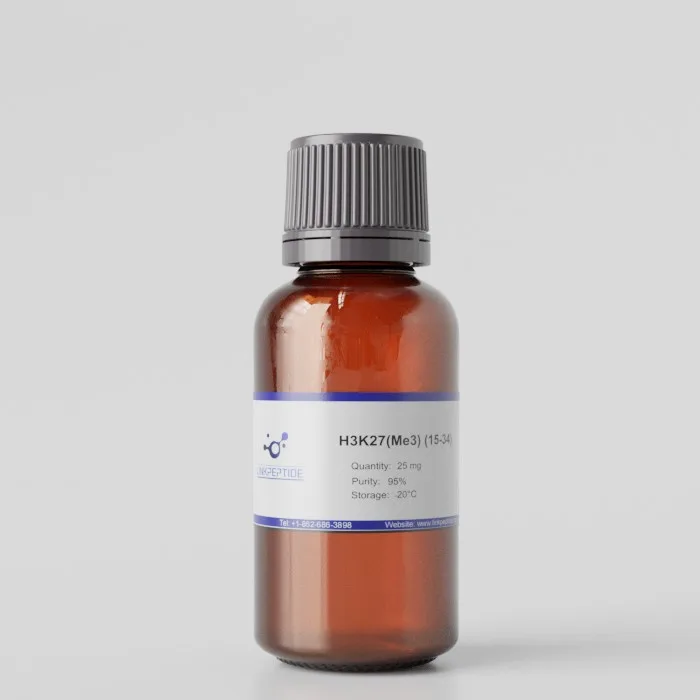
Product Name: Bcl-2 Binding Peptide, Bad BH3 Peptide
Sequence One Letter Code: LWAAQRYGRELRRMSDEFEGSFKGL
Sequence Three Letter Code: H-Leu-Trp-Ala-Ala-Gln-Arg-Tyr-Gly-Arg-Glu-Leu-Arg-H-Leu-Trp-Ala-Ala-Gln-Arg-Tyr-Gly-Arg-Glu-Leu-Arg-Arg-Met-Ser-Asp-Glu-Phe-Glu-Gly-Ser-Phe-Lys-Gly-Leu-OH
Chemical Formula:C133H204N40O38S1
Molecular Weight: 3003.5
Purity: 95%
Form: Lyophilized
Storage Conditions: - 20 °C
Research Area: Cancer Disease Research
Source / Species: mouse, rat
Conjugation: Unconjugated
Code Nacres: NA.26
Application: The Bad BH3 peptide corresponds to residues 140–165 of the pro-apoptotic protein Bad and encompasses its BH3 death domain. This region binds anti-apoptotic Bcl-2 family members, disrupting their inhibitory interactions and promoting mitochondrial apoptosis signaling. The peptide is widely used to examine Bcl-2 family protein interactions, mitochondrial outer membrane permeabilization, and regulation of programmed cell death. It supports mechanistic studies in cancer biology, apoptosis research, and development of therapeutics targeting Bcl-2–mediated survival pathways.
Current Research: The Bad BH3 peptide corresponds to residues 140–165 of the Bcl-2–associated death promoter (Bad), a pro-apoptotic member of the Bcl-2 protein family. This segment contains the BH3 (Bcl-2 homology 3) domain, a conserved α-helical motif that mediates critical protein–protein interactions within the intrinsic apoptosis pathway. The BH3 domain of Bad selectively binds anti-apoptotic Bcl-2 family proteins, such as Bcl-2, Bcl-xL, and Bcl-w, thereby antagonizing their pro-survival functions and promoting mitochondrial outer membrane permeabilization (MOMP). As a defined interaction module, the Bad BH3 peptide is widely used in mechanistic studies of apoptosis regulation and therapeutic targeting of Bcl-2–dependent survival pathways. The intrinsic apoptotic pathway is governed by a dynamic balance between pro-apoptotic and anti-apoptotic Bcl-2 family proteins. Anti-apoptotic members sequester pro-apoptotic effectors such as Bax and Bak, preventing mitochondrial membrane disruption. BH3-only proteins—including Bad, Bid, Bim, and Puma—serve as upstream sensors that respond to cellular stress signals and neutralize anti-apoptotic proteins. The Bad BH3 region forms an amphipathic α-helix that docks into a hydrophobic groove on anti-apoptotic Bcl-2 proteins. This interaction displaces bound pro-apoptotic factors, enabling activation of Bax and Bak and subsequent cytochrome c release from mitochondria. The synthetic Bad BH3 (140–165) peptide recapitulates this binding interface and is extensively used to probe Bcl-2 family interactions in vitro. In fluorescence polarization or surface plasmon resonance assays, the peptide binds purified anti-apoptotic proteins with measurable affinity, enabling quantification of interaction strength and competitive displacement. These assays help define specificity profiles among Bcl-2 family members and assess how mutations or post-translational modifications alter binding dynamics. In mitochondrial functional assays, the Bad BH3 peptide can induce mitochondrial outer membrane permeabilization in isolated mitochondria or permeabilized cells by neutralizing anti-apoptotic protection. Release of cytochrome c or other apoptogenic factors can be monitored to evaluate mitochondrial priming and apoptotic susceptibility. This approach is particularly useful in “BH3 profiling,” a technique used to assess mitochondrial dependency on specific anti-apoptotic proteins in cancer cells. In oncology research, dysregulated expression of anti-apoptotic Bcl-2 family members contributes to tumor cell survival and resistance to chemotherapy. The Bad BH3 peptide serves as a molecular template for designing BH3 mimetics—small molecules that replicate BH3 domain interactions and selectively inhibit Bcl-2 proteins. Compounds such as venetoclax were developed based on structural insights from BH3–Bcl-2 binding interfaces. The peptide is therefore instrumental in preclinical evaluation of Bcl-2 inhibitors and in understanding resistance mechanisms driven by shifts in anti-apoptotic protein expression. The Bad BH3 region is also relevant for studying post-translational regulation of apoptosis. In full-length Bad, phosphorylation at specific serine residues modulates its interaction with Bcl-2 family proteins and cytosolic sequestration by 14-3-3 proteins. Using the isolated BH3 peptide allows researchers to focus specifically on core death domain interactions independent of upstream regulatory modifications. Beyond cancer, the peptide supports investigation of apoptosis in neurodegenerative disorders, ischemic injury, and immune cell homeostasis. By selectively disrupting anti-apoptotic interactions, the Bad BH3 peptide enables controlled induction of mitochondrial apoptosis in experimental systems, clarifying how stress signals converge on the Bcl-2 network. In summary, the Bad BH3 peptide (residues 140–165) represents the functional death domain of the pro-apoptotic protein Bad. Through selective binding to anti-apoptotic Bcl-2 family members, it disrupts survival complexes and promotes mitochondrial apoptosis signaling. As a defined molecular probe, the peptide is central to studies of programmed cell death, mitochondrial priming, and therapeutic development targeting Bcl-2–mediated survival pathways in cancer and other diseases.
Get a Quote
 LinkPeptide