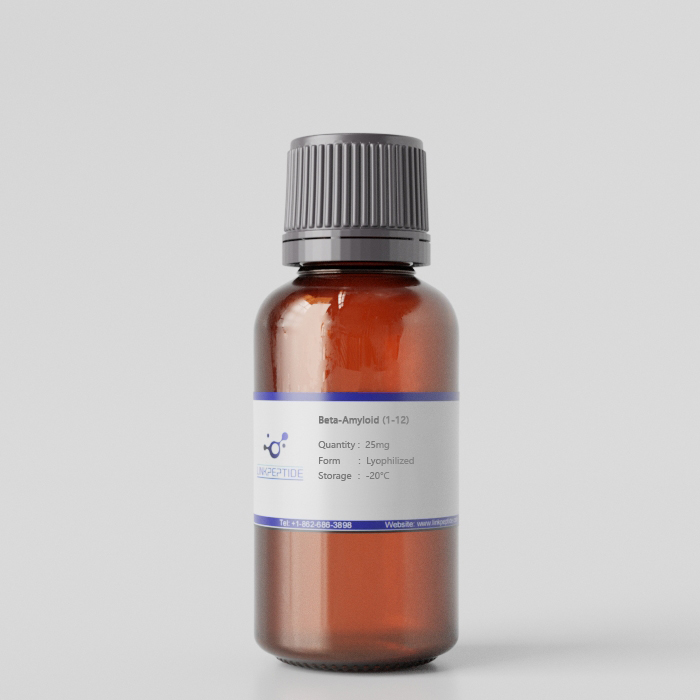
Product Name: Beta-Amyloid (1-12)
Sequence One Letter Code: DAEFRHDSGYEV
Sequence Three Letter Code: H-Asp-Ala-Glu-Phe-Arg-His-Asp-Ser-Gly-Tyr-Glu-Val-OH
Chemical Formula:C61H85N17O23
Molecular Weight: 1424.5
Purity: 95%
Form: Lyophilized
Storage Conditions: - 20 °C
Research Area: Alzheimer's Disease
Source / Species: human
Conjugation: Unconjugated
Code Nacres: NA.26
Application: Beta-Amyloid (1–12) is a synthetic peptide corresponding to the N-terminal region of the amyloid-β sequence. This fragment has been widely used as an immunogen for antibody generation targeting amyloid plaques and related neuropathological structures. Antisera raised against this peptide recognize tangle-bearing neurons, neuritic plaques, and neuropil threads in brain tissue. As a defined epitope, it supports immunological assays, epitope mapping, and antibody characterization workflows. The peptide is commonly applied in Alzheimer’s disease research to investigate amyloid deposition, pathological progression, and diagnostic biomarker development.
Current Research: Alzheimer’s disease (AD) is a progressive neurodegenerative disorder characterized by cognitive decline, synaptic dysfunction, and widespread neuronal loss. A central pathological hallmark of the disease is the accumulation of amyloid-β (Aβ) peptides in extracellular plaques within the brain. These peptides are generated through proteolytic processing of the amyloid precursor protein (APP) and vary in length, with Aβ40 and Aβ42 being the most extensively studied forms. While much attention has focused on full-length Aβ peptides, shorter fragments derived from specific regions of the sequence have become valuable experimental tools. Among these, Beta-Amyloid (1–12)—a synthetic peptide corresponding to the N-terminal region of Aβ—plays an important role in immunological and biochemical studies of Alzheimer’s disease. One of the primary research applications of the Aβ (1–12) fragment is its use as an immunogen for antibody production. Because this peptide represents a well-defined epitope located at the N-terminus of the amyloid-β sequence, it can be used to generate antibodies that specifically recognize amyloid-related structures in brain tissue. Antisera raised against this peptide have demonstrated strong reactivity toward neuritic plaques, neurofibrillary tangle-bearing neurons, and neuropil threads in histological analyses of Alzheimer’s disease brain samples. These antibodies are widely used in immunohistochemistry and immunofluorescence assays to detect amyloid pathology and visualize disease-associated protein aggregates. Recent research has continued to employ Aβ (1–12) in epitope mapping and antibody characterization studies. Mapping the precise binding sites of anti-amyloid antibodies is essential for understanding how different antibodies recognize amyloid aggregates or soluble peptide species. By using defined peptide fragments such as Aβ (1–12), researchers can systematically identify antibody binding regions and determine whether antibodies target linear epitopes or conformational structures within the amyloid protein. This information is critical for the development of highly specific antibodies used in both research and diagnostic contexts. Another area of current investigation involves the development of antibody-based diagnostics and therapeutics for Alzheimer’s disease. Monoclonal antibodies targeting amyloid-β are actively being explored as potential treatments designed to promote the clearance of amyloid plaques or neutralize toxic soluble oligomers. Defined peptide fragments, including the N-terminal Aβ (1–12) sequence, are frequently used to evaluate antibody specificity, cross-reactivity, and binding affinity during early stages of therapeutic antibody development. These studies help identify antibodies capable of selectively recognizing pathogenic amyloid species without interacting with unrelated proteins. In addition to antibody generation, the Aβ (1–12) fragment has utility in biochemical assays designed to study amyloid processing and protein–protein interactions. Because the N-terminal region of amyloid-β is involved in interactions with metals, receptors, and other biomolecules, short peptides derived from this region provide simplified systems for analyzing these interactions. Researchers can use the fragment in binding assays or structural studies to investigate how the N-terminal sequence contributes to amyloid aggregation behavior or cellular signaling pathways. The peptide is also employed in biomarker development and assay calibration. Detecting amyloid-β species in cerebrospinal fluid (CSF) or plasma has become an important strategy for early diagnosis and disease monitoring in Alzheimer’s disease. Antibodies generated using defined peptide epitopes such as Aβ (1–12) can be incorporated into enzyme-linked immunosorbent assays (ELISA), immunoassay platforms, and other analytical methods used to quantify amyloid-related biomarkers. Furthermore, advances in imaging and neuropathological analysis continue to benefit from antibodies developed against specific Aβ epitopes. These antibodies enable detailed visualization of amyloid deposition patterns in both animal models and human brain tissue. Such studies contribute to a better understanding of how amyloid pathology spreads throughout the brain during disease progression. In summary, Beta-Amyloid (1–12) is an important peptide tool in Alzheimer’s disease research. Its defined N-terminal epitope makes it particularly useful for antibody generation, epitope mapping, and assay development. By supporting immunological detection of amyloid structures and enabling detailed characterization of anti-amyloid antibodies, this peptide contributes to ongoing efforts to understand amyloid pathology and develop improved diagnostic and therapeutic strategies for Alzheimer’s disease.
Get a Quote
 LinkPeptide