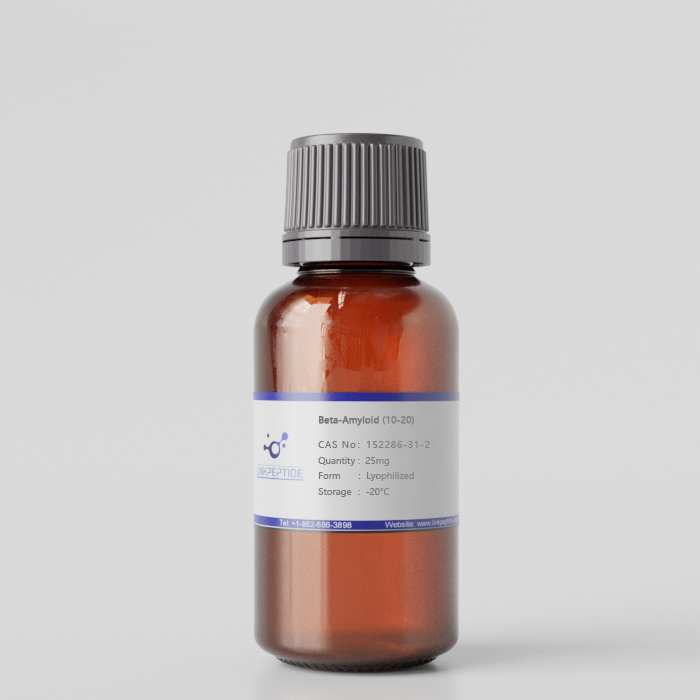
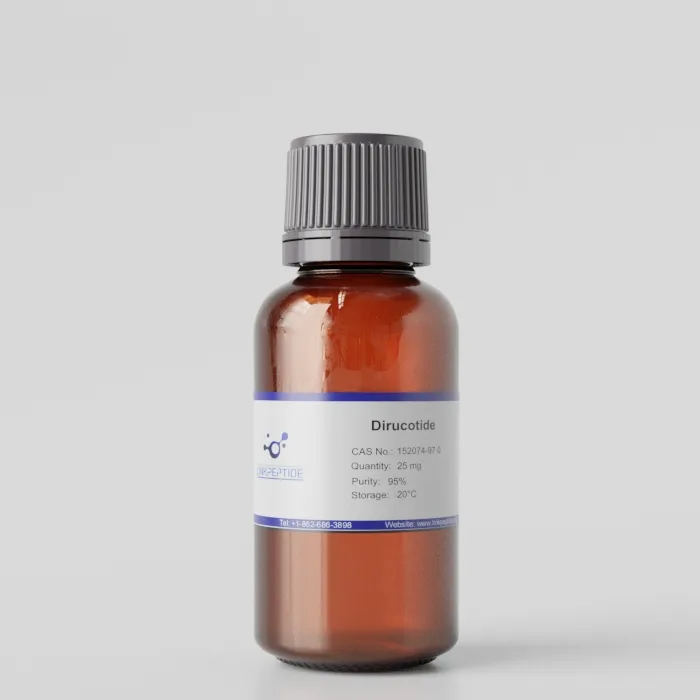
Product Name: Beta-Amyloid (10-20)
Sequence One Letter Code: YEVHHQKLVFF
Sequence Three Letter Code: H-Tyr-Glu-Val-His-His-Gln-Lys-Leu-Val-Phe-Phe-OH
Cas No: 152286-31-2
Chemical Formula:C71H99N17O16
Molecular Weight: 1446.7
Purity: ≥ 95%
Form: Lyophilized
Storage Conditions: - 20 °C
SMILES: CC(C)C[C@@H](C(=O)N[C@@H](C(C)C)C(=O)N[C@@H](CC1=CC=CC=C1)C(=O)N[C@@H](CC2=CC=CC=C2)C(=O)O)NC(=O)[C@H](CCCCN)NC(=O)[C@H](CCC(=O)N)NC(=O)[C@H](CC3=CN=CN3)NC(=O)[C@H](CC4=CN=CN4)NC(=O)[C@H](C(C)C)NC(=O)[C@H](CCC(=O)O)NC(=O)[C@H](CC5=CC=C(C=C5)O)N
IUPAC: (4S)-5-[[(2S)-1-[[(2S)-1-[[(2S)-1-[[(2S)-5-amino-1-[[(2S)-6-amino-1-[[(2S)-1-[[(2S)-1-[[(2S)-1-[[(1S)-1-carboxy-2-phenylethyl]amino]-1-oxo-3-phenylpropan-2-yl]amino]-3-methyl-1-oxobutan-2-yl]amino]-4-methyl-1-oxopentan-2-yl]amino]-1-oxohexan-2-yl]amino]-1,5-dioxopentan-2-yl]amino]-3-(1H-imidazol-5-yl)-1-oxopropan-2-yl]amino]-3-(1H-imidazol-5-yl)-1-oxopropan-2-yl]amino]-3-methyl-1-oxobutan-2-yl]amino]-4-[[(2S)-2-amino-3-(4-hydroxyphenyl)propanoyl]amino]-5-oxopentanoic acid
INCHIKEY: VCLPDRBVMCWMCN-JQNWNMCVSA-N
INCHI:
InChI=1S/C71H99N17O16/c1-39(2)29-52(68(100)88-60(41(5)6)69(101)84-53(31-42-15-9-7-10-16-42)65(97)86-56(71(103)104)32-43-17-11-8-12-18-43)82-62(94)49(19-13-14-28-72)80-63(95)50(24-26-57(74)90)81-66(98)54(33-45-35-75-37-77-45)83-67(99)55(34-46-36-76-38-78-46)85-70(102)59(40(3)4)87-64(96)51(25-27-58(91)92)79-61(93)48(73)30-44-20-22-47(89)23-21-44/h7-12,15-18,20-23,35-41,48-56,59-60,89H,13-14,19,24-34,72-73H2,1-6H3,(H2,74,90)(H,75,77)(H,76,78)(H,79,93)(H,80,95)(H,81,98)(H,82,94)(H,83,99)(H,84,101)(H,85,102)(H,86,97)(H,87,96)(H,88,100)(H,91,92)(H,103,104)/t48-,49-,50-,51-,52-,53-,54-,55-,56-,59-,60-/m0/s1
Source / Species: human
Conjugation: Unconjugated
Code Nacres: NA.26
Application: Beta-Amyloid (10–20) is a synthetic amyloid-β fragment involved in promoting aggregation of full-length Aβ peptides, including Aβ (1–40). Research indicates that amyloid fragments containing residues 17–20 or 30–35 can significantly enhance fibril formation, highlighting key aggregation-driving regions within the beta-amyloid sequence. Beta-Amyloid (10–20) is widely used in Alzheimer’s disease research to study peptide–peptide interactions, aggregation kinetics, amyloid nucleation, and molecular determinants of plaque formation. This peptide is also valuable for screening aggregation inhibitors and investigating mechanisms of neurodegenerative amyloid pathology.
Get a Quote
 LinkPeptide