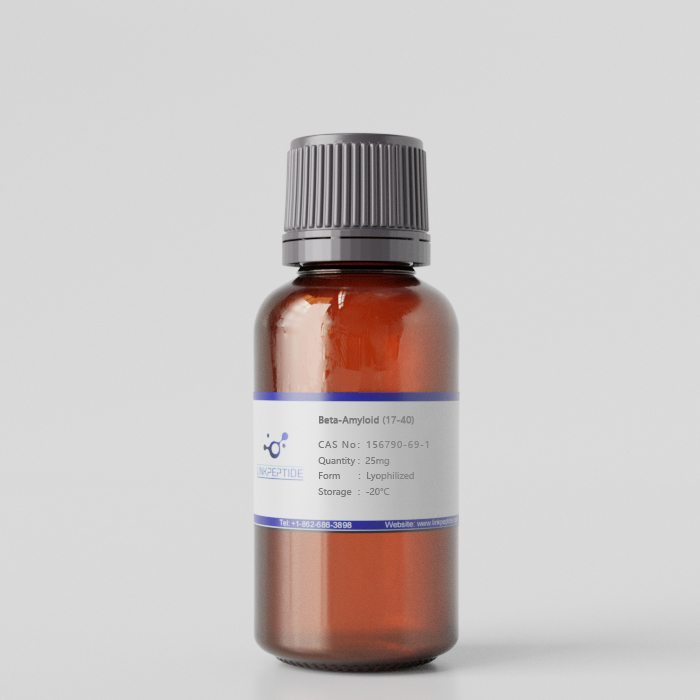
Product Name: Beta-Amyloid (17-40)
Sequence One Letter Code: LVFFAEDVGSNKGAIIGLMVGGVV
Sequence Three Letter Code: H-Leu-Val-Phe-Phe-Ala-Glu-Asp-Val-Gly-Ser-Asn-Lys-Gly-Ala-Ile-Ile-Gly-Leu-Met-Val-Gly-Gly-Val-Val-OH
Cas No: 156790-69-1
Chemical Formula:C110H178N26O31S
Molecular Weight: 2392,9
Purity: 95%
Form: Lyophilized
Storage Conditions: - 20 °C
Research Area: Alzheimer's Disease
SMILES: CC[C@H](C)[C@@H](C(=O)N[C@@H]([C@@H](C)CC)C(=O)NCC(=O)N[C@@H](CC(C)C)C(=O)N[C@@H](CCSC)C(=O)N[C@@H](C(C)C)C(=O)NCC(=O)NCC(=O)N[C@@H](C(C)C)C(=O)N[C@@H](C(C)C)C(=O)O)NC(=O)[C@H](C)NC(=O)CNC(=O)[C@H](CCCCN)NC(=O)[C@H](CC(=O)N)NC(=O)[C@H](CO)NC(=O)CNC(=O)[C@H](C(C)C)NC(=O)[C@H](CC(=O)O)NC(=O)[C@H](CCC(=O)O)NC(=O)[C@H](C)NC(=O)[C@H](CC1=CC=CC=C1)NC(=O)[C@H](CC2=CC=CC=C2)NC(=O)[C@H](C(C)C)NC(=O)[C@H](CC(C)C)N
IUPAC: (4S)-5-[[(2S)-1-[[(2S)-1-[[2-[[(2S)-1-[[(2S)-4-amino-1-[[(2S)-6-amino-1-[[2-[[(2S)-1-[[(2S,3S)-1-[[(2S,3S)-1-[[2-[[(2S)-1-[[(2S)-1-[[(2S)-1-[[2-[[2-[[(2S)-1-[[(1S)-1-carboxy-2-methylpropyl]amino]-3-methyl-1-oxobutan-2-yl]amino]-2-oxoethyl]amino]-2-oxoethyl]amino]-3-methyl-1-oxobutan-2-yl]amino]-4-methylsulfanyl-1-oxobutan-2-yl]amino]-4-methyl-1-oxopentan-2-yl]amino]-2-oxoethyl]amino]-3-methyl-1-oxopentan-2-yl]amino]-3-methyl-1-oxopentan-2-yl]amino]-1-oxopropan-2-yl]amino]-2-oxoethyl]amino]-1-oxohexan-2-yl]amino]-1,4-dioxobutan-2-yl]amino]-3-hydroxy-1-oxopropan-2-yl]amino]-2-oxoethyl]amino]-3-methyl-1-oxobutan-2-yl]amino]-3-carboxy-1-oxopropan-2-yl]amino]-4-[[(2S)-2-[[(2S)-2-[[(2S)-2-[[(2S)-2-[[(2S)-2-amino-4-methylpentanoyl]amino]-3-methylbutanoyl]amino]-3-phenylpropanoyl]amino]-3-phenylpropanoyl]amino]propanoyl]amino]-5-oxopentanoic acid
INCHIKEY: QKAFHCYMOBODRG-FZSVSODXSA-N
INCHI:
InChI=1S/C110H178N26O31S/c1-22-61(17)90(106(162)118-51-80(141)121-71(43-55(5)6)99(155)125-70(39-41-168-21)97(153)132-85(56(7)8)104(160)116-48-78(139)114-49-82(143)130-87(58(11)12)108(164)134-89(60(15)16)110(166)167)136-109(165)91(62(18)23-2)135-93(149)63(19)119-79(140)50-115-95(151)68(36-30-31-40-111)124-101(157)74(46-77(113)138)127-103(159)76(53-137)122-81(142)52-117-105(161)86(57(9)10)133-102(158)75(47-84(146)147)128-96(152)69(37-38-83(144)145)123-92(148)64(20)120-98(154)72(44-65-32-26-24-27-33-65)126-100(156)73(45-66-34-28-25-29-35-66)129-107(163)88(59(13)14)131-94(150)67(112)42-54(3)4/h24-29,32-35,54-64,67-76,85-91,137H,22-23,30-31,36-53,111-112H2,1-21H3,(H2,113,138)(H,114,139)(H,115,151)(H,116,160)(H,117,161)(H,118,162)(H,119,140)(H,120,154)(H,121,141)(H,122,142)(H,123,148)(H,124,157)(H,125,155)(H,126,156)(H,127,159)(H,128,152)(H,129,163)(H,130,143)(H,131,150)(H,132,153)(H,133,158)(H,134,164)(H,135,149)(H,136,165)(H,144,145)(H,146,147)(H,166,167)/t61-,62-,63-,64-,67-,68-,69-,70-,71-,72-,73-,74-,75-,76-,85-,86-,87-,88-,89-,90-,91-/m0/s1
Source / Species: human
Conjugation: Unconjugated
Code Nacres: NA.26
Application: Beta-Amyloid (17–40) is an N-terminally truncated fragment of amyloid precursor protein generated through α-secretase processing, commonly referred to as the p3 peptide. Unlike full-length amyloid-β peptides, it exhibits distinct aggregation and biological properties. This fragment has been identified in amyloid deposits and is associated with neuroinflammatory responses rather than classic fibril formation. Beta-Amyloid (17–40) has been shown to induce cytokine and chemokine production in experimental models, implicating it in inflammation-driven neurodegeneration. It is widely used to study alternative amyloid processing pathways, non-fibrillar peptide species, and immune responses in Alzheimer’s disease and related neurodegenerative conditions.
Current Research: β-Amyloid (17–40), commonly referred to as the p3 peptide, is an N-terminally truncated fragment derived from amyloid precursor protein (APP) through α-secretase–mediated processing. Unlike full-length amyloid-β peptides such as Aβ (1–40) and Aβ (1–42), which are generated via β-secretase cleavage, the p3 fragment reflects a non-amyloidogenic processing pathway. This distinction gives β-Amyloid (17–40) unique biochemical and biological properties that are increasingly relevant in studies of neuroinflammation and alternative amyloid biology. Origin and Alternative APP Processing Pathway APP can be processed via two major pathways: Amyloidogenic pathway: Involves β- and γ-secretase cleavage, producing full-length Aβ peptides associated with plaque formation Non-amyloidogenic pathway: Initiated by α-secretase, which cleaves within the Aβ region, preventing formation of full-length Aβ β-Amyloid (17–40) arises from this latter pathway and is therefore considered a product of α-secretase activity, often regarded as protective against classical amyloid plaque formation. Structural and Biophysical Properties The absence of the N-terminal region (residues 1–16) significantly alters the peptide’s properties. Compared to full-length Aβ: It shows reduced propensity for β-sheet–driven fibril formation It exhibits distinct aggregation behavior, often forming non-classical assemblies It lacks key residues involved in metal binding and early nucleation events These differences make β-Amyloid (17–40) particularly useful for studying non-fibrillar amyloid species and their biological effects. Role in Neuroinflammation Emerging evidence suggests that β-Amyloid (17–40) is not biologically inert. Instead, it has been implicated in inflammatory signaling within the central nervous system. Experimental studies indicate that this peptide can: Induce cytokine and chemokine production Activate microglia and astrocytes Contribute to immune-mediated responses in the brain These findings position the p3 peptide as a potential contributor to inflammation-driven neurodegeneration, even in the absence of classical amyloid plaque formation. Presence in Amyloid Deposits Although less prominent than Aβ (1–40) and Aβ (1–42), β-Amyloid (17–40) has been detected in amyloid deposits and brain tissue. Its presence suggests that multiple APP processing pathways contribute to the molecular complexity of amyloid-related pathology. Importantly, its role appears to be more closely associated with modulation of the local immune environment rather than structural plaque formation. Applications in Neurodegeneration Research β-Amyloid (17–40) is widely used in research focused on alternative amyloid processing and non-fibrillar peptide function. Its unique properties make it an important tool for dissecting pathways that differ from classical amyloid aggregation. Key applications include: Studies of α-secretase–mediated APP processing Investigation of non-amyloidogenic pathways in neurodegeneration Analysis of neuroinflammatory signaling and cytokine responses Comparative studies with full-length Aβ peptides Evaluation of immune cell activation in the CNS These applications help clarify how different peptide species contribute to disease beyond plaque formation. Insights into Non-Fibrillar Amyloid Species Traditional Alzheimer’s research has focused heavily on fibrillar amyloid plaques. However, increasing attention is being given to non-fibrillar and truncated peptide species, such as β-Amyloid (17–40), which may influence disease through alternative mechanisms. This peptide provides a model for studying: Inflammation-driven neurotoxicity Peptide-mediated immune modulation Diverse outcomes of APP processing pathways Such insights are essential for developing a more comprehensive understanding of Alzheimer’s disease and related disorders. A Valuable Tool for Exploring Alternative Amyloid Biology β-Amyloid (17–40) (p3 peptide) represents a distinct class of APP-derived fragments with unique functional and pathological implications. By lacking the N-terminal region responsible for classical aggregation, it shifts the research focus toward inflammation, signaling, and non-fibrillar peptide activity. Through its application in studies of APP processing, neuroinflammation, and immune responses, this peptide continues to expand our understanding of the complex molecular landscape underlying Alzheimer’s disease and neurodegenerative pathology.
Get a Quote
 LinkPeptide

![LEIUROTOXIN I [R7]-](https://www.linkpeptide.com/wp-content/uploads/2024/10/LEIUROTOXIN-I-R7-jpg-2.webp "LEIUROTOXIN I [R7]-")