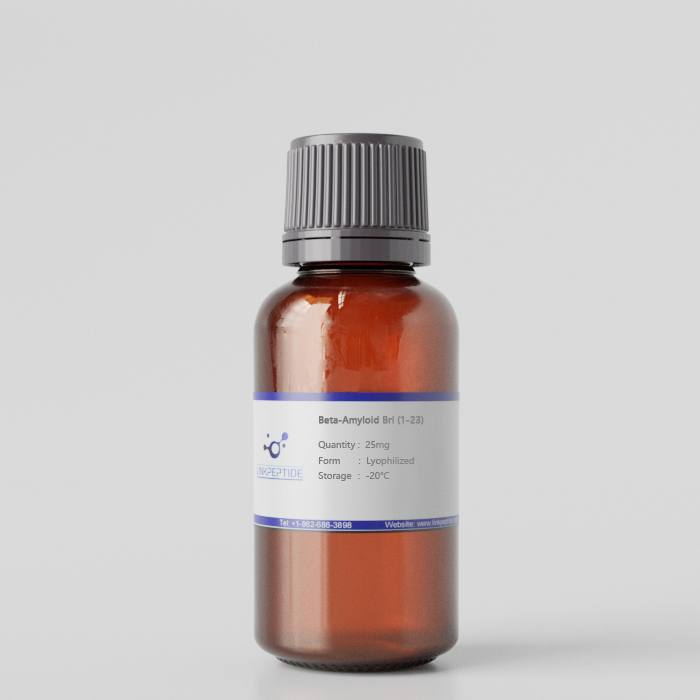
Product Name: Beta-Amyloid Bri (1-23)
Sequence One Letter Code: EASNCFAIRHFENKFAVETLICS-OH
Sequence Three Letter Code: Glu-Ala-Ser-Asn-Cys-Phe-Ala-Ile-Arg-His-Phe-Glu-Asn-Lys-Phe-Ala-Val-Glu-Thr-Leu-Ile-Cys-Ser-OH
Chemical Formula:C116H177N31O35S2
Molecular Weight: 2630.1
Purity: 95%
Form: Lyophilized
Storage Conditions: - 20 °C
Research Area: Neurological Disease Research
Source / Species: human
Conjugation: Unconjugated
Code Nacres: NA.26
Application: β-Amyloid Bri (1–23) is a synthetic peptide corresponding to residues 1–23 of the amyloid Bri sequence derived from a mutated BRI2 gene. Amyloid Bri peptides accumulate as cerebral amyloid deposits in Familial British Dementia (FBD), a rare hereditary neurodegenerative disorder with pathological similarities to Alzheimer’s disease. This peptide serves as a disease-relevant model for studying amyloid aggregation, fibril formation, and neurotoxicity associated with inherited amyloidoses. It supports mechanistic research into protein misfolding, plaque deposition, and comparative amyloid pathology. β-Amyloid Bri (1–23) is particularly suitable for aggregation assays, inhibitor screening, and investigations of rare dementia-related amyloidogenic processes.
Current Research: β-Amyloid Bri (1–23) is derived from the N-terminal region of the amyloid peptide generated by mutation of the BRI2 gene in Familial British Dementia (FBD), a rare autosomal dominant neurodegenerative disorder characterized by progressive cognitive decline, spasticity, and widespread cerebral amyloid deposition. In FBD, the mutant BRI2 precursor undergoes aberrant processing to produce amyloidogenic peptides that accumulate in parenchymal plaques and vascular deposits, sharing pathological features with Alzheimer’s disease while retaining distinct biochemical properties. The 1–23 fragment encompasses a core region implicated in early aggregation and fibril assembly. Current research leverages Bri peptides to examine how sequence variations drive amyloid nucleation, β-sheet formation, and protofibril stabilization. Comparative studies between Aβ and Bri-derived peptides provide insight into shared structural determinants of amyloidogenesis as well as disease-specific aggregation kinetics. β-Amyloid Bri (1–23) is frequently used in thioflavin-based fluorescence assays, circular dichroism spectroscopy, electron microscopy, and seeding experiments to characterize conformational transitions and fibrillar morphology. Beyond structural studies, Bri peptides support investigation of amyloid-associated neurotoxicity and vascular pathology. Experimental systems evaluate membrane interactions, oxidative stress induction, and inflammatory activation linked to amyloid deposition. Because FBD prominently features cerebral amyloid angiopathy, Bri-derived fragments are also applied in models exploring vascular amyloid formation and endothelial dysfunction. In therapeutic research, defined Bri fragments are incorporated into screening platforms for small molecules, peptides, and antibodies that inhibit aggregation or destabilize fibrils. Their use allows assessment of compound selectivity across different amyloidogenic sequences, contributing to broader understanding of anti-amyloid strategies. Collectively, β-Amyloid Bri (1–23) provides a disease-relevant model for studying hereditary amyloidosis, protein misfolding mechanisms, and comparative amyloid pathology. It enables detailed examination of sequence-dependent aggregation behavior and supports translational efforts aimed at targeting rare dementia-associated amyloid deposition.
Get a Quote
 LinkPeptide