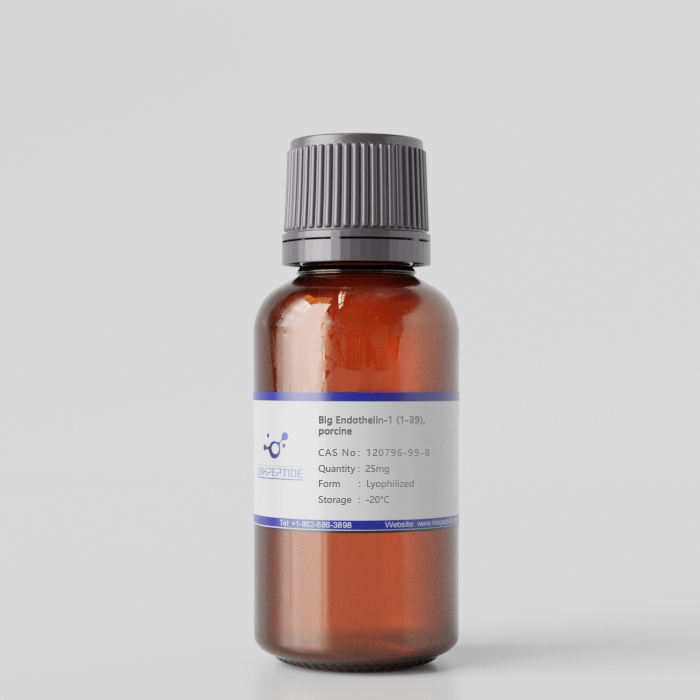
Product Name: Big Endothelin-1 (1-39), porcine
Sequence One Letter Code: CSCSSLMDKECVYFCHLDIIWVNTPEHIVPYGLGSPSRS (Disulfide bridge: 1-15 and 3-11)
Sequence Three Letter Code: H-Cys-Ser-Cys-Ser-Ser-Leu-Met-Asp-Lys-Glu-Cys-Val-Tyr-Phe-Cys-His-Leu-Asp-Ile-Ile-Trp-Val-Asn-Thr-Pro-Glu-His-Ile-Val-Pro-Tyr-Gly-Leu-Gly-Ser-Pro-Ser-Arg-Ser-OH
Cas No: 120796-99-8
Chemical Formula:C193H289N49O58S5
Molecular Weight: 4384.2
Purity: 95%
Form: Lyophilized
Storage Conditions: - 20 °C
Research Area: Cardiovascular Disease Research
SMILES: CC[C@H](C)[C@@H](C(=O)N[C@@H](C(C)C)C(=O)N1CCC[C@H]1C(=O)N[C@@H](CC2=CC=C(C=C2)O)C(=O)NCC(=O)N[C@@H](CC(C)C)C(=O)NCC(=O)N[C@@H](CO)C(=O)N3CCC[C@H]3C(=O)N[C@@H](CO)C(=O)N[C@@H](CCCNC(=N)N)C(=O)N[C@@H](CO)C(=O)O)NC(=O)[C@H](CC4=CNC=N4)NC(=O)[C@H](CCC(=O)O)NC(=O)[C@@H]5CCCN5C(=O)[C@H]([C@@H](C)O)NC(=O)[C@H](CC(=O)N)NC(=O)[C@H](C(C)C)NC(=O)[C@H](CC6=CNC7=CC=CC=C76)NC(=O)[C@H]([C@@H](C)CC)NC(=O)[C@H]([C@@H](C)CC)NC(=O)[C@H](CC(=O)O)NC(=O)[C@H](CC(C)C)NC(=O)[C@H](CC8=CNC=N8)NC(=O)[C@H](CS)NC(=O)[C@H](CC9=CC=CC=C9)NC(=O)[C@H](CC1=CC=C(C=C1)O)NC(=O)[C@H](C(C)C)NC(=O)[C@H](CS)NC(=O)[C@H](CCC(=O)O)NC(=O)[C@H](CCCCN)NC(=O)[C@H](CC(=O)O)NC(=O)[C@H](CCSC)NC(=O)[C@H](CC(C)C)NC(=O)[C@H](CO)NC(=O)[C@H](CO)NC(=O)[C@H](CS)NC(=O)[C@H](CO)NC(=O)[C@H](CS)N
IUPAC: (4S)-4-[[(2S)-1-[(2S,3R)-2-[[(2S)-4-amino-2-[[(2S)-2-[[(2S)-2-[[(2S,3S)-2-[[(2S,3S)-2-[[(2S)-2-[[(2S)-2-[[(2S)-2-[[(2R)-2-[[(2S)-2-[[(2S)-2-[[(2S)-2-[[(2R)-2-[[(2S)-2-[[(2S)-6-amino-2-[[(2S)-2-[[(2S)-2-[[(2S)-2-[[(2S)-2-[[(2S)-2-[[(2R)-2-[[(2S)-2-[[(2R)-2-amino-3-sulfanylpropanoyl]amino]-3-hydroxypropanoyl]amino]-3-sulfanylpropanoyl]amino]-3-hydroxypropanoyl]amino]-3-hydroxypropanoyl]amino]-4-methylpentanoyl]amino]-4-methylsulfanylbutanoyl]amino]-3-carboxypropanoyl]amino]hexanoyl]amino]-4-carboxybutanoyl]amino]-3-sulfanylpropanoyl]amino]-3-methylbutanoyl]amino]-3-(4-hydroxyphenyl)propanoyl]amino]-3-phenylpropanoyl]amino]-3-sulfanylpropanoyl]amino]-3-(1H-imidazol-4-yl)propanoyl]amino]-4-methylpentanoyl]amino]-3-carboxypropanoyl]amino]-3-methylpentanoyl]amino]-3-methylpentanoyl]amino]-3-(1H-indol-3-yl)propanoyl]amino]-3-methylbutanoyl]amino]-4-oxobutanoyl]amino]-3-hydroxybutanoyl]pyrrolidine-2-carbonyl]amino]-5-[[(2S)-1-[[(2S,3S)-1-[[(2S)-1-[(2S)-2-[[(2S)-1-[[2-[[(2S)-1-[[2-[[(2S)-1-[(2S)-2-[[(2S)-1-[[(2S)-5-carbamimidamido-1-[[(1S)-1-carboxy-2-hydroxyethyl]amino]-1-oxopentan-2-yl]amino]-3-hydroxy-1-oxopropan-2-yl]carbamoyl]pyrrolidin-1-yl]-3-hydroxy-1-oxopropan-2-yl]amino]-2-oxoethyl]amino]-4-methyl-1-oxopentan-2-yl]amino]-2-oxoethyl]amino]-3-(4-hydroxyphenyl)-1-oxopropan-2-yl]carbamoyl]pyrrolidin-1-yl]-3-methyl-1-oxobutan-2-yl]amino]-3-methyl-1-oxopentan-2-yl]amino]-3-(1H-imidazol-4-yl)-1-oxopropan-2-yl]amino]-5-oxopentanoic acid
INCHIKEY: NBLKJUUVNGANMG-KLDCKYJXSA-N
INCHI:
InChI=1S/C193H293N49O58S5/c1-21-98(16)152(238-188(295)154(100(18)23-3)237-173(280)129(74-148(261)262)220-165(272)120(65-94(8)9)214-168(275)125(70-106-76-199-90-205-106)218-178(285)136(87-302)231-167(274)122(66-102-35-25-24-26-36-102)216-166(273)123(68-104-46-50-109(251)51-47-104)222-184(291)150(96(12)13)234-180(287)138(89-304)230-162(269)115(52-54-145(255)256)211-159(266)113(39-29-30-57-194)209-169(276)128(73-147(259)260)219-163(270)117(56-62-305-20)212-164(271)119(64-93(6)7)215-175(282)131(81-244)226-176(283)132(82-245)227-179(286)137(88-303)232-177(284)130(80-243)225-156(263)111(195)86-301)186(293)223-124(69-105-75-202-112-38-28-27-37-110(105)112)170(277)233-149(95(10)11)185(292)224-127(72-142(196)252)172(279)239-155(101(19)249)191(298)242-61-34-42-140(242)181(288)213-116(53-55-146(257)258)161(268)217-126(71-107-77-200-91-206-107)171(278)236-153(99(17)22-2)187(294)235-151(97(14)15)190(297)241-60-33-43-141(241)182(289)221-121(67-103-44-48-108(250)49-45-103)158(265)204-78-143(253)207-118(63-92(4)5)157(264)203-79-144(254)208-134(84-247)189(296)240-59-32-41-139(240)183(290)228-133(83-246)174(281)210-114(40-31-58-201-193(197)198)160(267)229-135(85-248)192(299)300/h24-28,35-38,44-51,75-77,90-101,111,113-141,149-155,202,243-251,301-304H,21-23,29-34,39-43,52-74,78-89,194-195H2,1-20H3,(H2,196,252)(H,199,205)(H,200,206)(H,203,264)(H,204,265)(H,207,253)(H,208,254)(H,209,276)(H,210,281)(H,211,266)(H,212,271)(H,213,288)(H,214,275)(H,215,282)(H,216,273)(H,217,268)(H,218,285)(H,219,270)(H,220,272)(H,221,289)(H,222,291)(H,223,293)(H,224,292)(H,225,263)(H,226,283)(H,227,286)(H,228,290)(H,229,267)(H,230,269)(H,231,274)(H,232,284)(H,233,277)(H,234,287)(H,235,294)(H,236,278)(H,237,280)(H,238,295)(H,239,279)(H,255,256)(H,257,258)(H,259,260)(H,261,262)(H,299,300)(H4,197,198,201)/t98-,99-,100-,101+,111-,113-,114-,115-,116-,117-,118-,119-,120-,121-,122-,123-,124-,125-,126-,127-,128-,129-,130-,131-,132-,133-,134-,135-,136-,137-,138-,139-,140-,141-,149-,150-,151-,152-,153-,154-,155-/m0/s1
Source / Species: porcine
Conjugation: Unconjugated
Code Nacres: NA.26
Application: Big Endothelin-1 (1–39), porcine is a synthetic 39–amino acid peptide corresponding to the inactive precursor of endothelin-1 in porcine systems. This propeptide is cleaved by endothelin-converting enzyme (ECE) to generate the potent vasoconstrictor endothelin-1 (1–21). Alternative processing by chymase has also been described in vitro. Endothelins regulate vascular tone, blood pressure, and smooth muscle contraction through ETA and ETB receptor activation. Big Endothelin-1 serves as a defined substrate for studying endothelin biosynthesis, enzyme specificity, and precursor processing kinetics. It is widely applied in cardiovascular research to investigate endothelial function, vascular reactivity, and enzymatic regulation of vasoactive peptide signaling pathways.
Current Research: Big Endothelin-1 (1–39), porcine is a synthetic 39–amino acid peptide corresponding to the inactive precursor of endothelin-1 (ET-1) in porcine systems. As the immediate propeptide in the endothelin biosynthetic pathway, Big Endothelin-1 is enzymatically cleaved by endothelin-converting enzyme (ECE) to generate the biologically active 21–amino acid endothelin-1. Because ET-1 is among the most potent endogenous vasoconstrictors identified, controlled study of its precursor processing is central to understanding vascular regulation and cardiovascular pathophysiology. Endothelin Biosynthesis and Processing Endothelins are synthesized as larger prepropeptides that undergo sequential proteolytic processing. In endothelial cells, preproendothelin is first cleaved to form Big Endothelin-1 (1–39), which is then converted to mature ET-1 (1–21) by endothelin-converting enzyme, a zinc-dependent metalloprotease. This cleavage represents the rate-limiting step in endothelin activation. Alternative processing pathways have also been described. In vitro studies indicate that chymase and other proteases can generate endothelin-like peptides from Big Endothelin-1 under specific conditions. These alternative pathways may contribute to localized ET-1 production in inflammatory or pathological settings. Using the porcine sequence ensures physiological relevance in porcine vascular models, where endothelin biology is frequently studied due to anatomical and functional similarity to human cardiovascular systems. Endothelin Receptor Signaling Mature endothelin-1 exerts its effects through ETA and ETB receptors, both members of the G protein–coupled receptor family. Activation of ETA receptors on vascular smooth muscle cells promotes vasoconstriction through G_q-mediated phospholipase C activation, intracellular calcium mobilization, and smooth muscle contraction. ETB receptors, expressed on endothelial cells, can mediate nitric oxide release and contribute to vasodilatory counter-regulation, though they may also participate in vasoconstrictive signaling depending on cellular context. Because Big Endothelin-1 itself is biologically inactive until cleaved, it serves as a controlled substrate for studying enzymatic generation of active endothelin peptides and subsequent receptor-mediated responses. Applications in Cardiovascular Research Big Endothelin-1 (1–39), porcine is widely used in: Endothelin-converting enzyme (ECE) activity assays Enzyme kinetics and substrate specificity studies Comparative analysis of metalloprotease inhibitors Vascular reactivity experiments in isolated vessel preparations Endothelial function and smooth muscle contraction models In ex vivo vascular systems, addition of Big Endothelin-1 allows researchers to assess the functional capacity of endogenous ECE to generate active ET-1 and induce vasoconstriction. This approach helps distinguish precursor processing from direct receptor activation by exogenous ET-1. Pathophysiological Relevance Elevated endothelin signaling is implicated in hypertension, pulmonary arterial hypertension, heart failure, and vascular remodeling. Investigating the enzymatic regulation of Big Endothelin-1 processing provides insight into early events driving excessive vasoconstrictor production. Inhibition of ECE or modulation of precursor availability represents a potential therapeutic strategy in endothelin-associated diseases. Porcine cardiovascular models are frequently used in translational research due to their physiological similarity to human systems. The porcine Big Endothelin-1 sequence ensures compatibility with species-specific enzymatic and receptor interactions. Experimental Advantages Defined precursor substrate for ECE Physiologically relevant porcine sequence Suitable for enzymatic and vascular functional assays Enables investigation of alternative proteolytic pathways Supports pharmacological evaluation of endothelin pathway modulators Research Significance Big Endothelin-1 (1–39), porcine serves as a foundational tool for studying endothelin biosynthesis and enzymatic regulation of vasoactive peptide signaling. By enabling controlled analysis of precursor processing and downstream vascular responses, it supports mechanistic investigation of endothelial function, smooth muscle contraction, and blood pressure regulation in cardiovascular research models.
Get a Quote
 LinkPeptide

![Lys-[Des-Arg9]Bradykinin](https://www.linkpeptide.com/wp-content/uploads/2024/10/Lys-Des-Arg9Bradykinin-jpg-3.webp "Lys-[Des-Arg9]Bradykinin")