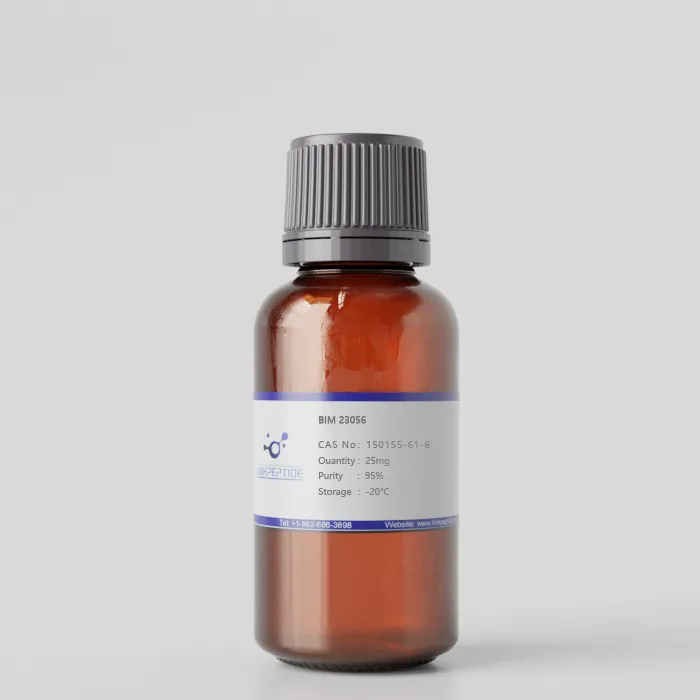
Product Name:BIM 23056
CAS No:150155-61-6
Purity:95%
Molar Mass:1232.5
Chemical Formula:C71H81N11O9
Storage:Store at -20 degrees Celsius
Sequence:FFYWKVFX
Target:somatostatin receptor subtype 5 (SSTR5)
Application:
BIM 23056 is a potent and selective somatostatin receptor subtype 5 (SSTR5) antagonist, widely used in research focused on neuroendocrine regulation and hormone secretion. This peptide is particularly valuable in studies exploring the role of SSTR5 in the inhibition of growth hormone, insulin, and other hormone secretions, making it relevant for research into conditions such as acromegaly, diabetes, and neuroendocrine tumors. BIM 23056's high specificity and affinity for SSTR5 ensure precise targeting, providing reliable and reproducible results in experimental settings. It is an essential tool for researchers investigating the therapeutic potential of targeting somatostatin receptors.
Current Research:
BIM 23056 (CAS: 150155-61-6) is a synthetic linear octapeptide that functions as a potent and selective antagonist of somatostatin receptor subtypes 3 (sst₃) and 5 (sst₅). Somatostatin receptors are G protein-coupled receptors involved in regulating endocrine and neuronal signaling pathways. Among the five known subtypes (sst₁–sst₅), sst₃ and sst₅ play significant roles in modulating hormone secretion and neuronal activity.
Chemical Structure and Selectivity
The molecular formula of BIM 23056 is C₇₁H₈₁N₁₁O₉, with a molecular weight of approximately 1232.49 g/mol. Its sequence is D-Phe-Phe-Tyr-D-Trp-Lys-Val-Phe-D-Nal-NH₂, where D-Nal represents D-2-naphthylalanine. Binding affinity studies reveal that BIM 23056 exhibits high selectivity for sst₃ and sst₅, with Kᵢ values of 10.8 nM and 5.7 nM, respectively. In contrast, it shows significantly lower affinities for other somatostatin receptor subtypes: sst₁ (Kᵢ = 142 nM), sst₄ (Kᵢ = 16.6 nM), and sst₂ (Kᵢ > 1000 nM).
Mechanism of Action
As an antagonist, BIM 23056 binds to sst₃ and sst₅ receptors, inhibiting the action of endogenous somatostatin. This blockade prevents receptor-mediated inhibition of adenylyl cyclase, leading to increased cyclic AMP (cAMP) levels and subsequent modulation of downstream signaling pathways. By selectively targeting sst₃ and sst₅, BIM 23056 allows for the dissection of subtype-specific physiological and pathological processes.
Pharmacological Applications
BIM 23056 has been instrumental in elucidating the roles of sst₃ and sst₅ in various biological systems. In vitro studies have demonstrated that BIM 23056 effectively inhibits somatostatin-induced responses in cells expressing human sst₃ and sst₅ receptors, indicating its efficacy in preventing receptor activation.
Research Implications
The high selectivity and potency of BIM 23056 make it a valuable tool for probing sst₃- and sst₅-specific functions in both normal and disease states. Its application extends to studies on hormone secretion, neuronal excitability, and tumor growth, where these receptor subtypes are implicated. By selectively inhibiting sst₃ and sst₅, researchers can delineate the receptors' contributions to complex signaling networks and explore therapeutic avenues for conditions such as neuroendocrine tumors, where somatostatin analogs are of clinical interest.
Conclusion
BIM 23056 serves as a critical agent in the pharmacological exploration of somatostatin receptor biology. Its specificity for sst₃ and sst₅ enables detailed studies of receptor function and aids in the development of targeted therapies for diseases involving dysregulated somatostatin signaling.
Reference:
Get a Quote
 LinkPeptide

![[Nphe1]Nociceptin(1-13)NH2](https://www.linkpeptide.com/wp-content/uploads/2024/10/Nphe1Nociceptin1-13NH2-jpg-3.webp "[Nphe1]Nociceptin(1-13)NH2")
![SCYLLATOXIN [Tyr2]-](https://www.linkpeptide.com/wp-content/uploads/2024/10/SCYLLATOXIN-Tyr2-jpg-2.webp "SCYLLATOXIN [Tyr2]-")