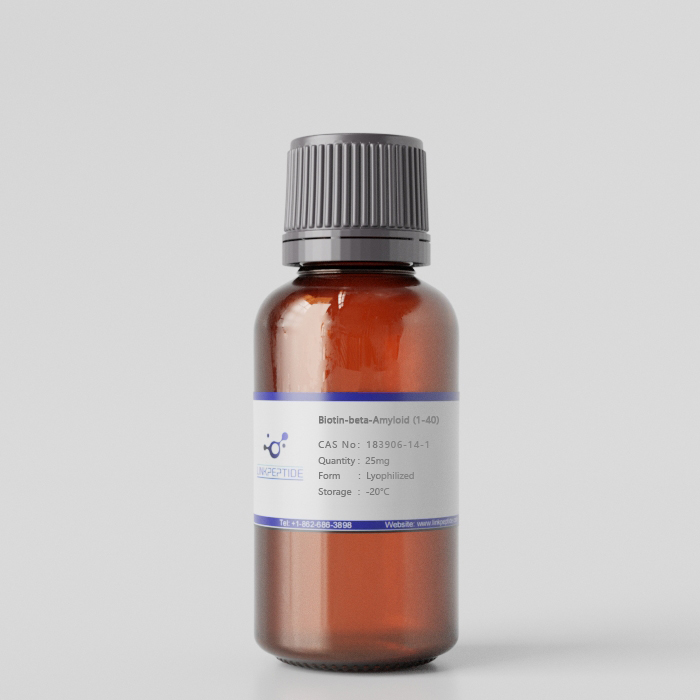
Product Name: Biotin-beta-Amyloid (1-40)
Sequence One Letter Code: Biotin-DAEFRHDSGYEVHHQKLVFFAEDVGSNKGAIIGLMVGGVV
Sequence Three Letter Code: Biotin-Asp-Ala-Glu-Phe-Arg-His-Asp-Ser-Gly-Tyr-Glu-Val-His-His-Gln-Lys-Leu-Val-Phe-Phe-Ala-Glu-Asp-Val-Gly-Ser-Asn-Lys-Gly-Ala-Ile-Ile-Gly-Leu-Met-Val-Gly-Gly-Val-Val-OH
Cas No: 183906-14-1
Chemical Formula:C204H309N55O60S2
Molecular Weight: 4556.4
Purity: 95%
Form: Lyophilized
Storage Conditions: - 20 °C
Research Area: Alzheimer's Disease
Source / Species: human
Conjugation: Conjugated
Conjugation Type: Biotins
Code Nacres: NA.26
Application: Biotin–β-Amyloid (1–40) is a biotinylated form of a major amyloid-β peptide generated from amyloid precursor protein processing. Along with Aβ (1–42), it aggregates and deposits in the brains of individuals with Alzheimer’s disease, particularly in cerebrovascular amyloid. The biotin tag enables affinity-based detection, immobilization, and protein interaction studies using streptavidin-based systems. This peptide is widely used in neurodegeneration research to investigate amyloid aggregation, binding interactions, and molecular mechanisms of amyloid-associated toxicity. It also supports studies of plaque formation and vascular amyloid pathology, providing a useful tool for analyzing protein interactions and aggregation processes relevant to Alzheimer’s disease.
Current Research: Biotin–β-Amyloid (1–40) is a synthetic, biotin-labeled version of the amyloid-β (Aβ) 1–40 peptide, one of the principal cleavage products of amyloid precursor protein (APP). Together with Aβ (1–42), this peptide plays a central role in the pathogenesis of Alzheimer’s disease (AD), where it aggregates and accumulates in the brain, forming amyloid plaques and contributing to neurodegeneration. The addition of a biotin tag enables versatile use in biochemical assays, particularly those involving affinity capture, detection, and protein interaction analysis. Amyloid-β (1–40) in Alzheimer’s Disease Aβ (1–40) is the most abundant amyloid-β isoform found in the human brain and is generated through sequential cleavage of APP by β-secretase and γ-secretase. While Aβ (1–42) is more prone to aggregation, Aβ (1–40) is a major component of cerebrovascular amyloid deposits, particularly in conditions such as cerebral amyloid angiopathy (CAA). Key pathological features associated with Aβ (1–40) include: Aggregation into oligomers and fibrils Deposition in vascular walls and brain parenchyma Contribution to neurotoxicity and vascular dysfunction These processes are central to understanding the molecular basis of Alzheimer’s disease and related neurodegenerative disorders. Structural and Functional Features of the Biotinylated Peptide Biotin–β-Amyloid (1–40) retains the native Aβ sequence while incorporating a biotin moiety, typically at the N-terminus or via a linker. This modification allows the peptide to interact with streptavidin or avidin, which bind biotin with extremely high affinity. This design enables: Efficient immobilization on assay surfaces Sensitive detection in biochemical assays Selective enrichment of interacting proteins Importantly, the biotin tag is positioned to minimize interference with the peptide’s aggregation behavior and binding properties, preserving its relevance for studying amyloid biology. Applications in Amyloid Aggregation Studies Aggregation of Aβ peptides into oligomers and fibrils is a hallmark of Alzheimer’s disease. Biotin–β-Amyloid (1–40) is widely used to investigate the kinetics and mechanisms of amyloid aggregation. Typical applications include: In vitro aggregation assays to monitor fibril formation Studies of oligomerization and aggregation intermediates Evaluation of factors influencing aggregation dynamics Screening of compounds that modulate amyloid formation These studies help elucidate how Aβ peptides transition from soluble monomers to toxic aggregates. Protein Interaction and Binding Studies The biotin label makes this peptide particularly useful for protein–amyloid interaction studies. By immobilizing the peptide on streptavidin-coated surfaces or beads, researchers can capture proteins that bind to Aβ. Applications include: Affinity pull-down assays to identify Aβ-binding partners Characterization of receptor–amyloid interactions Investigation of chaperone proteins and aggregation modulators Proteomic analysis of amyloid-associated complexes Such studies provide insight into how Aβ interacts with cellular components and contributes to toxicity. Role in Neurotoxicity and Disease Mechanisms Aβ peptides are implicated in multiple aspects of Alzheimer’s disease pathology, including synaptic dysfunction, oxidative stress, and neuronal death. Biotin–β-Amyloid (1–40) enables controlled investigation of these processes in experimental systems. Researchers use this peptide to study: Mechanisms of amyloid-induced cytotoxicity Cellular responses to Aβ exposure Pathways involved in neuroinflammation and vascular damage Because Aβ (1–40) is particularly associated with vascular amyloid deposition, it is also relevant for examining interactions between amyloid and cerebrovascular systems. Applications in Plaque and Vascular Amyloid Research In addition to plaque formation, Aβ (1–40) plays a major role in amyloid deposition within blood vessels, contributing to vascular dysfunction in the brain. Biotinylated forms of the peptide facilitate studies of: Amyloid accumulation in vascular tissues Interactions with endothelial cells and extracellular matrix components Mechanisms underlying cerebral amyloid angiopathy These investigations are important for understanding the broader impact of amyloid pathology beyond neuronal damage. A Versatile Tool for Alzheimer’s Disease Research Biotin–β-Amyloid (1–40) combines the biological relevance of a major amyloid peptide with the practical advantages of biotin-based detection and purification. This makes it a highly versatile reagent for studying amyloid aggregation, protein interactions, and neurodegenerative mechanisms. Through its use in biochemical, cellular, and proteomic assays, this peptide continues to support advances in understanding Alzheimer’s disease pathology, amyloid-associated toxicity, and the molecular interactions that drive neurodegeneration.
Get a Quote
 LinkPeptide

![[Lys(Me3)27]-Histone H3 (23-34)-GGK(Biotin)](https://www.linkpeptide.com/wp-content/uploads/2026/05/LysMe327-Histone-H3-23-34-GGKBiotin.jpg "[Lys(Me3)27]-Histone H3 (23-34)-GGK(Biotin)")