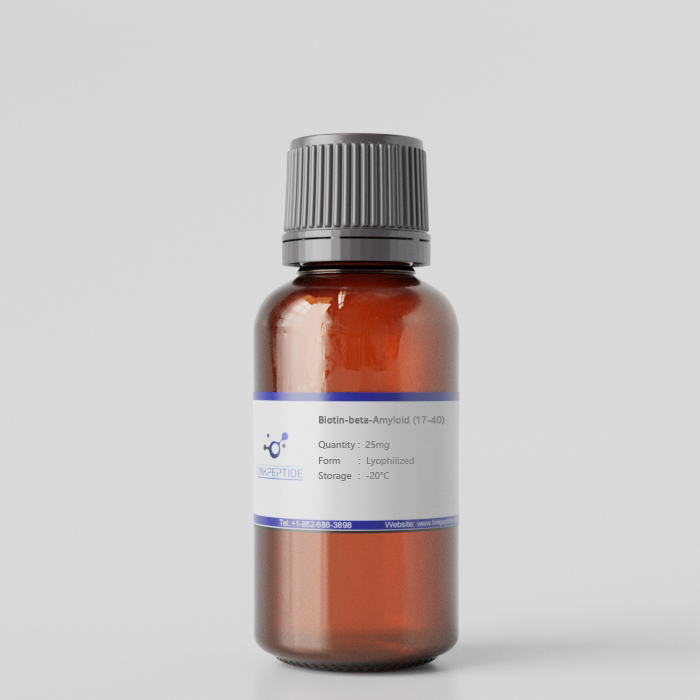
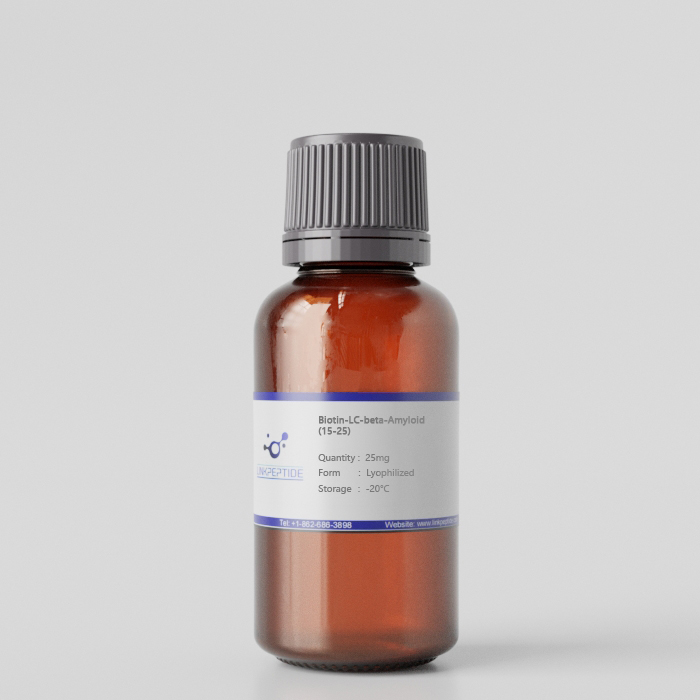
Product Name: Biotin-LC-beta-Amyloid (15-25)
Sequence One Letter Code: Biotin-LC-QKLVFFAEDVG
Sequence Three Letter Code: Biotin-LC-Gln-Lys-Leu-Val-Phe-Phe-Ala-Glu-Asp-Val-Gly-OH
Molecular Weight: 1592
Purity: 95%
Form: Lyophilized
Storage Conditions: - 20 °C
Research Area: Alzheimer's Disease
Source / Species: human
Conjugation: Conjugated
Conjugation Type: Biotins
Code Nacres: NA.26
Application: Biotin-LC-β-Amyloid (15–25) is a biotinylated peptide fragment encompassing residues 15–25 of human, mouse, and rat β-amyloid. This region contributes to aggregation propensity and neurotoxic activity associated with Alzheimer’s disease pathology. The long-chain (LC) biotin spacer enhances accessibility in affinity-based assays, enabling sensitive detection and capture using streptavidin systems. The peptide is widely used in studies of amyloid aggregation, protein–protein interactions, and screening of amyloid-binding compounds or antibodies. It provides a defined tool for investigating molecular mechanisms underlying amyloid-driven neurodegeneration and therapeutic targeting strategies.
Current Research: Alzheimer’s disease (AD) is a progressive neurodegenerative disorder characterized by memory loss, cognitive decline, and widespread neuronal damage. One of the defining pathological features of AD is the accumulation of amyloid-β (Aβ) peptides, which aggregate to form extracellular plaques in the brain. Understanding how amyloid peptides aggregate, interact with cellular components, and contribute to neurotoxicity is a major focus of neuroscience research. Synthetic peptide fragments derived from amyloid-β provide valuable experimental tools for dissecting these processes. Biotin-LC-β-Amyloid (15–25) represents a biotinylated fragment of the amyloid sequence that supports biochemical studies of aggregation, molecular recognition, and therapeutic targeting. Amyloid-β Peptides and Alzheimer’s Disease Amyloid-β peptides are produced through proteolytic processing of the amyloid precursor protein (APP), a membrane-associated protein expressed in many tissues, including neurons. Sequential cleavage of APP by β-secretase and γ-secretase generates Aβ peptides of varying lengths, most commonly Aβ40 and Aβ42. These peptides can self-associate and form soluble oligomers, fibrils, and eventually insoluble plaques. Research has shown that amyloid oligomers and aggregates disrupt neuronal signaling and contribute to synaptic dysfunction, processes believed to play a major role in Alzheimer’s disease progression. Because full-length Aβ peptides are relatively long and complex, researchers often study shorter fragments that capture important structural or functional regions of the protein. The 15–25 region of β-amyloid represents one such segment that contributes to aggregation behavior and interactions with other biomolecules. Structural Importance of the Aβ (15–25) Region The central region of amyloid-β, including residues 15–25, is associated with the peptide’s tendency to form β-sheet structures that drive aggregation. Within this segment are residues that contribute to hydrophobic interactions and intermolecular contacts during fibril formation. Because aggregation is a key step in amyloid pathology, studying fragments that contain aggregation-relevant motifs helps researchers understand the molecular events leading to amyloid assembly. Short peptides derived from these regions can reproduce important aspects of the aggregation process while providing a simpler system for biochemical analysis. The Aβ (15–25) sequence is conserved across human, mouse, and rat amyloid proteins, making it useful for comparative studies across commonly used experimental models. Biotinylation and the Role of the Long-Chain Spacer In Biotin-LC-β-Amyloid (15–25), the peptide fragment is modified with a long-chain (LC) biotin tag. Biotin is widely used in molecular biology because of its extremely strong affinity for streptavidin and avidin proteins. This interaction enables efficient capture, immobilization, and detection of biotin-labeled molecules. The long-chain spacer incorporated between the peptide and the biotin group increases the flexibility and accessibility of the peptide when immobilized on streptavidin surfaces. Without such a spacer, the peptide sequence might be sterically restricted when attached to a matrix, potentially limiting interactions with proteins or antibodies. The LC spacer therefore improves the performance of the peptide in affinity-based assays, ensuring that the amyloid fragment remains accessible for binding and detection experiments. Applications in Amyloid Aggregation Studies Biotinylated amyloid fragments are widely used in aggregation assays and biophysical studies. By immobilizing the peptide on streptavidin-coated plates or beads, researchers can examine how other molecules interact with the amyloid sequence during aggregation processes. Such experiments help clarify how peptide segments participate in the formation of amyloid oligomers and fibrillar assemblies. Understanding these interactions provides insights into the molecular basis of amyloid plaque formation and its role in neurodegeneration. Short amyloid fragments also allow researchers to study aggregation kinetics and structural transitions under controlled experimental conditions. Investigating Protein–Protein Interactions Another important application of Biotin-LC-β-Amyloid (15–25) is the analysis of protein–protein interactions involving amyloid peptides. The immobilized peptide can be used in pull-down assays to capture proteins that interact with amyloid sequences. These studies help identify molecules that recognize or bind amyloid peptides, including chaperone proteins, receptors, and other regulatory factors that influence aggregation or toxicity. Mapping such interactions provides valuable insight into the cellular pathways involved in amyloid metabolism and clearance. Screening for Amyloid-Binding Compounds and Antibodies Biotinylated amyloid peptides are frequently used in screening assays for compounds or antibodies that bind amyloid sequences. Such assays are important for the development of diagnostic tools and therapeutic strategies aimed at targeting amyloid aggregates. For example, candidate molecules designed to inhibit amyloid aggregation can be evaluated by measuring their ability to interact with immobilized amyloid peptides. Similarly, antibodies developed to recognize amyloid epitopes can be tested for specificity and binding affinity using defined peptide fragments. These applications contribute to ongoing efforts to identify agents capable of modulating amyloid formation or detecting amyloid pathology. Insights into Neurodegenerative Disease Mechanisms Research using defined amyloid fragments has helped advance understanding of the molecular mechanisms underlying amyloid-driven neurodegeneration. By studying how specific peptide segments interact with proteins, membranes, and small molecules, scientists can better understand the factors that promote or inhibit amyloid aggregation. Such knowledge is essential for developing therapeutic strategies aimed at reducing amyloid toxicity or preventing plaque formation in Alzheimer’s disease. Conclusion Biotin-LC-β-Amyloid (15–25) provides a defined peptide fragment representing a key region of the amyloid-β sequence involved in aggregation and neurotoxic processes. The incorporation of a long-chain biotin spacer enables efficient immobilization and detection in streptavidin-based affinity assays while preserving accessibility of the peptide sequence. Through applications in amyloid aggregation studies, protein interaction analysis, and screening of amyloid-binding compounds or antibodies, this peptide supports research into the molecular events that drive Alzheimer’s disease pathology. As scientists continue to investigate mechanisms of amyloid formation and neurodegeneration, defined peptide reagents such as this remain valuable tools for advancing both fundamental understanding and therapeutic development.
Get a Quote
 LinkPeptide

![[Lys(Me2)20]-Histone H4 (8-30)-WGK(Biotin)](https://www.linkpeptide.com/wp-content/uploads/2026/06/LysMe220-Histone-H4-8-30-WGKBiotin.jpg "[Lys(Me2)20]-Histone H4 (8-30)-WGK(Biotin)")