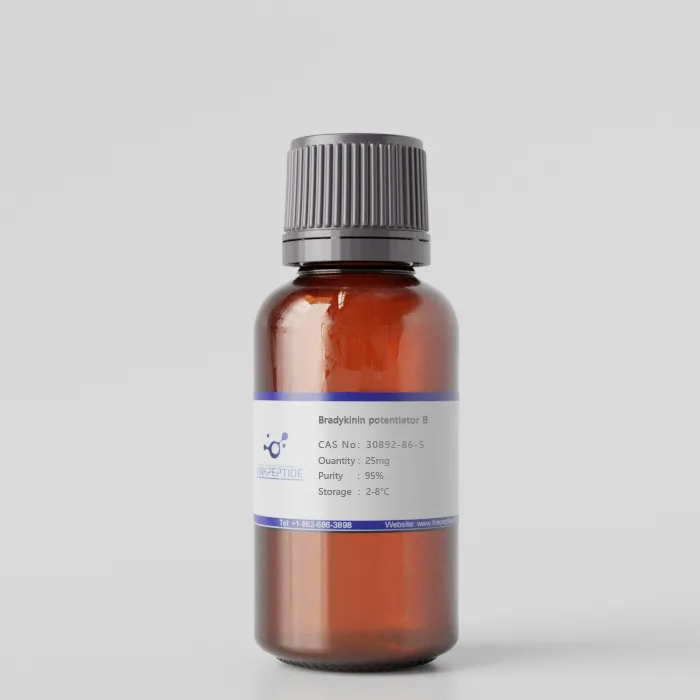
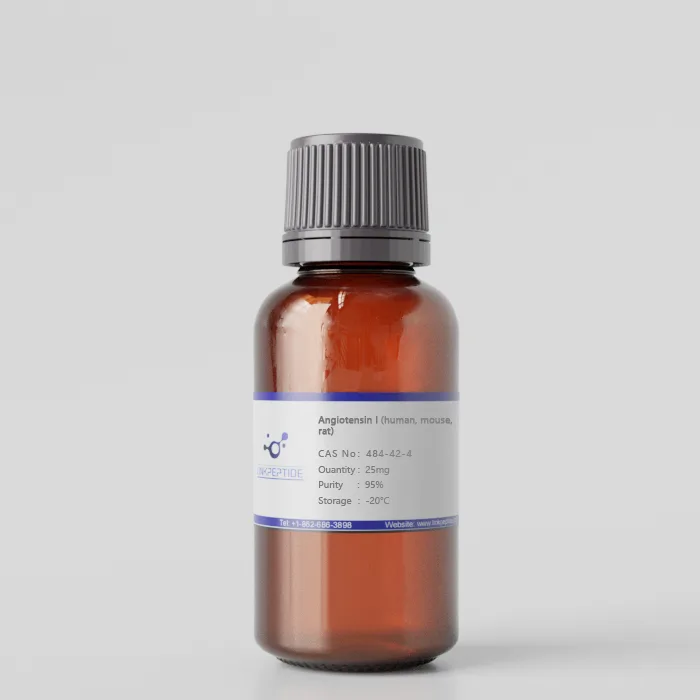
Product Name:Bradykinin potentiator B
Form:free base
Purity:95%
Storage:2-8 degree Celsius
Cas No:30892-86-5
Molar Mass:1182.4
Chemical Formula:C56H91N15O13
IUPAC Name:1-[1-[2-[[6-amino-2-[[1-[5-(diaminomethylideneamino)-2-[[1-[1-[4-methyl-2-[[2-[(5-oxopyrrolidine-2-carbonyl)amino]acetyl]amino]pentanoyl]pyrrolidine-2-carbonyl]pyrrolidine-2-carbonyl]amino]pentanoyl]pyrrolidine-2-carbonyl]amino]hexanoyl]amino]-3-methylpentanoyl]pyrrolidine-2-carbonyl]pyrrolidine-2-carboxylic acid
SMILES:CCC(C)C(C(=O)N1CCCC1C(=O)N2CCCC2C(=O)O)NC(=O)C(CCCCN)NC(=O)C3CCCN3C(=O)C(CCCN=C(N)N)NC(=O)C4CCCN4C(=O)C5CCCN5C(=O)C(CC(C)C)NC(=O)CNC(=O)C6CCC(=O)N6
InChIKey:JXGBFZMUUPNIBD-UHFFFAOYSA-N
InChI:InChI=1S/C56H91N15O13/c1-5-33(4)45(54(82)70-28-12-19-41(70)53(81)71-29-13-20-42(71)55(83)84)66-47(75)34(14-6-7-23-57)64-48(76)38-16-9-25-67(38)50(78)36(15-8-24-60-56(58)59)65-49(77)39-17-10-26-68(39)52(80)40-18-11-27-69(40)51(79)37(30-32(2)3)63-44(73)31-61-46(74)35-21-22-43(72)62-35/h32-42,45H,5-31,57H2,1-4H3,(H,61,74)(H,62,72)(H,63,73)(H,64,76)(H,65,77)(H,66,75)(H,83,84)(H4,58,59,60)
Sequence:Glp-Gly-Leu-Pro-Pro-Arg-Pro-Lys-Ile-Pro-Pro
Application:Bradykinin Potentiator B (BPB) is a bioactive peptide derived from Bothrops jararaca (Brazilian pit viper) venom, known for enhancing bradykinin activity by inhibiting angiotensin-converting enzyme (ACE). By preventing bradykinin degradation, BPB promotes vasodilation, blood pressure regulation, and inflammatory responses. It has been widely studied for its role in hypertension management, cardiovascular protection, and pain modulation. Bradykinin Potentiator B has contributed to the development of ACE inhibitors such as captopril, which revolutionized antihypertensive therapy. Ongoing research explores its potential in vascular health, inflammatory disease treatments, and neuroprotection, making it an essential peptide for cardiovascular and pharmacological studies.
Current Research:
Bradykinin Potentiator B (BPB) is a natural ACE inhibitor that enhances bradykinin signaling, leading to vasodilation, reduced blood pressure, and anti-inflammatory effects. As part of the bradykinin-potentiating peptide family, BPB has been extensively studied for its impact on hypertension, cardiovascular diseases, and inflammatory conditions.
BPB reduces systemic vascular resistance, improving endothelial function.
It shows synergistic effects with synthetic ACE inhibitors, offering new strategies for resistant hypertension.
It contributes to angiogenesis and vascular remodeling, making it beneficial for post-stroke and heart failure recovery.
Recent research explores BPB-derived peptides as next-generation antihypertensive agents, with a focus on improving bioavailability and minimizing side effects.
Chronic pain management, particularly in neuropathic pain and arthritis.
Neuroinflammatory conditions, where bradykinin is linked to neuroprotection and blood-brain barrier integrity.
Post-surgical pain relief, as an alternative to opioid analgesics.
BPB is also under investigation for its effects on inflammatory cytokine regulation, which could make it valuable in treating autoimmune and chronic inflammatory diseases.
Protective effects in diabetic nephropathy, by reducing renal inflammation and fibrosis.
Potential in insulin resistance modulation, suggesting benefits in type 2 diabetes (T2D).
BPB’s ability to improve vascular function and reduce metabolic inflammation makes it a candidate for therapies targeting diabetes-associated complications.
Optimize BPB-derived peptides for clinical applications.
Develop stable analogs for better therapeutic outcomes in hypertension and inflammation.
Explore BPB’s neuroprotective effects, given its potential to improve cerebral blood flow and reduce neuroinflammation in conditions such as Alzheimer’s disease.
Conclusion
Bradykinin Potentiator B remains a crucial compound in cardiovascular, renal, and inflammatory disease research. Its ACE-inhibitory and bradykinin-enhancing properties have significant therapeutic potential, particularly in hypertension management, chronic inflammation, and pain relief. Future research will continue to explore its clinical applications, paving the way for next-generation peptide-based therapies.
Get a Quote
 LinkPeptide