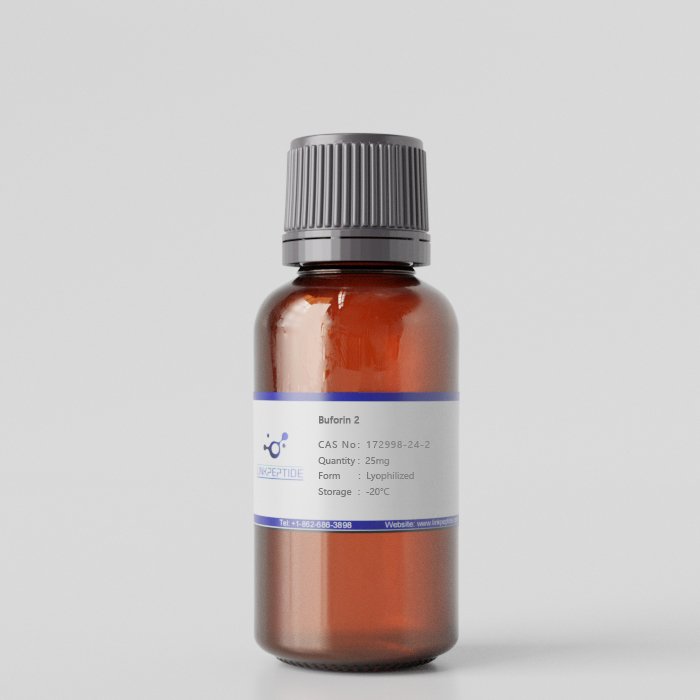
Product Name: Buforin 2
Sequence One Letter Code: TRSSRAGLQFPVGRVHRLLRK
Sequence Three Letter Code: Thr-Arg-Ser-Ser-Arg-Ala-Gly-Leu-Gln-Phe-Pro-Val-Gly-Arg-Val-His-Arg-Leu-Leu-Arg-Lys
Cas No: 172998-24-2
Chemical Formula:C106H184N40O26
Molecular Weight: 2434.9
Purity: 95%
Form: Lyophilized
Storage Conditions: - 20 °C
Research Area: Bacterial
SMILES: C[C@H]([C@@H](C(=O)N[C@@H](CCCNC(=N)N)C(=O)N[C@@H](CO)C(=O)N[C@@H](CO)C(=O)N[C@@H](CCCNC(=N)N)C(=O)N[C@@H](C)C(=O)NCC(=O)N[C@@H](CC(C)C)C(=O)N[C@@H](CCC(=O)N)C(=O)N1CCC[C@H]1C(=O)N[C@@H](C(C)C)C(=O)NCC(=O)N[C@@H](CCCNC(=N)N)C(=O)N[C@@H](C(C)C)C(=O)N[C@@H](CC2=CN=CN2)C(=O)N[C@@H](CCCNC(=N)N)C(=O)N[C@@H](CC(C)C)C(=O)N[C@@H](CC(C)C)C(=O)N[C@@H](CCCNC(=N)N)C(=O)N[C@@H](CCCCN)C(=O)O)N)O
IUPAC: (2S)-6-amino-2-[[(2S)-2-[[(2S)-2-[[(2S)-2-[[(2S)-2-[[(2S)-2-[[(2S)-2-[[(2S)-2-[[2-[[(2S)-2-[[(2S)-1-[(2S)-5-amino-2-[[(2S)-2-[[2-[[(2S)-2-[[(2S)-2-[[(2S)-2-[[(2S)-2-[[(2S)-2-[[(2S,3R)-2-amino-3-hydroxybutanoyl]amino]-5-carbamimidamidopentanoyl]amino]-3-hydroxypropanoyl]amino]-3-hydroxypropanoyl]amino]-5-carbamimidamidopentanoyl]amino]propanoyl]amino]acetyl]amino]-4-methylpentanoyl]amino]-5-oxopentanoyl]pyrrolidine-2-carbonyl]amino]-3-methylbutanoyl]amino]acetyl]amino]-5-carbamimidamidopentanoyl]amino]-3-methylbutanoyl]amino]-3-(1H-imidazol-5-yl)propanoyl]amino]-5-carbamimidamidopentanoyl]amino]-4-methylpentanoyl]amino]-4-methylpentanoyl]amino]-5-carbamimidamidopentanoyl]amino]hexanoic acid
INCHIKEY: LWUHOMXMYZUNOI-SJQMMDBASA-N
INCHI:
InChI=1S/C97H175N39O25/c1-47(2)37-62(122-71(142)42-117-75(143)52(11)120-76(144)56(23-16-32-113-94(103)104)125-85(153)66(44-137)133-86(154)67(45-138)132-79(147)59(26-19-35-116-97(109)110)126-88(156)72(100)53(12)139)81(149)127-60(28-29-69(99)140)91(159)136-36-20-27-68(136)87(155)135-73(50(7)8)89(157)118-43-70(141)121-55(22-15-31-112-93(101)102)80(148)134-74(51(9)10)90(158)131-65(40-54-41-111-46-119-54)84(152)124-58(25-18-34-115-96(107)108)78(146)129-64(39-49(5)6)83(151)130-63(38-48(3)4)82(150)123-57(24-17-33-114-95(105)106)77(145)128-61(92(160)161)21-13-14-30-98/h41,46-53,55-68,72-74,137-139H,13-40,42-45,98,100H2,1-12H3,(H2,99,140)(H,111,119)(H,117,143)(H,118,157)(H,120,144)(H,121,141)(H,122,142)(H,123,150)(H,124,152)(H,125,153)(H,126,156)(H,127,149)(H,128,145)(H,129,146)(H,130,151)(H,131,158)(H,132,147)(H,133,154)(H,134,148)(H,135,155)(H,160,161)(H4,101,102,112)(H4,103,104,113)(H4,105,106,114)(H4,107,108,115)(H4,109,110,116)/t52-,53+,55-,56-,57-,58-,59-,60-,61-,62-,63-,64-,65-,66-,67-,68-,72-,73-,74-/m0/s1
Source / Species: toad
Conjugation: Unconjugated
Code Nacres: NA.26
Application: Buforin 2 is a 21-amino-acid antimicrobial peptide derived from Buforin I, originally isolated from the Asian toad Bufo gargarizans. Unlike membrane-lytic antimicrobial peptides, Buforin 2 penetrates bacterial membranes with minimal disruption and exerts its activity primarily through intracellular targeting of nucleic acids. A central proline hinge is essential for its membrane translocation capability. The peptide demonstrates strong binding affinity to bacterial DNA and RNA, exceeding that of magainin 2, and exhibits potent broad-spectrum antibacterial activity. In addition to antimicrobial studies, Buforin 2 is widely applied as a cell-penetrating delivery peptide and has been shown to efficiently transport siRNA into mammalian cells, supporting gene silencing and intracellular delivery research.
Current Research: Buforin 2 is a 21–amino acid cationic antimicrobial peptide derived from Buforin I, which itself was originally isolated from the stomach tissue of the Asian toad Bufo gargarizans. Buforin I corresponds to a fragment of histone H2A, and Buforin 2 represents its truncated, more active antimicrobial derivative. Structurally, Buforin 2 adopts an amphipathic α-helical conformation but displays a mechanism of action distinct from many classical membrane-lytic antimicrobial peptides (AMPs). Unlike peptides such as magainin 2 that kill bacteria primarily by disrupting membrane integrity, Buforin 2 penetrates bacterial membranes with minimal permeabilization. This translocation is facilitated by a critical proline residue located centrally within the sequence, which introduces a flexible hinge. The proline-induced bend disrupts continuous helix formation, enabling the peptide to traverse lipid bilayers efficiently without forming large pores or causing extensive membrane lysis. Mutational analyses have demonstrated that substitution of this proline significantly reduces translocation efficiency and antimicrobial potency, underscoring its functional importance. Once inside the bacterial cytoplasm, Buforin 2 exerts its antimicrobial activity predominantly through intracellular targeting. The peptide exhibits high affinity binding to bacterial DNA and RNA, interfering with nucleic acid function and essential cellular processes such as transcription and replication. Biophysical studies indicate that its nucleic acid binding affinity exceeds that of several other well-characterized AMPs, including magainin 2. This intracellular mechanism reduces reliance on membrane disruption and contributes to potent broad-spectrum antibacterial activity against both Gram-positive and Gram-negative organisms. Because Buforin 2 does not extensively damage membranes at bactericidal concentrations, it provides a valuable model for studying non-lytic antimicrobial mechanisms. This property also makes it useful for dissecting structure–function relationships among amphipathic peptides that combine membrane interaction with intracellular targeting. Experimental approaches commonly include membrane permeability assays, fluorescence microscopy for intracellular localization, electrophoretic mobility shift assays (EMSAs) for nucleic acid binding, and antimicrobial susceptibility testing. Beyond its antimicrobial applications, Buforin 2 has been widely adopted as a cell-penetrating peptide (CPP) for intracellular delivery in mammalian systems. Its membrane translocation capacity, coupled with limited cytotoxicity, enables it to serve as a carrier for biologically active cargos. Studies have demonstrated efficient delivery of small interfering RNA (siRNA), plasmid DNA, proteins, and other macromolecules into cultured cells. Buforin 2–mediated siRNA delivery supports gene silencing applications, making it relevant to functional genomics and therapeutic development research. Mechanistically, the peptide’s ability to cross membranes without extensive lysis parallels features of other CPPs, though Buforin 2 retains stronger intrinsic antimicrobial activity. Investigations into its uptake pathways suggest contributions from direct translocation and endocytic mechanisms depending on cell type and experimental conditions. Structural modifications and conjugation strategies are often explored to optimize delivery efficiency and cargo release. Overall, Buforin 2 is a multifunctional peptide combining potent antimicrobial activity with efficient membrane translocation capability. Its unique non-lytic mechanism of bacterial killing through nucleic acid binding distinguishes it from many classical AMPs. Simultaneously, its utility as a cell-penetrating delivery vector supports research in intracellular transport, gene silencing, and therapeutic cargo development. These dual properties make Buforin 2 a valuable model for studying antimicrobial peptide biology, membrane translocation mechanisms, and intracellular targeting strategies.
Get a Quote
 LinkPeptide