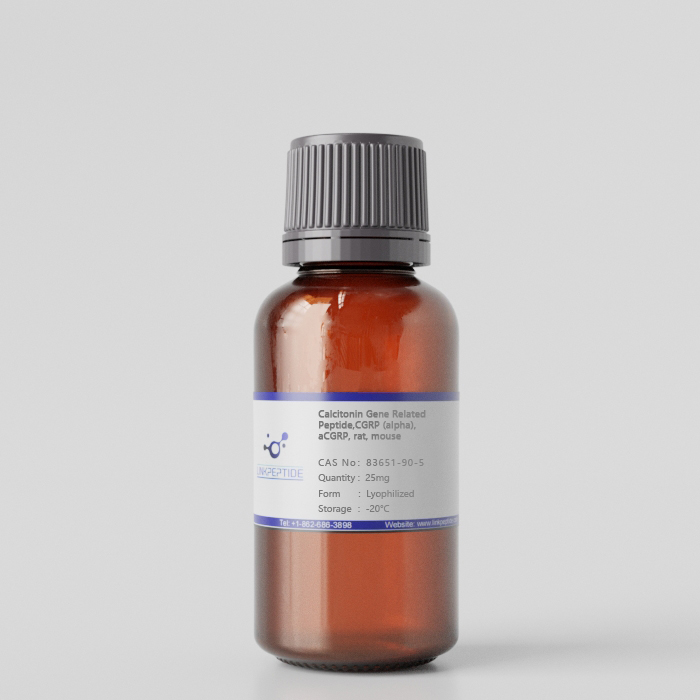
Product Name: Calcitonin Gene Related Peptide,CGRP (alpha), aCGRP, rat, mouse
Sequence One Letter Code: SCNTATCVTHRLAGLLSRSGGVVKDNFVPTNVGSEAF-NH2 (Disulfide bridge: 2-7)
Sequence Three Letter Code: H-Ser-Cys-Asn-Thr-Ala-Thr-Cys-Val-Thr-His-Arg-Leu-Ala-Gly-Leu-Leu-Ser-Arg-Ser-Gly-Gly-Val-Val-Lys-Asp-Asn-Phe-Val-Pro-Thr-Asn-Val-Gly-Ser-Glu-Ala-Phe-NH2 (Disulfide bridge: 2-7)
Cas No: 83651-90-5
Chemical Formula:C162H262N50O52S2
Molecular Weight: 3806.5
Purity: 95%
Form: Lyophilized
Storage Conditions: - 20 °C
Research Area: Cardiovascular Disease Research
SMILES: C[C@H]1C(=O)N[C@H](C(=O)N[C@@H](CSSC[C@@H](C(=O)N[C@H](C(=O)N[C@H](C(=O)N1)[C@@H](C)O)CC(=O)N)NC(=O)[C@H](CO)N)C(=O)N[C@@H](C(C)C)C(=O)N[C@@H]([C@@H](C)O)C(=O)N[C@@H](CC2=CNC=N2)C(=O)N[C@@H](CCCNC(=N)N)C(=O)N[C@@H](CC(C)C)C(=O)N[C@@H](C)C(=O)NCC(=O)N[C@@H](CC(C)C)C(=O)N[C@@H](CC(C)C)C(=O)N[C@@H](CO)C(=O)N[C@@H](CCCNC(=N)N)C(=O)N[C@@H](CO)C(=O)NCC(=O)NCC(=O)N[C@@H](C(C)C)C(=O)N[C@@H](C(C)C)C(=O)N[C@@H](CCCCN)C(=O)N[C@@H](CC(=O)O)C(=O)N[C@@H](CC(=O)N)C(=O)N[C@@H](CC3=CC=CC=C3)C(=O)N[C@@H](C(C)C)C(=O)N4CCC[C@H]4C(=O)N[C@@H]([C@@H](C)O)C(=O)N[C@@H](CC(=O)N)C(=O)N[C@@H](C(C)C)C(=O)NCC(=O)N[C@@H](CO)C(=O)N[C@@H](CCC(=O)O)C(=O)N[C@@H](C)C(=O)N[C@@H](CC5=CC=CC=C5)C(=O)N)[C@@H](C)O
IUPAC: (4S)-4-[[(2S)-2-[[2-[[(2S)-2-[[(2S)-4-amino-2-[[(2S,3R)-2-[[(2S)-1-[(2S)-2-[[(2S)-2-[[(2S)-4-amino-2-[[(2S)-2-[[(2S)-6-amino-2-[[(2S)-2-[[(2S)-2-[[2-[[2-[[(2S)-2-[[(2S)-2-[[(2S)-2-[[(2S)-2-[[(2S)-2-[[2-[[(2S)-2-[[(2S)-2-[[(2S)-2-[[(2S)-2-[[(2S,3R)-2-[[(2S)-2-[[(4R,7S,10S,13S,16S,19R)-19-[[(2S)-2-amino-3-hydroxypropanoyl]amino]-16-(2-amino-2-oxoethyl)-7,13-bis[(1R)-1-hydroxyethyl]-10-methyl-6,9,12,15,18-pentaoxo-1,2-dithia-5,8,11,14,17-pentazacycloicosane-4-carbonyl]amino]-3-methylbutanoyl]amino]-3-hydroxybutanoyl]amino]-3-(1H-imidazol-4-yl)propanoyl]amino]-5-carbamimidamidopentanoyl]amino]-4-methylpentanoyl]amino]propanoyl]amino]acetyl]amino]-4-methylpentanoyl]amino]-4-methylpentanoyl]amino]-3-hydroxypropanoyl]amino]-5-carbamimidamidopentanoyl]amino]-3-hydroxypropanoyl]amino]acetyl]amino]acetyl]amino]-3-methylbutanoyl]amino]-3-methylbutanoyl]amino]hexanoyl]amino]-3-carboxypropanoyl]amino]-4-oxobutanoyl]amino]-3-phenylpropanoyl]amino]-3-methylbutanoyl]pyrrolidine-2-carbonyl]amino]-3-hydroxybutanoyl]amino]-4-oxobutanoyl]amino]-3-methylbutanoyl]amino]acetyl]amino]-3-hydroxypropanoyl]amino]-5-[[(2S)-1-[[(2S)-1-amino-1-oxo-3-phenylpropan-2-yl]amino]-1-oxopropan-2-yl]amino]-5-oxopentanoic acid
INCHIKEY: SVAGNGUJZNLSEY-TYNJZYKVSA-N
INCHI:
InChI=1S/C162H262N50O52S2/c1-71(2)49-95(184-114(225)62-177-129(233)79(17)181-138(242)96(50-72(3)4)191-136(240)91(40-32-46-174-161(169)170)186-141(245)99(54-88-59-173-70-180-88)197-158(262)127(85(23)220)211-155(259)122(77(13)14)205-150(254)108-69-266-265-68-107(201-132(236)89(164)64-213)149(253)195-101(56-111(166)222)146(250)209-124(82(20)217)156(260)183-81(19)131(235)208-125(83(21)218)159(263)202-108)139(243)192-97(51-73(5)6)140(244)200-106(67-216)148(252)187-92(41-33-47-175-162(171)172)137(241)199-104(65-214)133(237)178-60-113(224)176-61-116(227)203-120(75(9)10)154(258)206-121(76(11)12)153(257)189-90(39-30-31-45-163)135(239)196-103(58-118(230)231)143(247)194-100(55-110(165)221)142(246)193-98(53-87-37-28-25-29-38-87)144(248)207-123(78(15)16)160(264)212-48-34-42-109(212)151(255)210-126(84(22)219)157(261)198-102(57-112(167)223)145(249)204-119(74(7)8)152(256)179-63-115(226)185-105(66-215)147(251)188-93(43-44-117(228)229)134(238)182-80(18)130(234)190-94(128(168)232)52-86-35-26-24-27-36-86/h24-29,35-38,59,70-85,89-109,119-127,213-220H,30-34,39-58,60-69,163-164H2,1-23H3,(H2,165,221)(H2,166,222)(H2,167,223)(H2,168,232)(H,173,180)(H,176,224)(H,177,233)(H,178,237)(H,179,256)(H,181,242)(H,182,238)(H,183,260)(H,184,225)(H,185,226)(H,186,245)(H,187,252)(H,188,251)(H,189,257)(H,190,234)(H,191,240)(H,192,243)(H,193,246)(H,194,247)(H,195,253)(H,196,239)(H,197,262)(H,198,261)(H,199,241)(H,200,244)(H,201,236)(H,202,263)(H,203,227)(H,204,249)(H,205,254)(H,206,258)(H,207,248)(H,208,235)(H,209,250)(H,210,255)(H,211,259)(H,228,229)(H,230,231)(H4,169,170,174)(H4,171,172,175)/t79-,80-,81-,82+,83+,84+,85+,89-,90-,91-,92-,93-,94-,95-,96-,97-,98-,99-,100-,101-,102-,103-,104-,105-,106-,107-,108-,109-,119-,120-,121-,122-,123-,124-,125-,126-,127-/m0/s1
Source / Species: rat, mouse
Conjugation: Unconjugated
Code Nacres: NA.26
Application: Calcitonin Gene–Related Peptide (CGRP), α-form, rat/mouse is a sensory neuropeptide involved in neurovascular signaling and cardiovascular regulation in rodent systems. α-CGRP acts as a potent vasodilator through receptor complexes comprising calcitonin receptor-like receptor and RAMP1, promoting cAMP-mediated signaling. In addition to vascular effects, CGRP modulates nociceptive transmission and contributes to neurogenic inflammation. In cardiac tissue, it exerts positive inotropic and chronotropic actions, influencing atrial contractility. This peptide is extensively used in migraine research, pain signaling studies, and cardiovascular physiology investigations. Its species-specific sequence ensures relevance in rodent experimental models designed to evaluate CGRP receptor pharmacology, vascular tone regulation, and sensory neuron function.
Current Research: Calcitonin Gene–Related Peptide (CGRP), α-form, rat/mouse is a synthetic neuropeptide corresponding to the endogenous rodent α-CGRP sequence. CGRP is a 37–amino acid sensory neuropeptide derived from alternative splicing of the calcitonin gene and is abundantly expressed in peripheral and central sensory neurons. In rodent systems, α-CGRP plays a central role in neurovascular regulation, nociceptive transmission, and cardiovascular function. The species-specific rat/mouse sequence ensures accurate receptor engagement and pharmacological relevance in rodent in vivo and ex vivo experimental models. Receptor Signaling and Molecular Mechanism α-CGRP exerts its biological effects through receptor complexes composed of the calcitonin receptor-like receptor (CLR) in association with receptor activity–modifying protein 1 (RAMP1). This heterodimeric receptor complex confers ligand specificity and initiates primarily G_s-coupled signaling pathways. Upon ligand binding, adenylyl cyclase activation increases intracellular cAMP levels, leading to protein kinase A (PKA) activation and downstream phosphorylation cascades. Beyond canonical cAMP signaling, CGRP receptor activation can influence nitric oxide production, MAPK pathway engagement, and modulation of ion channel activity in sensory neurons and vascular smooth muscle cells. These integrated signaling pathways underlie CGRP’s potent vasodilatory and neuromodulatory properties. Neurovascular and Vasodilatory Functions CGRP is among the most potent endogenous vasodilators identified in mammalian systems. Released from perivascular sensory nerve terminals, it relaxes vascular smooth muscle through cAMP-dependent mechanisms and nitric oxide–related signaling. In rodent vascular preparations, CGRP induces concentration-dependent vasodilation in arteries and resistance vessels, contributing to blood flow regulation and hemodynamic homeostasis. Because of its central role in neurovascular coupling, CGRP is extensively studied in models of migraine and neurogenic inflammation. Elevated CGRP levels are associated with migraine pathophysiology, and CGRP receptor antagonists represent a major therapeutic class in migraine treatment. Rodent α-CGRP is therefore critical for evaluating receptor pharmacology and antagonist efficacy in preclinical models. Nociception and Neurogenic Inflammation In sensory neurons, CGRP modulates pain signaling by influencing synaptic transmission and peripheral sensitization. It is co-released with substance P from nociceptive fibers, contributing to vasodilation, plasma extravasation, and inflammatory mediator recruitment. Studies in rodent pain models employ α-CGRP to investigate: Peripheral and central nociceptive pathways Sensory neuron excitability Neurogenic inflammation mechanisms Interactions with TRPV1 and other ion channels Its defined sequence and receptor specificity allow precise interrogation of CGRP-dependent signaling in sensory systems. Cardiovascular and Cardiac Effects Beyond vascular tone regulation, CGRP exerts positive inotropic and chronotropic effects in rodent cardiac tissue. It influences atrial contractility and may contribute to cardioprotective signaling under stress conditions. Experimental applications include isolated heart preparations, atrial strip contractility assays, and studies of myocardial signaling pathways. Recent research also explores CGRP’s role in hypertension, ischemia-reperfusion injury, and heart failure models, where it may act as a compensatory vasodilatory mediator. Applications in Research CGRP, α-form, rat/mouse is widely used in: Vascular reactivity and myography assays Migraine and headache research models Pain and sensory neuron signaling studies cAMP signaling assays Cardiac contractility experiments CGRP receptor antagonist evaluation Because ligand–receptor interactions can exhibit species-dependent differences, use of the rat/mouse sequence ensures accurate pharmacological characterization in rodent experimental systems. Experimental Advantages Species-specific sequence for rodent studies Potent and reproducible vasodilatory activity Defined receptor interaction with CLR/RAMP1 complexes Suitable for in vitro, ex vivo, and in vivo applications Compatible with GPCR signaling and pharmacology assays Research Significance α-CGRP remains a central molecule in neurovascular biology, migraine pathophysiology, and cardiovascular regulation research. Its robust cAMP-mediated signaling and potent vasoactive properties make it a foundational tool for dissecting sensory neuron function, vascular tone modulation, and receptor pharmacology. As therapeutic targeting of the CGRP pathway continues to expand, this peptide provides a critical experimental reagent for translational investigations in rodent models of pain, inflammation, and cardiovascular disease.
Get a Quote
 LinkPeptide

![[Pyr1]-Apelin-13](https://www.linkpeptide.com/wp-content/uploads/2024/10/Pyr1-Apelin-13-jpg-3.webp "[Pyr1]-Apelin-13")