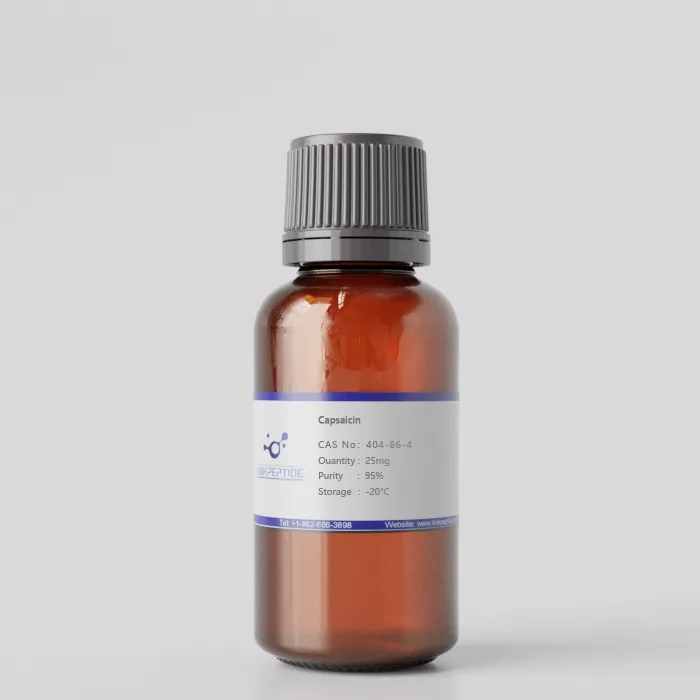
Product Name: Capsaicin
Cas No: 404-86-4
Purity: 95%
Storage: Keep in dark and cool dry place -5~8 degree Celsius
Molar Mass: 305.4
Chemical Formula: C18H27NO3
Synonyms: Zostrix; CAPSAICINE; Qutenza; Axsain
IUPAC Name: (E)-N-[(4-hydroxy-3-methoxyphenyl)methyl]-8-methylnon-6-enamide
SMILES: CC(C)/C=C/CCCCC(=O)NCC1=CC(=C(C=C1)O)OC
InChIKey: YKPUWZUDDOIDPM-SOFGYWHQSA-N
InChI: InChI=1S/C18H27NO3/c1-14(2)8-6-4-5-7-9-18(21)19-13-15-10-11-16(20)17(12-15)22-3/h6,8,10-12,14,20H,4-5,7,9,13H2,1-3H3,(H,19,21)/b8-6+
Application:
Capsaicin is a bioactive compound derived from chili peppers, valued in cosmetic research for its warming, stimulating, and microcirculation-boosting properties. Known for activating TRPV1 receptors, it helps promote a gentle warming sensation that supports studies on improved skin vitality, enhanced nutrient delivery, and a more radiant appearance. In slimming and body-care applications, capsaicin is frequently used to explore its role in improving surface firmness and refining skin tone. Its potent activity makes it suitable for low-dose incorporation into targeted treatments, serums, and warming formulas designed to energize the skin and promote a revitalized, healthier-looking complexion.
Current Research:
Capsaicin: Research Overview
Capsaicin (trans-8-methyl-N-vanillyl-6-nonenamide) is a naturally occurring vanilloid compound found in Capsicum species. It is the primary agonist of the transient receptor potential vanilloid 1 (TRPV1) ion channel, a non-selective cation channel expressed in sensory neurons, keratinocytes, immune cells, and vascular endothelial cells. Research on capsaicin focuses on its neuro-sensory effects, vasomodulation, keratinocyte signaling, inflammation pathways, and controlled nociception, all of which are relevant to topical and cosmetic sciences.
Capsaicin binds to the intracellular domain of TRPV1, inducing channel opening and allowing influx of calcium and sodium ions. Activation of TRPV1 leads to depolarization of sensory neurons and release of neuropeptides such as substance P, calcitonin gene-related peptide (CGRP), and neurokinin A. These mediators participate in neurogenic inflammation, transient discomfort, vasodilation, and increased cutaneous blood flow.
Repeated or sustained exposure results in defunctionalization of TRPV1-expressing sensory fibers, characterized by reduced neuropeptide release and diminished responsiveness to subsequent stimuli. This biphasic effect—initial excitation followed by desensitization—is central to capsaicin’s biological role and its applicability in skin research.
Keratinocytes express functional TRPV1 channels, making them direct targets of topical capsaicin. TRPV1 activation in keratinocytes influences several pathways:
Calcium-mediated signaling cascades regulating differentiation markers.
Modulation of cytokine expression, including IL-1α, IL-6, and TNF-α in dose-dependent patterns.
Influence on epidermal barrier-related proteins, including filaggrin and involucrin, in experimental models.
Research also notes increased production of prostaglandins and nitric oxide following capsaicin exposure, contributing to localized vasodilation.
Topical capsaicin causes transient vasodilation through neuropeptide release from sensory afferents. Experimental studies document increases in cutaneous blood flow, erythema, and local temperature within minutes of exposure. After repeated application, microcirculatory responses decrease, consistent with sensory-fiber desensitization.
These effects make capsaicin a tool compound in skin-physiology research, particularly for studying neurovascular coupling, microcirculation dynamics, and controlled stimulation of sensory pathways.
While capsaicin initially induces pro-inflammatory signaling, prolonged or repeated exposure leads to down-regulation of inflammatory mediator production. Sensory-fiber defunctionalization reduces release of substance P and CGRP, yielding an overall anti-inflammatory outcome in chronic exposure models.
This dual behavior is leveraged in dermatological research to study mechanisms of:
neurogenic inflammation
chronic inflammation linked to sensory neuron hyperactivity
cross-talk between the nervous and immune systems
Capsaicin-induced desensitization forms the basis of its analgesic properties. Desensitization involves:
depletion of neuropeptide stores
reversible retraction of sensory nerve endings
reduced responsiveness to thermal and mechanical stimuli
These processes are widely used in neuroscience and dermatology as models of nociceptor function, nerve plasticity, and peripheral sensitization.
Controlled exposure to low concentrations of capsaicin has been investigated for its effects on epidermal turnover and barrier integrity. TRPV1 stimulation influences keratinocyte proliferation rates and impacts lipid synthesis pathways. Some experimental models suggest mild increases in exfoliation or stratum corneum turnover due to elevated calcium signaling.
Capsaicin also modulates barrier recovery after disruption, although the effects vary depending on dose, duration, and skin model.
In cosmetic research, capsaicin is primarily studied for:
Warmth-inducing and stimulating effects through neurovascular activation.
Lip-plumping mechanisms involving increased microcirculation and transient swelling.
Scalp and hair-follicle microcirculation enhancement, investigated in hair-biology studies.
Sensory modulation, contributing to warming or tingling sensations in topical products.
These applications rely on capsaicin’s ability to trigger short-term vasodilation followed by reduced sensory activity with repeated exposure.
Capsaicin is a hydrophobic compound with limited water solubility and is typically incorporated into lipid carriers, emulsions, or encapsulated delivery systems to control release and reduce irritation. It remains stable under neutral to slightly acidic pH and is sensitive to oxidation and elevated temperatures. Formulation research emphasizes creating delivery systems that modulate the initial TRPV1 activation peak to enhance tolerability.
Get a Quote
 LinkPeptide