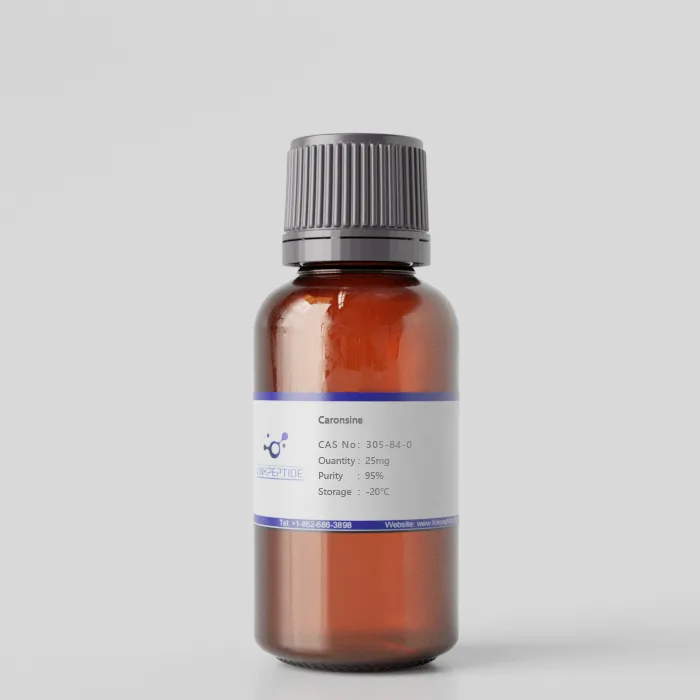
Product Name: Caronsine
Cas No: 305-84-0
Purity: 95%
Storage: Keep in dark and cool dry place -5~8 degree Celsius
Sequence: beta-AIa-His
Molar Mass: 226.23
Chemical Formula: C9H14N4O3
Synonyms: beta-Alanyl-L-histidine; Ignotine; Karnozin; Karnozzn
IUPAC Name: (2S)-2-(3-aminopropanoylamino)-3-(1H-imidazol-5-yl)propanoic acid
SMILES: C1=C(NC=N1)C[C@@H](C(=O)O)NC(=O)CCN
InChIKey: CQOVPNPJLQNMDC-ZETCQYMHSA-N
InChI: InChI=1S/C9H14N4O3/c10-2-1-8(14)13-7(9(15)16)3-6-4-11-5-12-6/h4-5,7H,1-3,10H2,(H,11,12)(H,13,14)(H,15,16)/t7-/m0/s1
Application:
Carnosine is a naturally occurring dipeptide composed of β-alanine and L-histidine, valued in cosmetic research for its strong antioxidant and anti-glycation properties. Known for helping protect skin proteins from sugar-induced damage, Carnosine supports studies focused on improving firmness, elasticity, and overall youthfulness. It also helps defend against oxidative stress, making it ideal for formulations targeting dullness, fine lines, and early signs of aging. With excellent water solubility and broad compatibility, Carnosine is widely used in serums, anti-aging creams, and revitalizing treatments designed to promote smoother texture and a brighter, healthier-looking complexion.
Current Research:
Carnosine: Research Overview
Carnosine (β-alanyl-L-histidine) is an endogenous dipeptide composed of β-alanine and histidine, concentrated in excitable tissues such as muscle and brain. In skin-science research, carnosine is investigated for its anti-glycation, antioxidant, pH-buffering, and cell-protective properties. Its multifunctional biochemical activity makes it a significant molecule in studies of cellular aging, protein modification, and environmental stress responses.
Carnosine contains an imidazole ring (from histidine) and a β-alanine moiety that give the molecule both nucleophilic and buffering capacities. The imidazole ring is responsible for:
strong metal-ion chelation, particularly copper and zinc
scavenging of reactive carbonyl species (RCS)
quenching of reactive oxygen species (ROS) in oxidative environments
This combination of chemical attributes supports the dipeptide’s ability to neutralize damaging species generated during metabolic stress, UV exposure, and pollution.
The most studied property of carnosine in skin research is its ability to inhibit protein glycation. Glycation is a non-enzymatic reaction between reducing sugars or carbonyl compounds and amino groups on proteins, leading to the formation of advanced glycation end products (AGEs). AGEs accumulate in the dermal matrix, affecting collagen flexibility, mechanical strength, and the uniformity of the extracellular matrix.
Carnosine acts as a carbonyl scavenger, reacting with α-dicarbonyls such as methylglyoxal. By doing so, it reduces the availability of carbonyl groups that would otherwise modify long-lived dermal proteins. Cell culture work shows that carnosine can slow AGE accumulation, preserve collagen organization, and reduce AGE-mediated crosslinking. Because glycation accelerates with UV exposure and oxidative stress, carnosine’s dual anti-glycation and antioxidant profile is particularly relevant to studies of photoaging.
Carnosine exhibits indirect antioxidant activity through several mechanisms:
quenching singlet oxygen
binding pro-oxidant metal ions
reducing lipid peroxidation products
neutralizing reactive aldehydes generated during oxidative stress
Metal chelation is especially noteworthy. Transition metal ions catalyze Fenton-type reactions that generate damaging hydroxyl radicals. Carnosine binds these ions and reduces their catalytic availability, therefore limiting oxidative chain reactions in proteins and lipids.
Research on keratinocytes and fibroblasts identifies additional protective activities:
modulation of heat-shock protein expression
stabilization of cellular proteins under stress
reduction of carbonyl stress–induced apoptosis
maintenance of mitochondrial membrane potential under oxidative load
These effects link carnosine to anti-senescence pathways, as carbonyl stress and mitochondrial dysfunction are major drivers of cellular aging. Fibroblast studies show that carnosine-treated cells maintain greater metabolic activity and structural protein synthesis under oxidative challenge.
By lowering AGE formation, carnosine indirectly preserves collagen structure and mechanical compliance. AGE accumulation stiffens collagen fibrils, reduces elastic recoil, and alters matrix hydration. In vitro work demonstrates that carnosine exposure leads to:
improved collagen fibril organization
reduced matrix stiffening
higher levels of soluble, functional collagen
better resistance to crosslink-induced deformation
These findings relate to improved biomechanical properties at the dermal level in skin-model systems.
Carnosine has been studied for effects on barrier cohesion and inflammatory signaling. Observed findings include:
improved recovery after barrier disruption due to reduced oxidative and glycation stress
lowered expression of pro-inflammatory cytokines in stress-exposed keratinocytes
stabilization of membrane lipids against peroxidation
These observations align with the broader theme of carnosine as a cytoprotective dipeptide that maintains homeostatic conditions in the epidermal environment.
Carnosine is hydrophilic and water-soluble. However, its topical diffusion may be limited due to rapid enzymatic degradation by carnosinase in human tissues. Research formulations often explore strategies to:
inhibit carnosinase activity
increase peptide stability
incorporate carnosine into liposomal or encapsulated forms
These approaches aim to preserve bioactive concentration in the viable epidermis or superficial dermis.
Get a Quote
 LinkPeptide