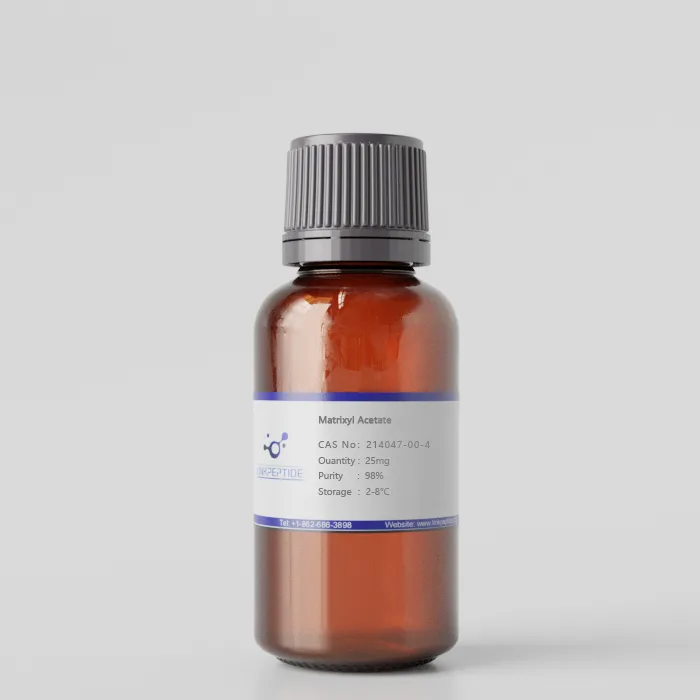
Product Name:Matrixyl Acetate
Form:Acetate salt
Purity:98%
Storage:2-8 degree Celsius
Cas No:214047-00-4
Molar Mass:802
Chemical Formula:C39H75N7O10
Synonyms:Palmitoyl Pentapeptide-4
IUPAC Name:(2S)-2-[[(2S)-6-amino-2-[[(2S,3R)-2-[[(2S,3R)-2-[[(2S)-6-amino-2-(hexadecanoylamino)hexanoyl]amino]-3-hydroxybutanoyl]amino]-3-hydroxybutanoyl]amino]hexanoyl]amino]-3-hydroxypropanoic acid
SMILES:CCCCCCCCCCCCCCCC(=O)N[C@@H](CCCCN)C(=O)N[C@@H]([C@@H](C)O)C(=O)N[C@@H]([C@@H](C)O)C(=O)N[C@@H](CCCCN)C(=O)N[C@@H](CO)C(=O)O
InChIKey:WSGCRSMLXFHGRM-DEVHWETNSA-N
InChI:InChI=1S/C39H75N7O10/c1-4-5-6-7-8-9-10-11-12-13-14-15-16-23-32(50)42-29(21-17-19-24-40)36(52)45-34(28(3)49)38(54)46-33(27(2)48)37(53)43-30(22-18-20-25-41)35(51)44-31(26-47)39(55)56/h27-31,33-34,47-49H,4-26,40-41H2,1-3H3,(H,42,50)(H,43,53)(H,44,51)(H,45,52)(H,46,54)(H,55,56)/t27-,28-,29+,30+,31+,33+,34+/m1/s1
Sequence:KTTKS
Application:
Matrixyl Acetate, also known as Palmitoyl Pentapeptide-4, is a synthetic peptide celebrated for its anti-aging properties. This compound consists of a sequence of five amino acids—lysine (Lys), threonine (Thr), threonine (Thr), lysine (Lys), and serine (Ser)—conjugated with a palmitic acid molecule, enhancing its lipophilicity and facilitating deeper skin penetration. By mimicking natural skin matrikines, Matrixyl Acetate stimulates the synthesis of collagen types I, III, and IV, as well as fibronectin and glycosaminoglycans, essential components for maintaining skin's structural integrity. Regular application leads to improved skin elasticity, reduced wrinkle depth, and enhanced hydration, making it a popular ingredient in anti-aging creams, serums, and lotions.
Current Research:
Matrixyl Acetate, scientifically known as Palmitoyl Pentapeptide-4, has been extensively studied for its potential in skin rejuvenation and anti-aging. As a lipopeptide, it combines a specific pentapeptide sequence with palmitic acid, enhancing its stability and skin penetration capabilities.
Mechanism of Action: Stimulation of Extracellular Matrix Components
Matrixyl Acetate functions by mimicking fragments of the extracellular matrix (ECM), particularly those involved in skin repair and remodeling. This structural analogy enables it to:
Stimulate Fibroblast Activity: Encourages fibroblasts to produce essential ECM components, including collagen types I, III, and IV, fibronectin, and glycosaminoglycans, which are vital for skin firmness and elasticity.
Enhance Hyaluronic Acid Production: Promotes the synthesis of hyaluronic acid, improving skin hydration and volume.
Collectively, these actions contribute to a more resilient and youthful skin appearance.
Clinical Studies and Efficacy
Several studies have investigated the efficacy of Matrixyl Acetate:
Collagen and Hyaluronic Acid Stimulation: Research indicates that Matrixyl Acetate can penetrate the stratum corneum and enhance collagen I production by fibroblasts in vitro. It also significantly increases procollagen production and regulates hyaluronic acid synthesis by human fibroblasts in vitro.
Reduction in Wrinkle Depth: Clinical evaluations have demonstrated that formulations containing Matrixyl Acetate lead to a significant reduction in wrinkle depth and volume, resulting in smoother and more youthful-looking skin.
Improvement in Skin Elasticity and Hydration: Regular application has been associated with enhanced skin elasticity and hydration, contributing to an overall improvement in skin appearance.
Comparison with Other Peptides
Matrixyl Acetate is often compared to other peptides like Palmitoyl Tripeptide-1 and Palmitoyl Tetrapeptide-7. While all these peptides aim to stimulate collagen production, Matrixyl Acetate uniquely mimics ECM fragments, providing targeted stimulation of collagen and ECM synthesis. This specificity may result in more pronounced improvements in skin elasticity and firmness.
Future Research and Applications
Ongoing research is exploring the broader applications of Matrixyl Acetate:
Wound Healing: Its ability to promote ECM production positions it as a potential agent in enhancing wound healing processes.
Combination Therapies: Investigating synergistic effects when combined with other peptides or active ingredients could lead to more effective anti-aging formulations.
Advanced Delivery Systems: Developing novel delivery mechanisms, such as encapsulation in liposomes or nanoparticles, may further enhance its stability and penetration, maximizing therapeutic outcomes.
In conclusion, Matrixyl Acetate stands as a promising ingredient in cosmetic and dermatological applications, offering multifaceted benefits in skin rejuvenation and anti-aging. Continued research and development are likely to expand its applications and efficacy in skincare formulations.
Reference:
Get a Quote
 LinkPeptide