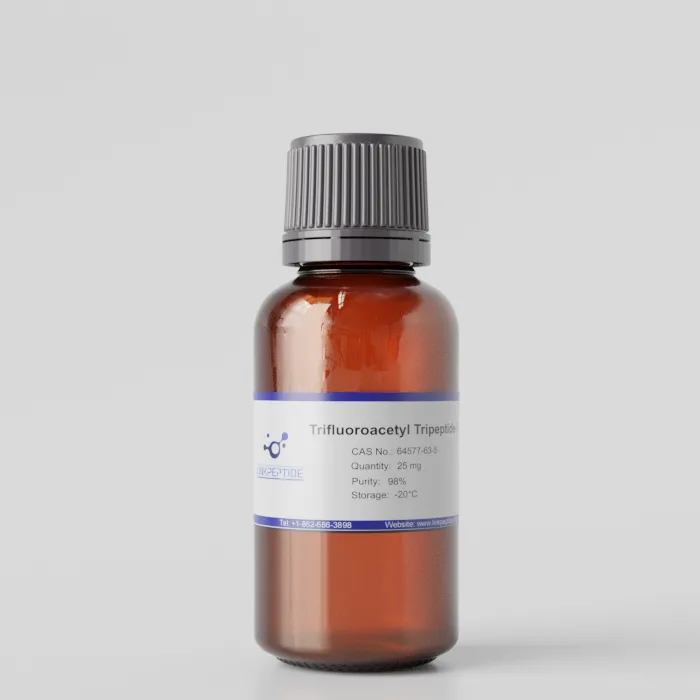
Product Name: Trifluoroacetyl Tripeptide-2
Cas No: 64577-63-5
Purity: 98%
Form: Free Base
Chemical Formula: C21H28F3N3O6
Molar Mass: 475.54
Synonyms: Ecm-protect; N-(2,2,2-Trifluoroacetyl)-L-valyl-L-tyrosyl-L-valine; E6WT9V3SGO
IUPAC Name: (2S)-2-[[(2S)-3-(4-hydroxyphenyl)-2-[[(2S)-3-methyl-2-[(2,2,2-trifluoroacetyl)amino]butanoyl]amino]propanoyl]amino]-3-methylbutanoic acid
SMILES: CC(C)C@@HO)C(=O)NC@@HC(=O)O)NC(=O)C(F)(F)F
InChIKey: SAVSLMGBKQKUAV-JYJNAYRXSA-N
InChI: InChI=1S/C21H28F3N3O6/c1-10(2)15(27-20(33)21(22,23)24)18(30)25-14(9-12-5-7-13(28)8-6-12)17(29)26-16(11(3)4)19(31)32/h5-8,10-11,14-16,28H,9H2,1-4H3,(H,25,30)(H,26,29)(H,27,33)(H,31,32)/t14-,15-,16-/m0/s1
Storage: -20 degree Celsius
Sequence: VYV
Application:
Trifluoroacetyl Tripeptide-2 (TFA-VYV) is an advanced anti-aging peptide developed to address visible skin sagging and loss of firmness. Known commercially as Progeline邃「, it targets factors associated with accelerated aging, promoting a more lifted, sculpted facial contour. This tripeptide helps reduce the appearance of wrinkles while improving elasticity for a smoother, tighter complexion. Its fast-acting, high-efficacy profile makes it a popular choice in premium serums, firming creams, and neck-care products. With excellent compatibility across emulsions and high-performance formulas, Trifluoroacetyl Tripeptide-2 provides formulators with a powerful tool for next-generation tightening and contour-refining skincare.
Current Research:
Trifluoroacetyl Tripeptide-2 (Progeline) – Current Research Overview
Trifluoroacetyl Tripeptide-2 is a synthetic biomimetic peptide widely used in advanced anti-aging and firming skincare. Chemically, it is the tripeptide TFA-Val-Tyr-Val-OH, with a trifluoroacetyl group on the N-terminus that improves stability and bioactivity. Often marketed under the trade name Progeline, this peptide is designed as an elafin-mimetic elastase and matrix metalloproteinase (MMP) modulator that also targets progerin, a key biomarker of cellular senescence. Current research positions Trifluoroacetyl Tripeptide-2 as a multi-pathway anti-aging active that addresses sagging, contour loss, and wrinkles by acting on both extracellular matrix (ECM) remodeling and senescence-related pathways.
The conceptual starting point for Trifluoroacetyl Tripeptide-2 is elafin, an endogenous protein that inhibits elastase and protects elastic fibers from degradation. By designing a short tripeptide with similar functional motifs but improved cosmetic suitability, researchers created a small, stable molecule capable of downregulating elastase and certain collagen-degrading MMPs. The addition of the trifluoroacetyl group enhances lipophilicity and interaction with biological targets, giving the peptide better stability and dermal penetration in topical formulations.
Beyond protease modulation, Trifluoroacetyl Tripeptide-2 was specifically developed to influence progerin, an abnormal, truncated form of lamin A associated with cellular aging and the rare genetic disease Hutchinson–Gilford progeria syndrome. Progerin also accumulates in normal skin with age and UV exposure, making it a meaningful marker for skin senescence.
In vitro studies on normal human fibroblasts show that Trifluoroacetyl Tripeptide-2 can reduce progerin synthesis, leading to a more youthful nuclear architecture and improved cellular homeostasis. By lowering this senescence-associated protein, the peptide helps delay the onset of aging-related dysfunctions such as altered gene expression, impaired ECM production, and chronic low-grade inflammation.
Some experimental and marketing-focused reports also describe modulation of “longevity proteins” and improved expression of structural proteins to levels seen in younger cells. While these claims are often based on supplier data, they fit with the broader view of Trifluoroacetyl Tripeptide-2 as an anti-senescence peptide rather than a simple ECM stimulant.
A major research theme is the peptide’s dual impact on ECM degradation and synthesis:
It has been shown to inhibit elastase and MMP-1, key enzymes responsible for breaking down elastin and collagen.
At the same time, it stimulates the expression of structural proteins such as collagen and elastin and increases levels of proteoglycans (for example syndecans), which are crucial for matrix organization and mechanical resilience.
This combination – reducing breakdown while supporting new synthesis – promotes a firmer, denser dermal matrix. In collagen gel contraction models, Trifluoroacetyl Tripeptide-2 enhances fibroblast-mediated contraction, suggesting stronger matrix tension and improved structural support. This mechanistic profile underpins its use in products aimed at treating skin slackness, jowling, and loss of facial contour.
Supplier-sponsored clinical studies have evaluated creams containing Trifluoroacetyl Tripeptide-2, often at around 2% active. In these trials, measurements with devices such as cutometers, profilometry, and image analysis report:
Improved skin firmness and elasticity, with increases of roughly 15–20% in selected parameters after four weeks of use.
Reduction in sagging and improved jawline definition, sometimes described as up to about 10% “lift” in the jawline area over eight weeks in split-face or full-face studies.
Visible wrinkle reduction, particularly in nasolabial folds and lower-face lines associated with gravitational aging.
Participants typically report enhanced tightness, better facial contour, and a more youthful appearance, creating a strong clinical and perceptual basis for “anti-sagging,” “face remodeling,” and “V-shape” marketing claims.
More recent technical summaries suggest that Trifluoroacetyl Tripeptide-2 may also influence oxidative stress responses and cell signaling. Reported findings include increased activity of endogenous antioxidant enzymes and modulation of pathways such as TGF-β that govern ECM production and repair. By affecting both protease activity and signaling cascades, the peptide contributes to a more comprehensive anti-aging environment – preserving collagen and elastin, supporting proteoglycan networks, and helping cells better resist environmental stressors.
Trifluoroacetyl Tripeptide-2 is generally used in low concentrations, often between 0.001–0.01% in finished formulations, reflecting its high potency. Technical datasheets describe it as insoluble in water but compatible with typical cosmetic emulsions and recommend incorporation during the cool-down phase, below about 40 °C, at pH values in the range of 5–7. Safety testing indicates a good tolerability profile, with no significant irritation or sensitization at cosmetic use levels in leave-on products.
Because of its specific anti-sagging and contour-focused activity, Trifluoroacetyl Tripeptide-2 is particularly favored in:
Firming and “lifting” face creams
Neck and jawline remodeling products
High-end anti-aging serums targeting mature or photoaged skin
Ongoing research on Trifluoroacetyl Tripeptide-2 explores combinations with other peptides, retinoid-like ingredients, and advanced delivery systems to amplify its anti-senescence and ECM-protective effects while maintaining comfort and safety. As interest grows in targeting fundamental aging mechanisms such as progerin accumulation, this peptide is likely to remain a central reference point for next-generation contouring and anti-sagging skincare technologies.
Reference:
Get a Quote
 LinkPeptide