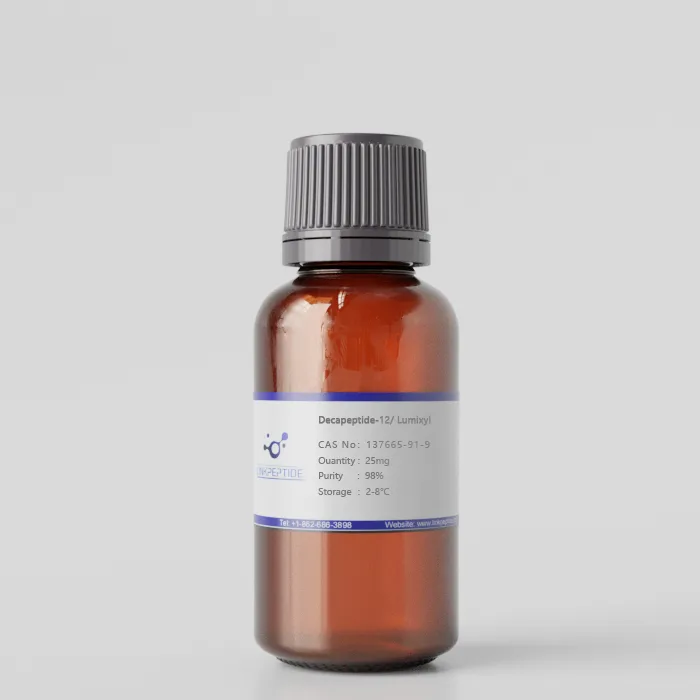
Product Name:Decapeptide-12/ Lumixyl
Form:Acetate salt
Purity:98%
Storage:2-8 degree Celsius
Cas No:137665-91-9
Molar Mass:1395.55
Chemical Formula:C65H90N18O17
Synonyms:DA-52389
IUPAC Name: 2-[[2-[[2-[[2-[[2-[[6-amino-2-[[2-[[2-[[2-[[2-amino-3-(4-hydroxyphenyl)propanoyl]amino]-5-(diaminomethylideneamino)pentanoyl]amino]-3-hydroxypropanoyl]amino]-5-(diaminomethylideneamino)pentanoyl]amino]hexanoyl]amino]-3-(4-hydroxyphenyl)propanoyl]amino]-3-hydroxypropanoyl]amino]-3-hydroxypropanoyl]amino]-3-(1H-indol-3-yl)propanoyl]amino]-3-(4-hydroxyphenyl)propanoic acid
SMILES:C1=CC=C2C(=C1)C(=CN2)CC(C(=O)NC(CC3=CC=C(C=C3)O)C(=O)O)NC(=O)C(CO)NC(=O)C(CO)NC(=O)C(CC4=CC=C(C=C4)O)NC(=O)C(CCCCN)NC(=O)C(CCCN=C(N)N)NC(=O)C(CO)NC(=O)C(CCCN=C(N)N)NC(=O)C(CC5=CC=C(C=C5)O)N
InChIKey:OYVFAMLECFSFEI-UHFFFAOYSA-N
InChI:InChI=1S/C65H90N18O17/c66-24-4-3-9-45(76-55(91)47(11-6-26-73-65(70)71)77-60(96)51(32-84)81-57(93)46(10-5-25-72-64(68)69)75-54(90)43(67)27-35-12-18-39(87)19-13-35)56(92)78-48(28-36-14-20-40(88)21-15-36)58(94)82-53(34-86)62(98)83-52(33-85)61(97)79-49(30-38-31-74-44-8-2-1-7-42(38)44)59(95)80-50(63(99)100)29-37-16-22-41(89)23-17-37/h1-2,7-8,12-23,31,43,45-53,74,84-89H,3-6,9-11,24-30,32-34,66-67H2,(H,75,90)(H,76,91)(H,77,96)(H,78,92)(H,79,97)(H,80,95)(H,81,93)(H,82,94)(H,83,98)(H,99,100)(H4,68,69,72)(H4,70,71,73)
Application:Decapeptide-12, commercially known as Lumixyl, is a skin-brightening peptide designed to reduce hyperpigmentation and improve skin tone. It works by inhibiting tyrosinase, the key enzyme responsible for melanin production, making it an effective alternative to hydroquinone. Clinical studies have shown that Decapeptide-12 can significantly lighten dark spots, melasma, and post-inflammatory hyperpigmentation (PIH) while being non-irritating and safe for all skin types. Unlike harsh depigmenting agents, Lumixyl provides gradual, even skin brightening without cytotoxic effects. It is commonly used in serums, brightening creams, and medical-grade skincare formulations to promote radiant, even-toned skin with continued use.
Current Research:Decapeptide-12, also known as Lumixyl, is a synthetic peptide that has been extensively studied for its skin-brightening and anti-hyperpigmentation properties. Unlike traditional depigmenting agents such as hydroquinone, Decapeptide-12 works gently yet effectively to inhibit melanin production without causing irritation, redness, or skin damage. Mechanism of Action in Skin Brightening Decapeptide-12 works by inhibiting tyrosinase, the enzyme responsible for catalyzing melanin production in melanocytes. Tyrosinase inhibition prevents the formation of excess melanin, leading to a gradual reduction in dark spots, age spots, and melasma. A study conducted at Stanford University demonstrated that Decapeptide-12 is 17 times more effective at inhibiting tyrosinase than hydroquinone, making it a highly potent yet safer alternative. Unlike hydroquinone, which may cause skin irritation, rebound pigmentation, and potential cytotoxic effects, Decapeptide-12 lightens skin evenly without causing damage to melanocytes, making it suitable for long-term use and for individuals with sensitive skin. Clinical Studies and Efficacy Several clinical trials have evaluated the effectiveness of Decapeptide-12 in treating melasma, post-inflammatory hyperpigmentation (PIH), and age-related dark spots. A 12-week clinical study found that topical application of Lumixyl led to a 50% reduction in hyperpigmentation, with visible improvement in skin brightness and evenness after just 8 weeks. Unlike hydroquinone, which has been associated with skin irritation and potential carcinogenic concerns, Decapeptide-12 has demonstrated a high safety profile, making it ideal for long-term use in treating persistent pigmentation issues. Comparison with Other Skin Brightening Agents Decapeptide-12 is often compared with hydroquinone, kojic acid, and arbutin, which are common skin-lightening agents. While hydroquinone is a stronger depigmenting agent, it can cause irritation, ochronosis, and cytotoxic effects with prolonged use. In contrast, Decapeptide-12 provides gradual, safe, and long-lasting skin tone correction. Additionally, unlike kojic acid and arbutin, which may cause sensitivity to UV radiation, Decapeptide-12 can be used daily without increasing sun sensitivity, making it a preferred option for individuals undergoing continuous hyperpigmentation treatment. Future Research and Applications Ongoing studies are exploring Decapeptide-12 in combination with other brightening agents like niacinamide, vitamin C, and tranexamic acid to enhance its depigmenting effects. Researchers are also investigating nano-encapsulation and delivery systems to increase peptide stability and absorption in skincare formulations. With its clinically proven ability to inhibit tyrosinase, reduce hyperpigmentation, and brighten skin safely, Decapeptide-12 (Lumixyl) is a leading innovation in skin tone correction, particularly in medical-grade and dermatological skincare formulations.
Reference:
Get a Quote
 LinkPeptide