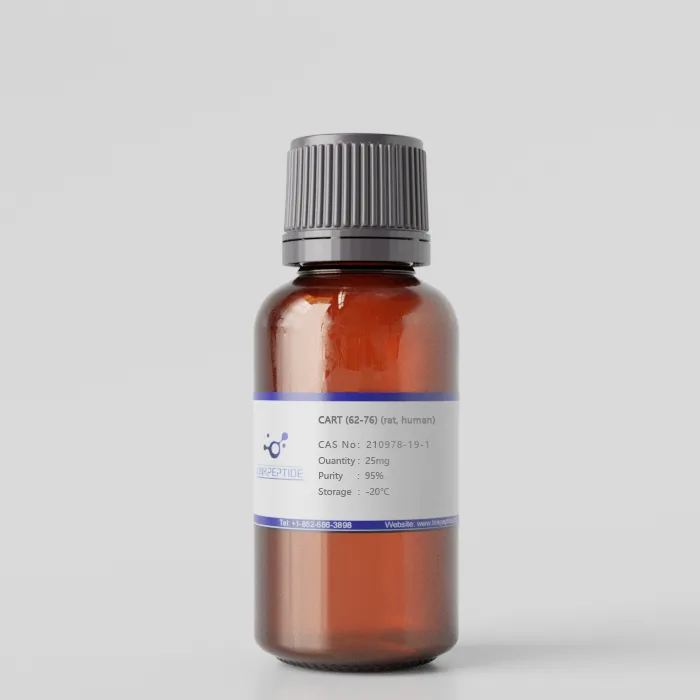
Product Name:CART (62-76) (rat, human)
CAS No:210978-19-1
Purity:95%
Molar Mass:1570.77
Chemical Formula:C64H99N17O23S3
Storage:Store at -20 degrees Celsius
Sequence:YGQVPMCDAGEQCAV
Application:
CART (62-76) refers to a peptide fragment derived from the cocaine- and amphetamine-regulated transcript (CART) protein, encompassing residues 62 to 76. This peptide is known to be involved in the regulation of appetite, energy balance, and stress responses. In both rats and humans, CART (62-76) has been studied for its role in neurotransmission and its potential impact on feeding behavior and metabolism. It is often used in research to explore the physiological effects of CART signaling and its implications in disorders such as obesity, addiction, and stress-related conditions.
Current Research:
Cocaine- and amphetamine-regulated transcript (CART) (62-76), a biologically active fragment of the CART neuropeptide family, has become a focus of interest in neuroscience due to its regulatory roles in feeding behavior, stress responses, and emotional regulation. This fragment, corresponding to residues 62-76 of the full-length peptide, exhibits distinct biological activities in both rats and humans. Biological Activity CART (62-76) has shown anorexigenic properties, making it a critical regulator of feeding behavior. Studies indicate that it suppresses neuropeptide Y (NPY)-induced hyperphagia and reduces food intake in fasting animal models without affecting locomotor activity. This specificity makes CART (62-76) a promising target for obesity-related research. Furthermore, CART (62-76) exhibits anxiogenic-like effects in rodent models, decreasing exploratory behavior in the elevated plus-maze test. These findings suggest its role in modulating emotional states. In addition to behavioral effects, CART (62-76) influences monoaminergic systems. It regulates noradrenergic activity in the striatum and serotoninergic pathways in the cortex and hypothalamus, key areas involved in stress and emotional processing. However, it appears to have minimal effects on dopaminergic pathways, highlighting its selective impact on neurotransmitter systems. Research Applications CART (62-76) is extensively used in studying the molecular mechanisms underlying feeding behavior, stress response, and emotional regulation. Its selective modulation of monoaminergic systems has been pivotal in understanding the interplay between neuropeptides and neurotransmitters. Recent studies also explore its role in insulin secretion and metabolic regulation, although findings indicate limited effects on insulin release from pancreatic islets. Therapeutic Implications The unique properties of CART (62-76) suggest potential therapeutic applications in addressing eating disorders, anxiety-related conditions, and metabolic dysregulation. Ongoing research aims to uncover its precise mechanisms and develop strategies for harnessing its therapeutic potential. Conclusion CART (62-76) is a critical tool for neuroscience research, providing valuable insights into neuropeptide-mediated regulation of behavior and metabolism. Its emerging applications continue to shape the understanding of complex neurochemical interactions.
Reference:
Get a Quote
 LinkPeptide