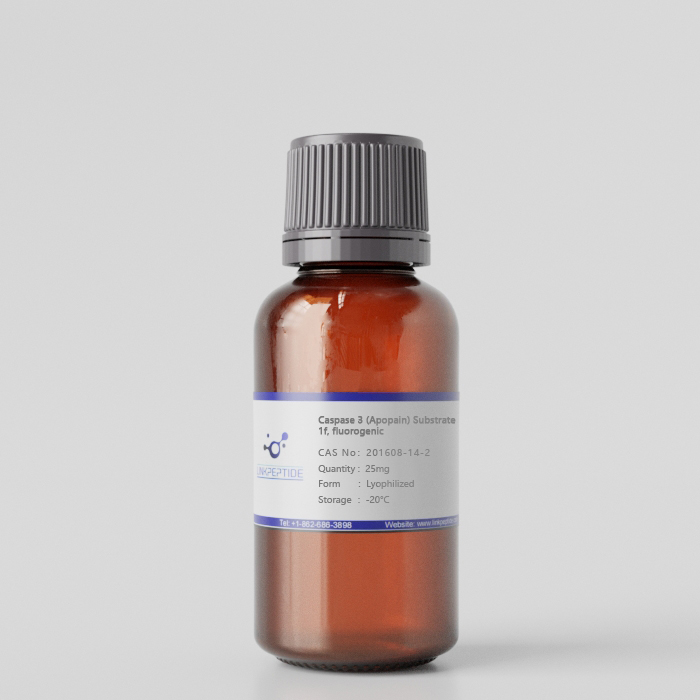
Product Name: Caspase 3 (Apopain) Substrate 1f, fluorogenic
Sequence One Letter Code: Ac-DEVD-AFC
Sequence Three Letter Code: Ac-Asp-Glu-Val-Asp-AFC
Cas No: 201608-14-2
Chemical Formula:C30H34F3N5O13
Molecular Weight: 729.5
Purity: 95%
Form: Lyophilized
Storage Conditions: - 20 °C Protected from light
Research Area: peptide substrate
SMILES: CC(C)[C@@H](C(=O)N[C@@H](CC(=O)O)C(=O)NC1=CC2=C(C=C1)C(=CC(=O)O2)C(F)(F)F)NC(=O)[C@H](CCC(=O)O)NC(=O)[C@H](CC(=O)O)NC(=O)C
IUPAC: (4S)-4-[[(2S)-2-acetamido-3-carboxypropanoyl]amino]-5-[[(2S)-1-[[(2S)-3-carboxy-1-oxo-1-[[2-oxo-4-(trifluoromethyl)chromen-7-yl]amino]propan-2-yl]amino]-3-methyl-1-oxobutan-2-yl]amino]-5-oxopentanoic acid
INCHIKEY: GZDRODOYEFEHGG-NUDCOPPTSA-N
INCHI:
InChI=1S/C30H34F3N5O13/c1-12(2)25(38-26(47)17(6-7-21(40)41)36-28(49)18(10-22(42)43)34-13(3)39)29(50)37-19(11-23(44)45)27(48)35-14-4-5-15-16(30(31,32)33)9-24(46)51-20(15)8-14/h4-5,8-9,12,17-19,25H,6-7,10-11H2,1-3H3,(H,34,39)(H,35,48)(H,36,49)(H,37,50)(H,38,47)(H,40,41)(H,42,43)(H,44,45)/t17-,18-,19-,25-/m0/s1
Conjugation: Conjugated
Conjugation Type: Fluorescent dyes
Code Nacres: NA.26
Application: Caspase-3 (Apopain) Substrate 1f is a fluorogenic peptide substrate optimized for high-sensitivity detection of executioner caspases. It is efficiently cleaved by caspase-3 (kcat/Km ≈ 1.3 × 10⁶ M⁻¹s⁻¹) and caspase-7, enabling selective profiling of apoptotic protease activity. Cleavage releases the AFC fluorophore, producing fluorescence measurable at Ex 370–390 nm and Em 500–510 nm. The substrate supports real-time kinetic analysis, inhibitor evaluation, and quantitative assessment of apoptotic signaling pathways.
Current Research: Caspase-3 (Apopain) Substrate 1f is a highly sensitive fluorogenic peptide substrate developed for quantitative detection of executioner caspase activity, particularly caspase-3 and caspase-7, in apoptosis research. The substrate incorporates a caspase-recognition sequence linked to 7-amino-4-trifluoromethylcoumarin (AFC), enabling fluorescence-based monitoring of proteolytic cleavage. With a reported catalytic efficiency of kcat/Km ≈ 1.3 × 10⁶ M⁻¹·s⁻¹ for caspase-3, Substrate 1f supports sensitive and selective profiling of apoptotic protease activation in biochemical and cell-based systems. Biological Context Caspase-3 and caspase-7 function as terminal executioner proteases in both intrinsic (mitochondrial) and extrinsic (death receptor–mediated) apoptotic pathways. Upon activation, they cleave a broad array of structural and regulatory substrates, leading to: Chromatin condensation and DNA fragmentation Cytoskeletal reorganization Membrane blebbing Formation of apoptotic bodies Accurate measurement of caspase-3/7 activity is therefore a central endpoint in studies of programmed cell death, cancer biology, and therapeutic response. Mechanism of Detection In the intact peptide–AFC conjugate, fluorescence is minimal due to quenching within the substrate structure. Upon cleavage at the caspase-specific recognition motif: The peptide bond adjacent to AFC is hydrolyzed. Free AFC is released into solution. Fluorescence intensity increases proportionally to enzymatic activity. The released AFC is measurable at approximately excitation 370–390 nm and emission 500–510 nm, enabling real-time, continuous kinetic analysis. Research Applications 1. Apoptosis Quantification Substrate 1f is widely used to monitor caspase activation in cell lysates following exposure to chemotherapeutic agents, oxidative stress, cytokines, or targeted therapies. 2. Kinetic Enzyme Characterization The high catalytic efficiency makes this substrate suitable for determining kinetic parameters and comparing activity between caspase-3 and caspase-7 under controlled conditions. 3. Inhibitor Screening The fluorogenic format supports high-throughput evaluation of caspase inhibitors. Decreased AFC release enables quantitative determination of IC₅₀ or Ki values. 4. Comparative Apoptotic Pathway Analysis By combining Substrate 1f with initiator caspase substrates (e.g., caspase-8 or caspase-9), researchers can delineate pathway hierarchy and confirm downstream executioner activation. Advantages High sensitivity and strong fluorescence signal Excellent catalytic efficiency with caspase-3 Real-time kinetic monitoring capability Compatible with standard fluorescence microplate readers Suitable for purified enzymes and cellular extracts Experimental Considerations Optimal assay performance typically requires reducing conditions (e.g., DTT) to maintain caspase catalytic activity. Substrate concentration should be selected relative to Km to ensure accurate kinetic interpretation. Inclusion of selective caspase inhibitors (e.g., Ac-DEVD-CHO analogs) can confirm assay specificity.
Get a Quote
 LinkPeptide