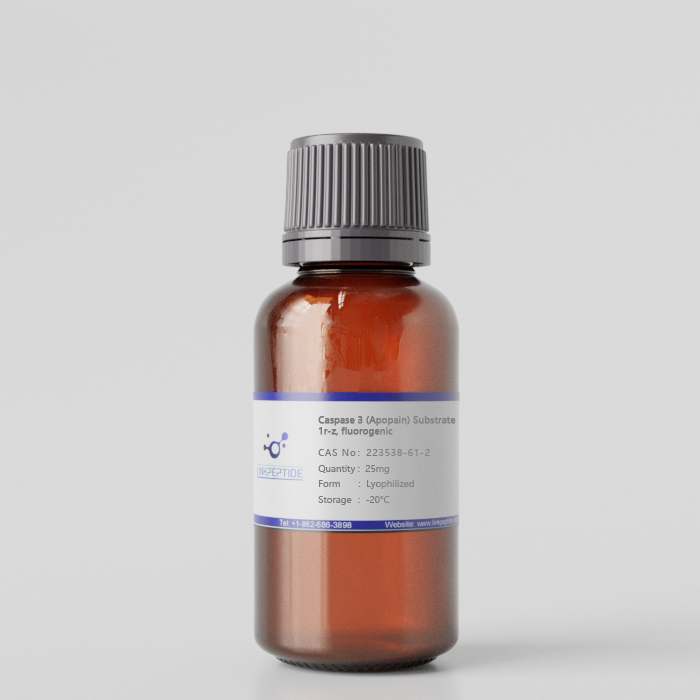
Product Name: Caspase 3 (Apopain) Substrate 1r-z, fluorogenic
Sequence One Letter Code: (Z-DEVD)2-Rh110
Sequence Three Letter Code: z-(Asp-Glu-Val-Asp)2-Rh110
Cas No: 223538-61-2
Chemical Formula:C72H78N10O27
Molecular Weight: 1515.4
Purity: 95%
Form: Lyophilized
Storage Conditions: - 20 °C Protected from light
Research Area: peptide substrate
SMILES: CC(C)[C@@H](C(=O)N[C@@H](CC(=O)O)C(=O)NC1=CC2=C(C=C1)C3(C4=C(O2)C=C(C=C4)NC(=O)[C@H](CC(=O)O)NC(=O)[C@H](C(C)C)NC(=O)[C@H](CCC(=O)O)NC(=O)[C@H](CC(=O)O)NC(=O)OCC5=CC=CC=C5)C6=CC=CC=C6C(=O)O3)NC(=O)[C@H](CCC(=O)O)NC(=O)[C@H](CC(=O)O)NC(=O)OCC7=CC=CC=C7
IUPAC: (4S)-5-[[(2S)-1-[[(2S)-3-carboxy-1-[[6'-[[(2S)-3-carboxy-2-[[(2S)-2-[[(2S)-4-carboxy-2-[[(2S)-3-carboxy-2-(phenylmethoxycarbonylamino)propanoyl]amino]butanoyl]amino]-3-methylbutanoyl]amino]propanoyl]amino]-3-oxospiro[2-benzofuran-1,9'-xanthene]-3'-yl]amino]-1-oxopropan-2-yl]amino]-3-methyl-1-oxobutan-2-yl]amino]-4-[[(2S)-3-carboxy-2-(phenylmethoxycarbonylamino)propanoyl]amino]-5-oxopentanoic acid
INCHIKEY:
INCHI:
Conjugation: Conjugated
Conjugation Type: Fluorescent dyes
Code Nacres: NA.26
Application: Caspase-3 (Apopain) Substrate 1r-z is a highly sensitive fluorogenic peptide substrate developed for detection of executioner caspase activity in apoptosis research. It is efficiently cleaved by caspase-3 and caspase-7, enabling accurate monitoring of late-stage apoptotic signaling. The substrate incorporates rhodamine 110 (Rh110), a fluorophore known for exceptional sensitivity in protease assays. Proteolytic cleavage releases free Rh110, producing a strong fluorescence signal detectable at excitation 488 nm and emission 510–530 nm. Its compatibility with standard fluorescence platforms supports kinetic analysis, inhibitor screening, and high-sensitivity quantification of caspase activation in biochemical and cell-based systems.
Current Research: Caspase-3 (Apopain) Substrate 1r-z is a highly sensitive fluorogenic peptide substrate optimized for quantitative detection of executioner caspase activity, specifically caspase-3 and caspase-7, in apoptosis research. The substrate incorporates rhodamine 110 (Rh110) as the reporting fluorophore, enabling exceptionally high signal intensity and low background detection in protease assays. Upon proteolytic cleavage at the caspase recognition sequence, free Rh110 is released, producing a robust fluorescence signal measurable at approximately excitation 488 nm and emission 510–530 nm. This spectral profile makes the substrate compatible with standard FITC/GFP filter sets and common fluorescence microplate readers or flow cytometry platforms. Biological Context Caspase-3 and caspase-7 function as terminal executioner proteases in both intrinsic (mitochondrial) and extrinsic apoptotic pathways. Once activated, they cleave a broad spectrum of intracellular substrates, driving hallmark apoptotic features such as: DNA fragmentation Cytoskeletal reorganization Membrane blebbing Formation of apoptotic bodies Sensitive detection of caspase-3/7 activity is therefore central to mechanistic studies of programmed cell death, cancer therapeutics, and inflammatory signaling. Mechanism of Detection The substrate is designed such that intact peptide–Rh110 conjugates exhibit minimal fluorescence due to quenching effects. Upon caspase-mediated cleavage: The peptide bond adjacent to Rh110 is hydrolyzed. Free Rh110 is liberated. Fluorescence intensity increases in direct proportion to enzymatic activity. Rhodamine 110 offers higher quantum yield and signal stability compared with coumarin-based substrates, supporting enhanced assay sensitivity. Research Applications 1. High-Sensitivity Apoptosis Quantification Substrate 1r-z is suitable for detecting low levels of caspase activation in early or weak apoptotic responses, particularly in cell lysates or limited biological samples. 2. Real-Time Kinetic Monitoring The strong fluorescence output enables continuous kinetic measurement of caspase activity in purified enzyme systems or cell-based assays. 3. Inhibitor Screening The substrate is compatible with medium- to high-throughput screening formats for evaluating caspase inhibitors. Reduced Rh110 release provides quantitative assessment of inhibitor potency. 4. Comparative Caspase Profiling When combined with substrates selective for initiator caspases (e.g., caspase-8 or caspase-9), Substrate 1r-z supports detailed mapping of apoptotic cascade activation. Advantages High fluorescence intensity and sensitivity Broad compatibility with standard fluorescence instrumentation Suitable for biochemical and cell-based assays Real-time kinetic analysis capability Effective for low-abundance protease detection Experimental Considerations Assays should be performed under reducing conditions (e.g., inclusion of DTT) to maintain caspase catalytic activity. Substrate concentration should be optimized relative to enzyme kinetics for accurate interpretation. Selective caspase inhibitors can be included to confirm specificity in complex samples.
Get a Quote
 LinkPeptide

![Syntide-2 [PLARTLSVAGLPGKK]](https://www.linkpeptide.com/wp-content/uploads/2026/05/Syntide-2-PLARTLSVAGLPGKK.jpg "Syntide-2 [PLARTLSVAGLPGKK]")