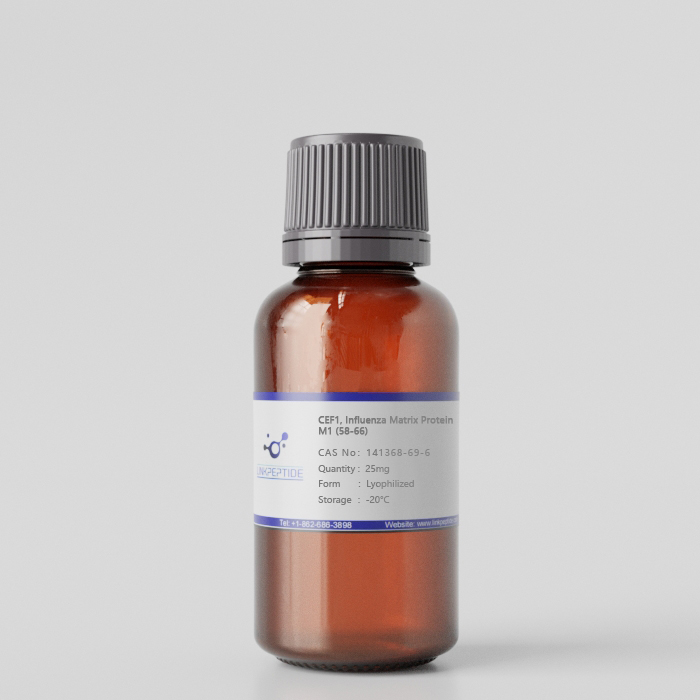
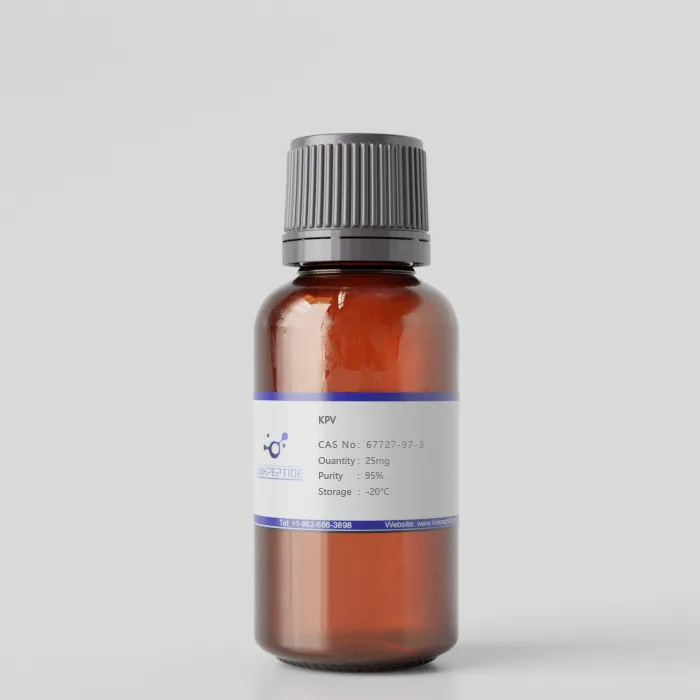
Product Name: CEF1, Influenza Matrix Protein M1 (58-66)
Sequence One Letter Code: GILGFVFTL
Sequence Three Letter Code: H-Gly-Ile-Leu-Gly-Phe-Val-Phe-Thr-Leu-OH
Cas No: 141368-69-6
Chemical Formula:C49H75N9O11
Molecular Weight: 966.3
Purity: 95%
Form: Lyophilized
Storage Conditions: - 20 °C
Research Area: Inflammation and Immunology Research
SMILES: CC[C@H](C)[C@@H](C(=O)N[C@@H](CC(C)C)C(=O)NCC(=O)N[C@@H](CC1=CC=CC=C1)C(=O)N[C@@H](C(C)C)C(=O)N[C@@H](CC2=CC=CC=C2)C(=O)N[C@@H]([C@@H](C)O)C(=O)N[C@@H](CC(C)C)C(=O)O)NC(=O)CN
IUPAC: (2S)-2-[[(2S,3R)-2-[[(2S)-2-[[(2S)-2-[[(2S)-2-[[2-[[(2S)-2-[[(2S,3S)-2-[(2-aminoacetyl)amino]-3-methylpentanoyl]amino]-4-methylpentanoyl]amino]acetyl]amino]-3-phenylpropanoyl]amino]-3-methylbutanoyl]amino]-3-phenylpropanoyl]amino]-3-hydroxybutanoyl]amino]-4-methylpentanoic acid
INCHIKEY: NBDRFCQNHCTWII-CXECYRLYSA-N
INCHI:
InChI=1S/C49H75N9O11/c1-10-30(8)41(56-38(60)25-50)47(66)53-34(21-27(2)3)43(62)51-26-39(61)52-35(23-32-17-13-11-14-18-32)44(63)57-40(29(6)7)46(65)54-36(24-33-19-15-12-16-20-33)45(64)58-42(31(9)59)48(67)55-37(49(68)69)22-28(4)5/h11-20,27-31,34-37,40-42,59H,10,21-26,50H2,1-9H3,(H,51,62)(H,52,61)(H,53,66)(H,54,65)(H,55,67)(H,56,60)(H,57,63)(H,58,64)(H,68,69)/t30-,31+,34-,35-,36-,37-,40-,41-,42-/m0/s1
Source / Species: Influenza
Conjugation: Unconjugated
Code Nacres: NA.26
Application: CEF1 is a synthetic peptide corresponding to amino acid residues 58–66 of the influenza A virus matrix protein M1 and constitutes a well-defined HLA-A02–restricted CD8⁺ T cell epitope. This peptide elicits an immunodominant cytotoxic T lymphocyte response in individuals expressing the HLA-A02 allele, one of the most prevalent MHC class I molecules worldwide. CEF1 is widely used to study antigen presentation, T cell receptor recognition, and effector T cell activation in influenza-specific immune responses. It supports functional assays measuring cytokine secretion, proliferation, and cytolytic activity in peripheral blood mononuclear cells. Additionally, CEF1 serves as a positive control in immune monitoring studies and assay validation protocols. By providing a standardized antigenic stimulus, this peptide facilitates mechanistic investigations into antiviral immunity, immune memory, and T cell–mediated host defense in both basic research and translational immunological applications.
Current Research: CEF1 is a synthetic peptide corresponding to amino acid residues 58–66 of the influenza A virus matrix protein M1 and represents a well-characterized HLA-A02–restricted CD8⁺ T cell epitope. As one of the most extensively studied influenza-derived class I epitopes, CEF1 elicits a strong and often immunodominant cytotoxic T lymphocyte (CTL) response in individuals expressing the HLA-A02 allele, one of the most prevalent MHC class I molecules globally. The influenza A matrix protein M1 is a structurally conserved internal viral protein that plays a key role in viral assembly and budding. Because of its high degree of sequence conservation across influenza strains, M1-derived epitopes such as CEF1 are frequently targeted by CD8⁺ T cells during natural infection. This conservation enhances the relevance of CEF1 for studying cross-reactive cellular immune responses and long-term immune memory against influenza viruses. In antigen presentation research, CEF1 is commonly used to evaluate peptide binding to HLA-A*02 molecules and subsequent recognition by specific T cell receptors (TCRs). Direct peptide loading onto antigen-presenting cells provides a controlled experimental system that isolates MHC–peptide–TCR interactions from upstream antigen processing variables. This approach enables precise analysis of T cell specificity, functional avidity, and clonal diversity within influenza-specific CD8⁺ T cell populations. CEF1 is widely applied in ex vivo functional assays using peripheral blood mononuclear cells (PBMCs) from HLA-A*02–positive donors. Upon stimulation with the peptide, influenza-specific CD8⁺ T cells can be evaluated for effector functions including interferon-γ and tumor necrosis factor-α secretion, degranulation marker expression, proliferation, and cytolytic activity. Common analytical platforms include ELISpot assays, intracellular cytokine staining, multicolor flow cytometry, and chromium-release or fluorescence-based cytotoxicity assays. These applications make CEF1 a robust reagent for quantifying antigen-specific cellular immune responses. In vaccine research and immune monitoring, CEF1 serves as a standardized antigenic stimulus for assessing influenza-specific T cell immunity. Because of its immunodominance and defined HLA restriction, it is frequently used as a positive control in assay validation protocols and quality control procedures. Its consistent performance supports inter-study comparability and longitudinal monitoring of T cell responses following vaccination or infection. Beyond functional assessment, CEF1 contributes to mechanistic investigations of T cell differentiation and memory formation. Studies examining central memory, effector memory, and tissue-resident memory CD8⁺ T cell subsets often employ this peptide to evaluate recall responses and durability of antiviral immunity. Structural analyses of peptide–MHC complexes involving CEF1 further enhance understanding of epitope presentation stability and TCR engagement. In translational immunology, CEF1 is used to compare immune competence across different populations, including immunocompromised individuals or patients with chronic inflammatory conditions. By providing a defined and reproducible epitope, it facilitates investigation into factors that influence antiviral CD8⁺ T cell responses and host defense mechanisms. Overall, CEF1 is a reliable and widely utilized HLA-A*02–restricted influenza epitope that supports detailed analysis of CD8⁺ T cell activation, effector function, and immune memory. Its standardized sequence and strong immunogenic profile make it an essential tool for studying antigen presentation, antiviral immunity, and T cell–mediated host protection in both basic and translational research settings.
Get a Quote
 LinkPeptide