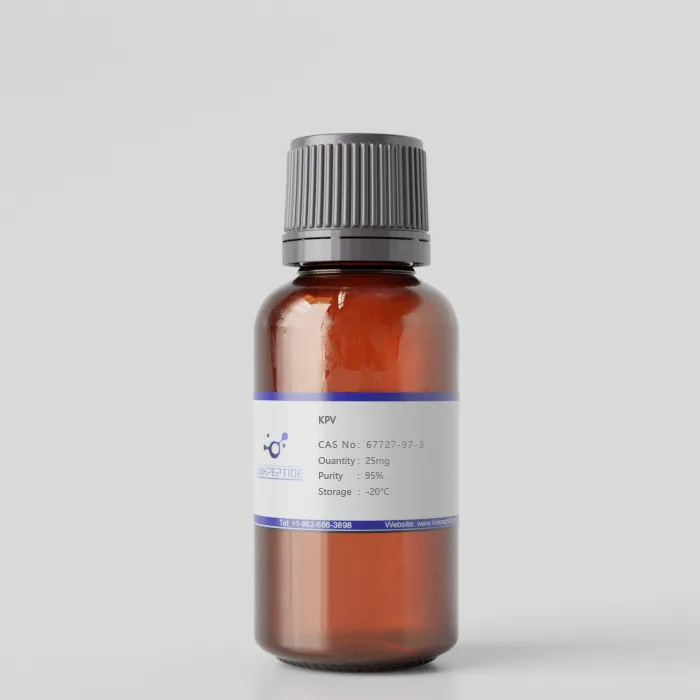
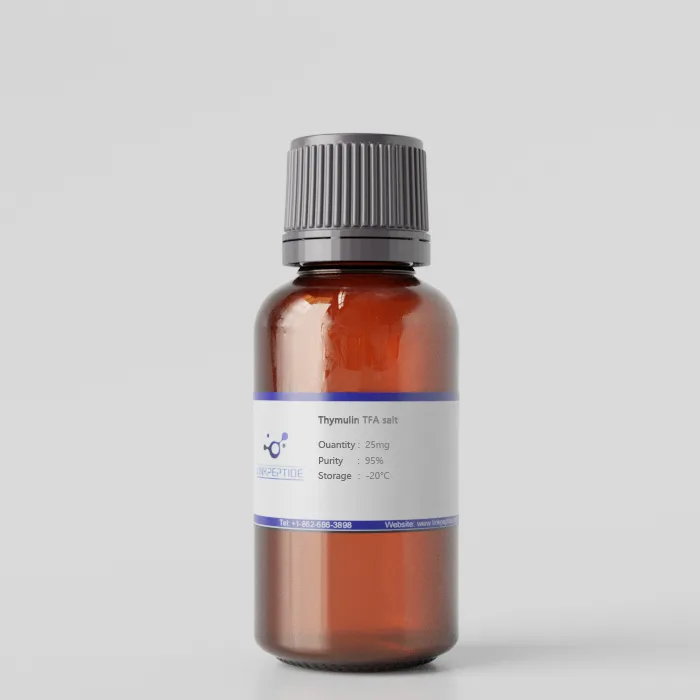
Product Name:KPV
Cas No:67727-97-3
Purity:95%
Chemical Formula:C16H30N4O4
Molar Mass:342.43
Synonyms:Lys-pro-val; L-Valine, N-(1-L-lysyl-L-prolyl)-; Msh (11-13); alpha-Msh (11-13); L-Lysyl-L-prolyl-L-valine; ACTH-(11-13)
IUPAC Name:(2S)-2-[[(2S)-1-[(2S)-2,6-diaminohexanoyl]pyrrolidine-2-carbonyl]amino]-3-methylbutanoic acid
SMILES:CC(C)[C@@H](C(=O)O)NC(=O)[C@@H]1CCCN1C(=O)[C@H](CCCCN)N
InChIKey:YSPZCHGIWAQVKQ-AVGNSLFASA-N
InChI:InChI=1S/C16H30N4O4/c1-10(2)13(16(23)24)19-14(21)12-7-5-9-20(12)15(22)11(18)6-3-4-8-17/h10-13H,3-9,17-18H2,1-2H3,(H,19,21)(H,23,24)/t11-,12-,13-/m0/s1
Storage:-20 degree Celsius
Sequence:KPV
Application:KPV (ACTH(11–13)) is a synthetic tripeptide—Lys-Pro-Val—derived from the C-terminal end of adrenocorticotropic hormone (ACTH). It is widely recognized for its potent anti-inflammatory and immunomodulatory effects, independent of glucocorticoid signaling. KPV inhibits pro-inflammatory cytokines such as TNF-α, IL-6, and IL-1β, and downregulates NF-κB activation. It has shown therapeutic promise in preclinical studies of inflammatory bowel disease (IBD), dermatitis, wound healing, and other autoimmune and inflammatory conditions. KPV is stable, well-tolerated, and effective in both topical and systemic models.
Current Research:Introduction: The Anti-Inflammatory Potential of KPV KPV (Lys-Pro-Val) is the shortest bioactive sequence of the adrenocorticotropic hormone (ACTH) that retains potent anti-inflammatory properties without activating adrenal glucocorticoid release. Originally isolated from ACTH(11–13), KPV has since become a subject of interest for researchers seeking alternatives to steroid-based anti-inflammatory agents. Its non-steroidal mechanism, excellent safety profile, and activity in both local and systemic models make it a unique tool in immunology, dermatology, and gut health studies. Mechanism of Action: NF-κB Suppression and Cytokine Inhibition KPV’s anti-inflammatory effects are mainly attributed to its ability to inhibit the nuclear factor kappa B (NF-κB) pathway, a central driver of pro-inflammatory gene transcription. This inhibition leads to a reduction in the expression of key cytokines, including: Tumor Necrosis Factor-alpha (TNF-α) Interleukin-6 (IL-6) Interleukin-1β (IL-1β) In addition, KPV downregulates iNOS (inducible nitric oxide synthase) and COX-2 (cyclooxygenase-2), enzymes heavily involved in inflammation and oxidative damage. Importantly, this peptide achieves these effects without immunosuppression or hormonal side effects, positioning it as a strong candidate for long-term or sensitive clinical applications. Dermatological Applications One of the most robust areas of KPV research is topical dermatology. In models of atopic dermatitis, psoriasis, and contact hypersensitivity, KPV: Reduces redness, swelling, and epidermal thickening Suppresses local cytokine production Enhances skin barrier recovery Unlike corticosteroids, KPV does not cause skin thinning or systemic hormonal disruption. This makes it an attractive agent for chronic or pediatric skin conditions where long-term safety is a concern. It has also shown wound-healing support by enhancing keratinocyte migration and reducing local inflammation. Inflammatory Bowel Disease (IBD) KPV has demonstrated significant benefit in preclinical models of ulcerative colitis and Crohn’s disease, particularly when administered via rectal enema, oral delivery, or intraperitoneal injection. Observed effects include: Decreased infiltration of neutrophils and macrophages Reduced production of IL-6 and TNF-α in colonic tissue Improved epithelial integrity and reduced ulceration Studies also report a restoration of tight junction proteins and reduced intestinal permeability, suggesting KPV’s relevance in gut barrier protection and microbiome-associated immune modulation. Wound Healing and Tissue Repair KPV also supports tissue regeneration and re-epithelialization. In models of: Burns Surgical incisions Diabetic ulcers KPV accelerates wound closure, reduces inflammatory cell infiltration, and improves granulation tissue quality. The peptide promotes a pro-resolving inflammatory state, allowing for healing without fibrosis or chronic inflammation. KPV may also reduce scarring, further enhancing its profile in regenerative dermatology and trauma recovery studies. Systemic Anti-Inflammatory Effects and Safety Unlike full-length ACTH or corticosteroids, KPV has minimal systemic toxicity, no immunosuppressive effect, and no interference with endocrine feedback loops. It is rapidly degraded in plasma but has strong local bioactivity, making it ideal for site-specific delivery such as creams, suppositories, and injectables. Moreover, KPV has shown promise in sepsis, endotoxemia, and lung inflammation models, indicating its potential as a systemic cytokine modulator under critical care conditions. Conclusion: A Compact Yet Powerful Peptide KPV (ACTH(11–13)) represents a novel anti-inflammatory strategy for conditions where traditional steroids are ineffective, contraindicated, or poorly tolerated. Its tripeptide structure offers simplicity and ease of synthesis, while its broad anti-cytokine activity makes it applicable in numerous inflammatory settings—from skin and gut to lung and immune disorders. Future directions in KPV research include formulation development, oral bioavailability enhancement, and combinatorial use with microbiome-targeted therapies and barrier-supporting agents.
Reference:
Get a Quote
 LinkPeptide