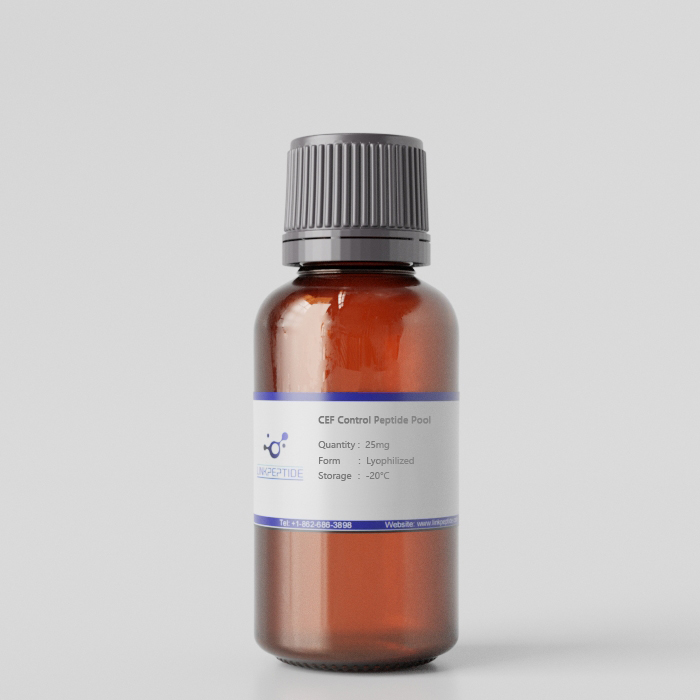
Product Name: CEF Control Peptide Pool - 8 mg
Purity: 95%
Form: Lyophilized
Storage Conditions: - 20 °C
Research Area: Inflammation and Immunology Research
Source / Species: CMV, EBV, Influenza
Conjugation: Unconjugated
Code Nacres: NA.26
Application: CEF Control Peptide Pool is a standardized mixture of 32 synthetic peptides (8–12 amino acids) derived from immunodominant CD8⁺ T cell epitopes of human cytomegalovirus (CMV), Epstein–Barr virus (EBV), and influenza virus. Selected for broad HLA class I coverage, these peptides elicit robust antigen-specific CD8⁺ T cell responses in individuals with defined HLA backgrounds. The CEF pool reliably induces interferon-γ (IFN-γ) secretion and serves as a validated positive control in cellular immune monitoring assays, including ELISPOT, intracellular cytokine staining, and cytotoxic T lymphocyte (CTL) assays. It is widely applied to evaluate T cell functionality, assay sensitivity, and overall immune competence in clinical and translational immunology studies.
Current Research: CEF Control Peptide Pool is a standardized mixture of 32 synthetic peptides (8–12 amino acids in length) derived from well-characterized, immunodominant CD8⁺ T cell epitopes of human cytomegalovirus (CMV), Epstein–Barr virus (EBV), and influenza virus. These viral antigens were selected based on their high immunogenicity and broad population exposure, ensuring that a large proportion of adults harbor memory CD8⁺ T cells specific to one or more components of the pool. Designed for broad HLA class I coverage, the CEF peptide pool stimulates antigen-specific CD8⁺ T cells across multiple HLA-A and HLA-B haplotypes, making it a reliable and widely accepted positive control in cellular immune monitoring assays. Upon in vitro stimulation of peripheral blood mononuclear cells (PBMCs) or whole blood samples, the CEF pool consistently induces interferon-γ (IFN-γ) secretion, along with other effector cytokines such as TNF-α, reflecting intact cytotoxic T lymphocyte (CTL) functionality. Scientific Rationale CMV, EBV, and influenza viruses establish either lifelong persistence (CMV, EBV) or repeated seasonal exposure (influenza), generating durable memory CD8⁺ T cell populations in immunocompetent individuals. The selected epitopes within the CEF pool are derived from viral proteins known to drive strong and reproducible cytotoxic T cell responses. Because these responses are generally robust in individuals with defined HLA backgrounds, CEF stimulation serves as a dependable measure of T cell immune competence. Unlike mitogenic stimulants (e.g., PHA or PMA/ionomycin), which activate T cells non-specifically, the CEF pool provides a physiologically relevant, antigen-specific stimulus, enabling more accurate assessment of functional memory CD8⁺ T cells. Key Research Applications 1. ELISPOT Assays CEF peptides are widely used to validate assay performance in IFN-γ ELISPOT workflows. The pool serves as a benchmark positive control to confirm: PBMC viability and responsiveness Assay sensitivity Operator consistency and reagent integrity A robust IFN-γ spot-forming cell response confirms preserved antigen-specific CD8⁺ T cell activity. 2. Intracellular Cytokine Staining (ICS) In flow cytometry-based ICS assays, CEF stimulation induces cytokine production in memory CD8⁺ T cells, enabling quantitative assessment of IFN-γ, TNF-α, IL-2, and polyfunctional T cell profiles. It is frequently incorporated into vaccine immunogenicity studies and immune monitoring panels. 3. Cytotoxic T Lymphocyte (CTL) Assays CEF peptides can be used to pulse target cells in CTL killing assays to evaluate cytolytic capacity. Measured endpoints may include target cell lysis, granzyme B release, or CD107a mobilization. 4. Clinical and Translational Immune Monitoring CEF serves as a quality control tool in studies involving: Vaccine development Cancer immunotherapy trials Transplant immunology Immunodeficiency evaluation Infectious disease research Its inclusion helps differentiate between true antigen-specific hyporesponsiveness and generalized T cell dysfunction. Advantages of the CEF Control Peptide Pool Antigen-specific positive control for CD8⁺ T cell assays Broad HLA class I applicability Reliable induction of IFN-γ secretion Suitable for PBMCs and whole blood formats Standardized composition for inter-study comparability Experimental Considerations Optimal working concentrations should be empirically determined depending on assay format and cell density. Typical workflows involve short-term in vitro stimulation (6–24 hours for ICS; 18–24 hours for ELISPOT), with appropriate negative controls included for background subtraction. Because donor responsiveness depends on prior viral exposure and HLA genotype, response magnitude may vary among individuals.
Get a Quote
 LinkPeptide