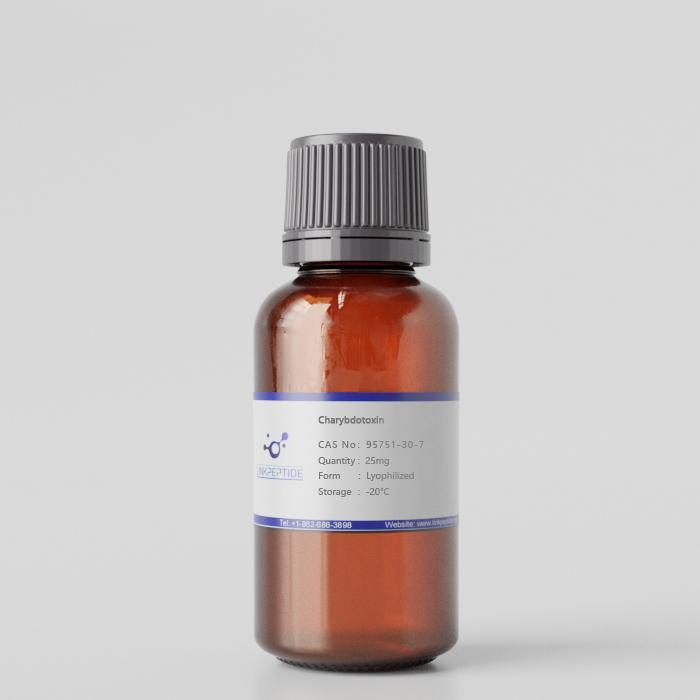
Product Name: Charybdotoxin
Sequence One Letter Code: Pyr-FTNVSCTTSKECWSVCQRLHNTSRGKCMNKKCRCYS (Disulfide bridge: 7-28, 13-33 and 17-35) Sequence Three Letter Code: Pyr-Phe-Thr-Asn-Val-Ser-Cys-Thr-Thr-Ser-Lys-Glu-Cys-Trp-Ser-Val-Cys-Gln-Arg-Leu-His-Asn-Thr-Ser-Arg-Gly-Lys-Cys-Met-Asn-Lys-Lys-Cys-Arg-Cys-Tyr-Ser-OH (Disulfide bridge: 7-28, 13-33 and 17-35)
Cas No: 95751-30-7
Chemical Formula:C176H277N57O55S7
Molecular Weight: 4296.1
Purity: 95%
Form: Lyophilized
Storage Conditions: - 20 °C
Research Area: Cancer Disease Research
SMILES: C[C@H]([C@H]1C(=O)N[C@H](C(=O)N[C@H](C(=O)N[C@H](C(=O)N[C@H](C(=O)N[C@H]2CSSC[C@H]3C(=O)N[C@H](C(=O)N[C@@H](CSSC[C@@H](C(=O)N[C@H](C(=O)N[C@H](C(=O)N[C@H](C(=O)N[C@H](C(=O)N[C@H](C(=O)N[C@H](C(=O)N[C@H](C(=O)N[C@H](C(=O)NCC(=O)N[C@H](C(=O)N[C@@H](CSSC[C@@H](C(=O)N1)NC(=O)[C@H](CO)NC(=O)[C@H](C(C)C)NC(=O)[C@H](CC(=O)N)NC(=O)[C@H]([C@@H](C)O)NC(=O)[C@H](CC4=CC=CC=C4)NC(=O)[C@@H]5CCC(=O)N5)C(=O)N[C@H](C(=O)N[C@H](C(=O)N[C@H](C(=O)N[C@H](C(=O)N3)CCCCN)CCCCN)CC(=O)N)CCSC)CCCCN)CCCNC(=N)N)CO)[C@@H](C)O)CC(=O)N)CC6=CN=CN6)CC(C)C)CCCNC(=N)N)CCC(=O)N)NC(=O)[C@@H](NC(=O)[C@@H](NC(=O)[C@@H](NC2=O)CC7=CNC8=CC=CC=C87)CO)C(C)C)C(=O)N[C@@H](CC9=CC=C(C=C9)O)C(=O)N[C@@H](CO)C(=O)O)CCCNC(=N)N)CCC(=O)O)CCCCN)CO)[C@@H](C)O)O
IUPAC: (2S)-3-hydroxy-2-[[(2S)-3-(4-hydroxyphenyl)-2-[[(1R,4S,7R,12R,15S,18S,21S,24S,27S,30S,33S,36S,42S,45R,50R,53S,56S,59S,62S,65S,68R,75S,78S,81S,84S,89S,92S,95S)-42,62,75,78-tetrakis(4-aminobutyl)-50-[[(2S)-2-[[(2S)-2-[[(2S)-4-amino-2-[[(2S,3R)-3-hydroxy-2-[[(2S)-2-[[(2S)-5-oxopyrrolidine-2-carbonyl]amino]-3-phenylpropanoyl]amino]butanoyl]amino]-4-oxobutanoyl]amino]-3-methylbutanoyl]amino]-3-hydroxypropanoyl]amino]-27,81-bis(2-amino-2-oxoethyl)-15-(3-amino-3-oxopropyl)-4,18,36-tris(3-carbamimidamidopropyl)-65-(2-carboxyethyl)-30,53,56-tris[(1R)-1-hydroxyethyl]-33,59,92-tris(hydroxymethyl)-24-(1H-imidazol-5-ylmethyl)-89-(1H-indol-3-ylmethyl)-21-(2-methylpropyl)-84-(2-methylsulfanylethyl)-2,5,13,16,19,22,25,28,31,34,37,40,43,51,54,57,60,63,66,74,77,80,83,86,87,90,93,96-octacosaoxo-95-propan-2-yl-9,10,47,48,70,71-hexathia-3,6,14,17,20,23,26,29,32,35,38,41,44,52,55,58,61,64,67,73,76,79,82,85,88,91,94,97-octacosazatricyclo[43.27.14.1112,68]heptanonacontane-7-carbonyl]amino]propanoyl]amino]propanoic acid
INCHIKEY: CNVQLPPZGABUCM-LIGYZCPXSA-N
INCHI:
InChI=1S/C176H277N57O55S7/c1-81(2)58-106-149(263)213-110(62-91-67-191-80-197-91)152(266)215-112(64-127(183)246)156(270)231-135(85(8)240)170(284)219-114(69-234)157(271)200-95(36-25-54-192-174(185)186)138(252)196-68-130(249)199-96(32-17-21-50-177)139(253)222-120-75-291-295-79-124(226-159(273)116(71-236)218-167(281)132(82(3)4)228-155(269)113(65-128(184)247)216-169(283)134(84(7)239)230-154(268)108(59-88-28-13-12-14-29-88)210-145(259)102-44-47-129(248)198-102)166(280)232-137(87(10)242)172(286)233-136(86(9)241)171(285)220-115(70-235)158(272)204-98(34-19-23-52-179)141(255)206-104(45-48-131(250)251)147(261)225-122-77-292-290-74-119(223-143(257)99(35-20-24-53-180)201-140(254)97(33-18-22-51-178)203-153(267)111(63-126(182)245)214-148(262)105(49-57-289-11)208-162(120)276)161(275)205-101(38-27-56-194-176(189)190)144(258)224-121(164(278)211-107(60-89-39-41-92(243)42-40-89)150(264)221-118(73-238)173(287)288)76-293-294-78-123(163(277)207-103(43-46-125(181)244)146(260)202-100(142(256)209-106)37-26-55-193-175(187)188)227-168(282)133(83(5)6)229-160(274)117(72-237)217-151(265)109(212-165(122)279)61-90-66-195-94-31-16-15-30-93(90)94/h12-16,28-31,39-42,66-67,80-87,95-124,132-137,195,234-243H,17-27,32-38,43-65,68-79,177-180H2,1-11H3,(H2,181,244)(H2,182,245)(H2,183,246)(H2,184,247)(H,191,197)(H,196,252)(H,198,248)(H,199,249)(H,200,271)(H,201,254)(H,202,260)(H,203,267)(H,204,272)(H,205,275)(H,206,255)(H,207,277)(H,208,276)(H,209,256)(H,210,259)(H,211,278)(H,212,279)(H,213,263)(H,214,262)(H,215,266)(H,216,283)(H,217,265)(H,218,281)(H,219,284)(H,220,285)(H,221,264)(H,222,253)(H,223,257)(H,224,258)(H,225,261)(H,226,273)(H,227,282)(H,228,269)(H,229,274)(H,230,268)(H,231,270)(H,232,280)(H,233,286)(H,250,251)(H,287,288)(H4,185,186,192)(H4,187,188,193)(H4,189,190,194)/t84-,85-,86-,87-,95+,96+,97+,98+,99+,100+,101+,102+,103+,104+,105+,106+,107+,108+,109+,110+,111+,112+,113+,114+,115+,116+,117+,118+,119+,120+,121+,122+,123+,124+,132+,133+,134+,135+,136+,137+/m1/s1
Source / Species: Scorpion
Conjugation: Unconjugated
Code Nacres: NA.26
Application: Charybdotoxin (ChTX) is a highly basic peptide toxin isolated from the venom of the scorpion Leiurus quinquestriatus hebraeus and extensively used in ion channel research. ChTX selectively blocks Ca²⁺-activated K⁺ channels, particularly intermediate- and large-conductance subtypes, resulting in membrane depolarization in both excitable and non-excitable cells. By inhibiting potassium efflux, ChTX modulates calcium signaling and downstream cellular responses. In immunological studies, blockade of these channels suppresses mitogen-induced proliferation of peripheral T lymphocytes, highlighting the importance of potassium channel activity in lymphocyte activation and immune regulation. ChTX is widely applied in electrophysiology, patch-clamp analysis, and signal transduction research to characterize channel function, gating mechanisms, and pharmacological modulation. This peptide provides a valuable tool for investigating Ca²⁺-dependent regulatory pathways, immune cell signaling, and ion channel contributions to physiological and pathological processes.
Current Research: Charybdotoxin (ChTX) is a 37-amino acid, highly basic peptide toxin originally isolated from the venom of the scorpion Leiurus quinquestriatus hebraeus. It belongs to the scorpion toxin family characterized by a compact structure stabilized by multiple disulfide bridges, which confer high affinity and specificity toward potassium channels. ChTX has become a widely used pharmacological tool in ion channel research due to its potent inhibitory activity against Ca²⁺-activated K⁺ (KCa) channels, particularly intermediate-conductance (IK, KCa3.1) and large-conductance (BK, KCa1.1) subtypes. KCa channels play essential roles in regulating membrane potential and intracellular calcium dynamics. In both excitable and non-excitable cells, activation of these channels facilitates potassium efflux, leading to membrane hyperpolarization. This hyperpolarized state enhances the electrochemical driving force for Ca²⁺ entry through voltage-independent calcium channels. By selectively blocking KCa channels, ChTX reduces potassium efflux and promotes membrane depolarization, thereby altering calcium influx and modulating downstream signaling pathways. In electrophysiological studies, ChTX is extensively used to dissect channel function and gating behavior. Patch-clamp recordings in the presence and absence of ChTX allow researchers to isolate KCa-mediated currents from other potassium channel subtypes. The peptide binds to the extracellular pore region of target channels, physically occluding ion conduction. This pore-blocking mechanism has provided valuable insights into channel structure–function relationships and has contributed to mapping critical residues involved in toxin binding and ion selectivity. Beyond its role in basic ion channel characterization, ChTX has significant relevance in immunological research. KCa3.1 channels are highly expressed in activated T lymphocytes and are essential for maintaining the membrane potential required for sustained calcium signaling during immune activation. Blockade of these channels by ChTX suppresses mitogen-induced proliferation of peripheral T cells, underscoring the importance of potassium channel activity in lymphocyte activation, cytokine production, and immune regulation. These findings have stimulated interest in KCa channel inhibitors as potential therapeutic agents for autoimmune and inflammatory diseases. ChTX is also applied in studies of vascular physiology, where BK channels regulate smooth muscle tone and vascular reactivity. Inhibition of these channels can influence vasoconstriction and blood pressure control, providing insight into Ca²⁺-dependent regulatory mechanisms in cardiovascular systems. Similarly, in neuronal models, ChTX helps delineate the contribution of BK channels to action potential repolarization, neurotransmitter release, and synaptic plasticity. In signal transduction research, the peptide serves as a functional probe for examining the interplay between potassium channel activity and intracellular calcium oscillations. Because calcium signaling governs diverse processes—including secretion, gene expression, and cell migration—ChTX-mediated modulation of membrane potential offers a controlled method to investigate Ca²⁺-dependent cellular responses. Pharmacological studies frequently use ChTX as a reference inhibitor to compare selectivity profiles of novel small-molecule channel modulators. Its well-characterized binding properties and predictable electrophysiological effects make it a benchmark reagent for evaluating channel blockade potency and specificity. Overall, Charybdotoxin remains an indispensable experimental tool in ion channel biology. Through selective inhibition of Ca²⁺-activated K⁺ channels, it enables detailed analysis of channel gating, membrane potential regulation, and calcium-dependent signaling pathways. Its applications span electrophysiology, immunology, neuroscience, and cardiovascular research, supporting investigations into both physiological regulation and pathological dysfunction of potassium channel–mediated processes.
Get a Quote
 LinkPeptide