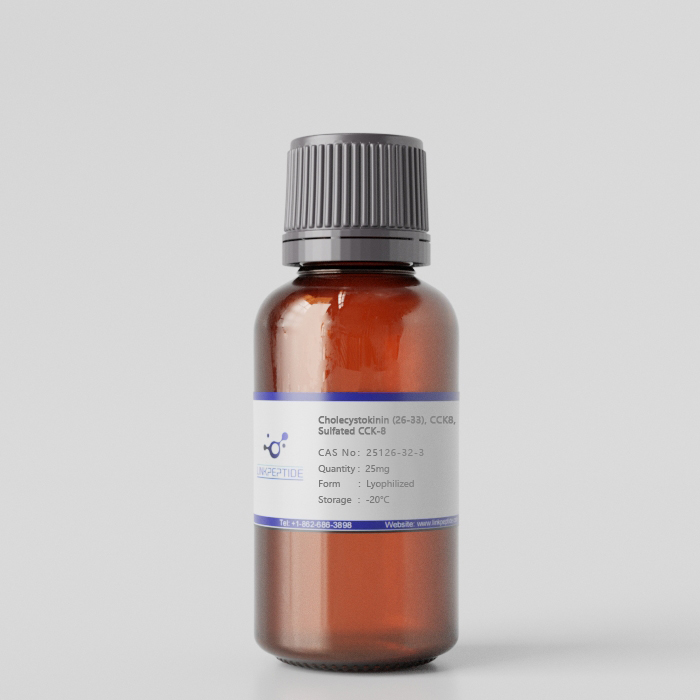
Product Name: Cholecystokinin (26-33), CCK8, Sulfated CCK-8
Sequence One Letter Code: D-Y(SO3H)-MGWMDF-NH2
Sequence Three Letter Code: H-Asp-Tyr(SO3H)-Met-Gly-Trp-Met-Asp-Phe-NH2
Cas No: 25126-32-3
Chemical Formula:C49H62N10O16S3
Molecular Weight: 1143.3
Purity: ≥ 95%
Form: Lyophilized
Storage Conditions: - 20 °C
SMILES: CSCC[C@@H](C(=O)NCC(=O)N[C@@H](CC1=CNC2=CC=CC=C21)C(=O)N[C@@H](CCSC)C(=O)N[C@@H](CC(=O)O)C(=O)N[C@@H](CC3=CC=CC=C3)C(=O)N)NC(=O)[C@H](CC4=CC=C(C=C4)OS(=O)(=O)O)NC(=O)[C@H](CC(=O)O)N
IUPAC: (3S)-3-amino-4-[[(2S)-1-[[(2S)-1-[[2-[[(2S)-1-[[(2S)-1-[[(2S)-1-[[(2S)-1-amino-1-oxo-3-phenylpropan-2-yl]amino]-3-carboxy-1-oxopropan-2-yl]amino]-4-methylsulfanyl-1-oxobutan-2-yl]amino]-3-(1H-indol-3-yl)-1-oxopropan-2-yl]amino]-2-oxoethyl]amino]-4-methylsulfanyl-1-oxobutan-2-yl]amino]-1-oxo-3-(4-sulfooxyphenyl)propan-2-yl]amino]-4-oxobutanoic acid
INCHIKEY: IZTQOLKUZKXIRV-YRVFCXMDSA-N
INCHI:
InChI=1S/C49H62N10O16S3/c1-76-18-16-34(55-47(69)37(58-44(66)32(50)23-41(61)62)21-28-12-14-30(15-13-28)75-78(72,73)74)45(67)53-26-40(60)54-38(22-29-25-52-33-11-7-6-10-31(29)33)48(70)56-35(17-19-77-2)46(68)59-39(24-42(63)64)49(71)57-36(43(51)65)20-27-8-4-3-5-9-27/h3-15,25,32,34-39,52H,16-24,26,50H2,1-2H3,(H2,51,65)(H,53,67)(H,54,60)(H,55,69)(H,56,70)(H,57,71)(H,58,66)(H,59,68)(H,61,62)(H,63,64)(H,72,73,74)/t32-,34-,35-,36-,37-,38-,39-/m0/s1
Source / Species: Human, mouse, rat, pig
Conjugation: Unconjugated
Code Nacres: NA.26
Application: Sulfated CCK-8 is the C-terminally sulfated and amidated octapeptide form of cholecystokinin, retaining the full biological activity of the native 33-amino-acid hormone. CCK functions as both a gastrointestinal hormone and central neurotransmitter, stimulating pancreatic enzyme secretion, gallbladder contraction, and satiety signaling. Sulfation is critical for high-affinity receptor binding and physiological potency. Sulfated CCK-8 is widely used in appetite regulation studies, gut–brain signaling research, gastrointestinal physiology, metabolic research, and investigations of CCK receptor pharmacology in endocrine, neurological, and digestive system models.
Get a Quote
 LinkPeptide