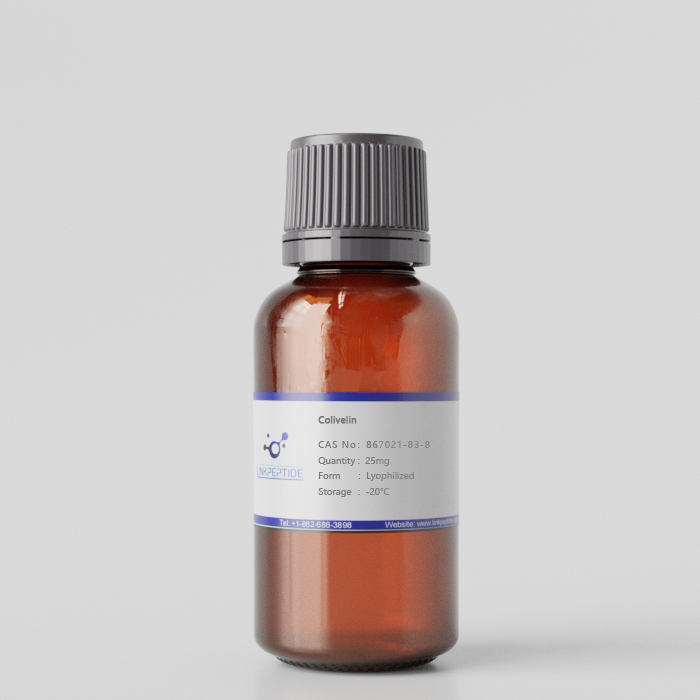
Product Name: Colivelin
Sequence One Letter Code: SALLRSIPAPAGASRLLLLTGEIDLP
Sequence Three Letter Code: H-Ser-Ala-Leu-Leu-Arg-Ser-Ile-Pro-Ala-Pro-Ala-Gly-Ala-Ser-Arg-Leu-Leu-Leu-Leu-Thr-Gly-Glu-Ile-Asp-Leu-Pro-OH
Cas No: 867021-83-8
Chemical Formula:C119H206N32O35
Molecular Weight: 2645.3
Purity: 95%
Form: Lyophilized
Storage Conditions: - 20 °C
Research Area: Alzheimer's Disease
SMILES: CC[C@H](C)[C@@H](C(=O)N[C@@H](CC(=O)O)C(=O)N[C@@H](CC(C)C)C(=O)N1CCC[C@H]1C(=O)O)NC(=O)[C@H](CCC(=O)O)NC(=O)CNC(=O)[C@H]([C@@H](C)O)NC(=O)[C@H](CC(C)C)NC(=O)[C@H](CC(C)C)NC(=O)[C@H](CC(C)C)NC(=O)[C@H](CC(C)C)NC(=O)[C@H](CCCNC(=N)N)NC(=O)[C@H](CO)NC(=O)[C@H](C)NC(=O)CNC(=O)[C@H](C)NC(=O)[C@@H]2CCCN2C(=O)[C@H](C)NC(=O)[C@@H]3CCCN3C(=O)[C@H]([C@@H](C)CC)NC(=O)[C@H](CO)NC(=O)[C@H](CCCNC(=N)N)NC(=O)[C@H](CC(C)C)NC(=O)[C@H](CC(C)C)NC(=O)[C@H](C)NC(=O)[C@H](CO)N
IUPAC: (2S)-1-[(2S)-2-[[(2S)-2-[[(2S,3S)-2-[[(2S)-2-[[2-[[(2S,3R)-2-[[(2S)-2-[[(2S)-2-[[(2S)-2-[[(2S)-2-[[(2S)-2-[[(2S)-2-[[(2S)-2-[[2-[[(2S)-2-[[(2S)-1-[(2S)-2-[[(2S)-1-[(2S,3S)-2-[[(2S)-2-[[(2S)-2-[[(2S)-2-[[(2S)-2-[[(2S)-2-[[(2S)-2-amino-3-hydroxypropanoyl]amino]propanoyl]amino]-4-methylpentanoyl]amino]-4-methylpentanoyl]amino]-5-carbamimidamidopentanoyl]amino]-3-hydroxypropanoyl]amino]-3-methylpentanoyl]pyrrolidine-2-carbonyl]amino]propanoyl]pyrrolidine-2-carbonyl]amino]propanoyl]amino]acetyl]amino]propanoyl]amino]-3-hydroxypropanoyl]amino]-5-carbamimidamidopentanoyl]amino]-4-methylpentanoyl]amino]-4-methylpentanoyl]amino]-4-methylpentanoyl]amino]-4-methylpentanoyl]amino]-3-hydroxybutanoyl]amino]acetyl]amino]-4-carboxybutanoyl]amino]-3-methylpentanoyl]amino]-3-carboxypropanoyl]amino]-4-methylpentanoyl]pyrrolidine-2-carboxylic acid
INCHIKEY: PTTAQOYOJJTWFD-IBAOLXMASA-N
INCHI:
InChI=1S/C119H206N32O35/c1-24-63(17)91(113(181)142-80(50-90(160)161)106(174)143-81(49-62(15)16)115(183)151-42-30-35-86(151)117(185)186)146-100(168)73(36-37-89(158)159)133-88(157)52-128-112(180)93(69(23)155)148-107(175)79(48-61(13)14)141-105(173)78(47-60(11)12)140-104(172)77(46-59(9)10)139-103(171)76(45-58(7)8)137-98(166)71(31-26-38-125-118(121)122)135-108(176)82(54-153)144-95(163)66(20)129-87(156)51-127-94(162)65(19)131-110(178)84-33-28-40-149(84)114(182)68(22)132-111(179)85-34-29-41-150(85)116(184)92(64(18)25-2)147-109(177)83(55-154)145-99(167)72(32-27-39-126-119(123)124)134-101(169)75(44-57(5)6)138-102(170)74(43-56(3)4)136-96(164)67(21)130-97(165)70(120)53-152/h56-86,91-93,152-155H,24-55,120H2,1-23H3,(H,127,162)(H,128,180)(H,129,156)(H,130,165)(H,131,178)(H,132,179)(H,133,157)(H,134,169)(H,135,176)(H,136,164)(H,137,166)(H,138,170)(H,139,171)(H,140,172)(H,141,173)(H,142,181)(H,143,174)(H,144,163)(H,145,167)(H,146,168)(H,147,177)(H,148,175)(H,158,159)(H,160,161)(H,185,186)(H4,121,122,125)(H4,123,124,126)/t63-,64-,65-,66-,67-,68-,69+,70-,71-,72-,73-,74-,75-,76-,77-,78-,79-,80-,81-,82-,83-,84-,85-,86-,91-,92-,93-/m0/s1
Source / Species: Synthetic construct
Conjugation: Unconjugated
Code Nacres: NA.26
Application: Colivelin is a synthetic neuroprotective peptide engineered to enhance the biological activity of humanin, a mitochondrial-associated peptide known for its protective effects against neurodegeneration. The molecule combines activity-dependent neurotrophic factor (ADNF) with a potent humanin derivative, producing a hybrid peptide with strong neuroprotective properties. Colivelin has been shown to suppress neuronal cell death induced by familial Alzheimer’s disease–related genes and β-amyloid toxicity. Because of these effects, it is widely used in neuroscience research investigating mechanisms of neuronal survival and neurodegeneration. The peptide supports studies of amyloid toxicity, synaptic function, and memory impairment, and is commonly applied in experimental models exploring therapeutic strategies for Alzheimer’s disease and related neurodegenerative disorders.
Current Research: Neurodegenerative diseases such as Alzheimer’s disease are characterized by progressive neuronal loss, synaptic dysfunction, and accumulation of toxic protein aggregates. Understanding the molecular mechanisms that protect neurons from degeneration is therefore a major focus of neuroscience research. Colivelin is a synthetic peptide designed to enhance neuroprotective signaling by combining elements from two biologically active neuroprotective peptides. Through its hybrid structure, Colivelin exhibits potent protective effects against neuronal damage and has become an important experimental tool for studying mechanisms of neuronal survival and neurodegeneration. Design and Molecular Composition Colivelin was engineered to integrate functional features of humanin, a mitochondrial-associated peptide with cytoprotective activity, and activity-dependent neurotrophic factor (ADNF), a peptide known for its ability to support neuronal survival and development. Humanin itself is a small peptide originally identified for its ability to protect neuronal cells from toxic insults associated with Alzheimer’s disease. By combining a potent humanin derivative with the neurotrophic activity of ADNF, Colivelin forms a hybrid peptide that exhibits enhanced neuroprotective potency compared with its individual components. This design allows the peptide to engage multiple cellular pathways involved in protecting neurons from stress and apoptosis. Humanin and Neuroprotective Signaling Humanin has been widely studied for its ability to counteract cellular stress and apoptotic signaling in neurons. It is associated with mitochondrial function and has been shown to interact with several cellular proteins involved in regulating cell survival. Humanin can interfere with pro-apoptotic pathways and help maintain neuronal viability under conditions that would otherwise lead to cell death. Research has demonstrated that humanin-derived peptides can protect neurons against several pathological triggers, including β-amyloid toxicity, oxidative stress, and genetic mutations linked to familial forms of Alzheimer’s disease. These protective properties have made humanin an important molecule in studies of neurodegenerative disease mechanisms. Enhanced Activity Through Hybrid Peptide Design The development of Colivelin was motivated by the goal of enhancing the biological activity of humanin-based peptides. Incorporating ADNF-derived sequences into the molecule allows the hybrid peptide to engage neurotrophic signaling pathways, which promote neuronal survival and resilience. As a result, Colivelin exhibits strong protective activity in cellular and experimental models of neurodegeneration. The peptide can reduce neuronal cell death and improve neuronal viability in conditions where toxic stimuli would otherwise trigger degeneration. Because it integrates protective mechanisms associated with both humanin and ADNF, Colivelin provides a powerful model for studying how multiple neuroprotective pathways can cooperate to preserve neuronal function. Protection Against β-Amyloid Toxicity A hallmark of Alzheimer’s disease is the accumulation of β-amyloid peptides, which can aggregate and form toxic structures that disrupt neuronal function. These aggregates are known to induce oxidative stress, impair synaptic activity, and trigger apoptotic signaling pathways in neurons. Colivelin has been shown to suppress neuronal damage induced by β-amyloid toxicity, making it a valuable experimental tool for studying how neurons respond to amyloid-associated stress. By preventing or reducing neuronal death in these models, the peptide allows researchers to investigate protective signaling pathways that counteract amyloid-induced damage. Such studies help clarify how neurons respond to pathological conditions associated with Alzheimer’s disease and may provide insights into mechanisms that support neuronal resilience. Applications in Neuroscience Research Because of its strong neuroprotective activity, Colivelin is widely used in neuroscience and neurodegeneration research. In cellular models, it is applied to examine mechanisms that regulate neuronal survival, apoptosis, and stress responses. Researchers also use Colivelin to investigate how neuroprotective signaling influences synaptic function and neuronal connectivity. Synaptic dysfunction is a key feature of many neurodegenerative disorders, and peptides that promote neuronal survival may also help preserve synaptic integrity. In addition, Colivelin has been used in studies exploring memory impairment and cognitive decline, particularly in experimental models of Alzheimer’s disease. These studies provide insight into how protective peptides might influence neuronal networks involved in learning and memory. Supporting Research on Neurodegenerative Disease Defined neuroprotective peptides such as Colivelin offer valuable experimental tools for studying the molecular processes that underlie neurodegenerative disorders. By providing a synthetic molecule capable of protecting neurons from multiple forms of stress, Colivelin enables researchers to examine how protective pathways operate and how neuronal survival can be enhanced. Through its application in studies of amyloid toxicity, neuronal signaling, and synaptic function, Colivelin continues to support investigations aimed at understanding the mechanisms of neurodegeneration and identifying potential strategies for preserving neuronal health in disorders such as Alzheimer’s disease.
Get a Quote
 LinkPeptide