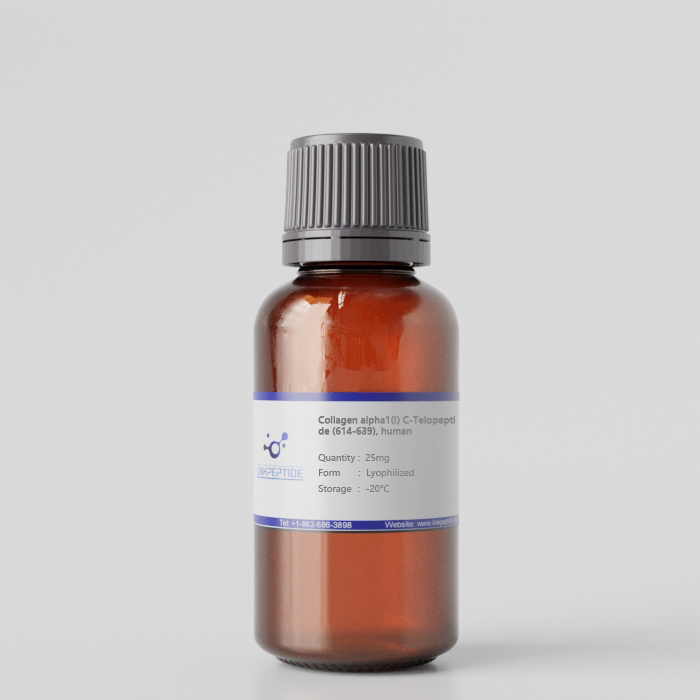
Product Name: Collagen alpha1(I) C-Telopeptide (614-639), human
Sequence One Letter Code: SAGFDFSFLPQPPQEKAHDGGRYYRA
Sequence Three Letter Code: H-Ser-Ala-Gly-Phe-Asp-Phe-Ser-Phe-Leu-Pro-Gln-Pro-Pro-Gln-Glu-Lys-Ala-His-Asp-Gly-Gly-Arg-Tyr-Tyr-Arg-Ala-OH
Chemical Formula:C134H189N37O39
Molecular Weight: 2942.4
Purity: 95%
Form: Lyophilized
Storage Conditions: - 20 °C
Research Area: Peptide Series
Source / Species: human
Conjugation: Unconjugated
Code Nacres: NA.26
Application: Collagen α1(I) C-telopeptide (614–639), human is a synthetic peptide derived from the C-terminal telopeptide region of type I collagen. This domain contributes to collagen fibril assembly and extracellular matrix organization. The peptide can inhibit collagen fibrillogenesis and is used to study matrix assembly, tissue remodeling, and fibrosis-related mechanisms. It supports research into extracellular matrix dynamics, connective tissue biology, and pathological conditions characterized by abnormal collagen deposition.
Current Research: Type I collagen is the most abundant structural protein in the extracellular matrix (ECM) of connective tissues, providing tensile strength and structural integrity to skin, bone, tendon, and fibrotic tissues. It is composed of two α1(I) chains and one α2(I) chain that assemble into a triple-helical structure, flanked by short non-helical regions known as telopeptides at both the N- and C-termini. The Collagen α1(I) C-telopeptide (614–639), human is a synthetic peptide corresponding to the C-terminal telopeptide region of the α1(I) chain. This domain plays a critical role in collagen fibril assembly and intermolecular crosslinking, making it a valuable tool for studying extracellular matrix organization and remodeling. Unlike the central triple-helical region of collagen, the telopeptides are non-helical and contain residues essential for covalent crosslink formation mediated by lysyl oxidase. These crosslinks stabilize collagen fibrils and contribute to mechanical strength in mature tissues. The C-telopeptide region participates in intermolecular alignment during fibrillogenesis, influencing nucleation, lateral growth, and fibril diameter. By isolating this specific sequence, researchers can examine how discrete domains contribute to higher-order collagen assembly. The synthetic C-telopeptide (614–639) is frequently used as a competitive inhibitor of collagen fibrillogenesis. When added to in vitro fibril formation assays, the peptide can interfere with proper molecular alignment and crosslinking interactions between collagen monomers. Turbidity assays monitoring fibril formation kinetics demonstrate delayed nucleation or reduced fibril growth in the presence of the telopeptide fragment. This approach allows mechanistic dissection of how telopeptide-mediated contacts drive supramolecular organization. In studies of extracellular matrix dynamics, the peptide supports investigation of collagen self-assembly under controlled conditions. By modulating concentration, pH, and ionic strength, researchers can characterize the structural contribution of the C-terminal telopeptide to fibril morphology using electron microscopy or atomic force microscopy. These analyses clarify how alterations in telopeptide interactions influence fibril stability and architecture. The Collagen α1(I) C-telopeptide is also relevant in fibrosis research. Excessive collagen deposition and abnormal crosslinking are hallmarks of fibrotic diseases affecting organs such as the liver, lung, heart, and kidney. Disruption of normal fibrillogenesis pathways contributes to pathological matrix stiffening and impaired tissue function. By using the C-telopeptide fragment to perturb collagen assembly, investigators can model aspects of altered matrix organization observed in fibrosis. This facilitates exploration of therapeutic strategies targeting collagen crosslinking or assembly pathways. In connective tissue biology, the peptide aids in studying cell–matrix interactions. Collagen fibril formation influences integrin engagement, mechanotransduction, and cellular differentiation. By modulating fibrillogenesis in vitro, researchers can evaluate how changes in matrix structure affect fibroblast behavior, myofibroblast activation, and tissue remodeling responses. Such studies are central to understanding wound healing, scar formation, and tissue regeneration. Additionally, the C-telopeptide domain is clinically relevant as a biomarker of collagen turnover. Fragments derived from this region are released during collagen degradation and are used in diagnostic assays to assess bone resorption and connective tissue metabolism. Although the synthetic peptide itself is not a degradation product, it reflects a functionally significant domain involved in collagen maturation and remodeling. In summary, Collagen α1(I) C-telopeptide (614–639), human is a defined peptide derived from the non-helical C-terminal region of type I collagen. By influencing fibrillogenesis and crosslink formation, it serves as a valuable tool for studying extracellular matrix assembly, tissue remodeling, and fibrosis-related mechanisms. Its application advances understanding of collagen organization and supports research into connective tissue biology and pathological matrix deposition.
Get a Quote
 LinkPeptide