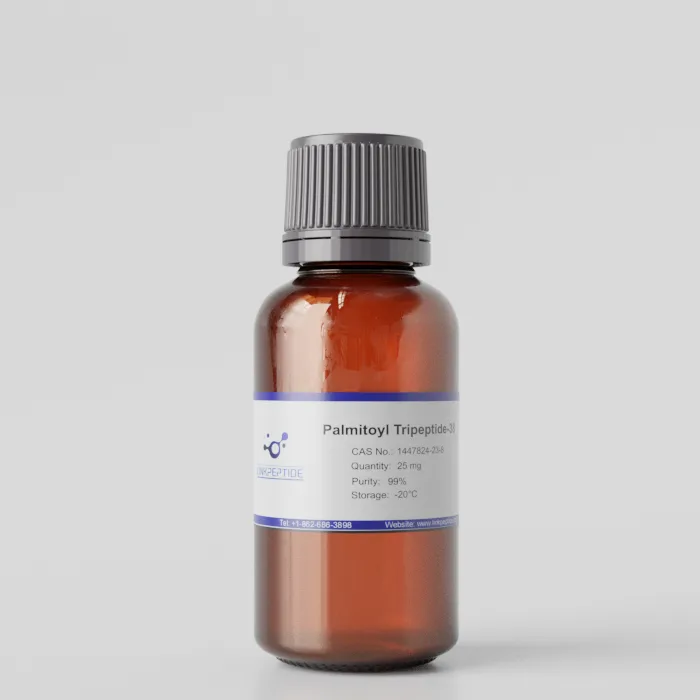
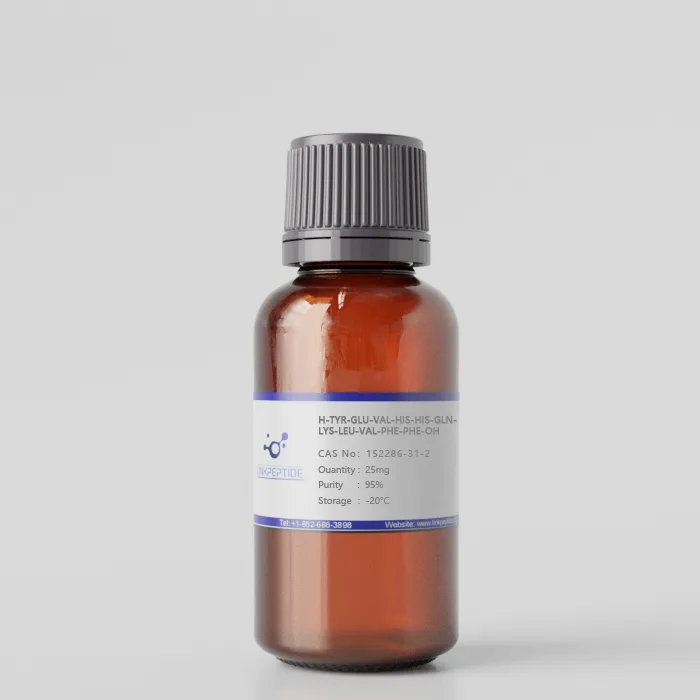
Product Name: Palmitoyl Tripeptide-38
Cas No: 1447824-23-8
Purity: 99%
Form: Acetate Salt
Chemical Formula: C33H65N5O7S
Molar Mass: 676.02
Synonyms: Palmitoyl lysyldioxymethionyllysine; UNII-T7A529FB8O; T7A529FB8O
IUPAC Name: (2S)-6-amino-2-[[(2S)-2-[[(2S)-6-amino-2-(hexadecanoylamino)hexanoyl]amino]-4-methylsulfonylbutanoyl]amino]hexanoic acid
SMILES: CCCCCCCCCCCCCCCC(=O)NC@@HC(=O)NC@@HC)C(=O)NC@@HC(=O)O
InChIKey: RGXYBFJDNNODFP-AWCRTANDSA-N
InChI: InChI=1S/C33H65N5O7S/c1-3-4-5-6-7-8-9-10-11-12-13-14-15-22-30(39)36-27(20-16-18-24-34)31(40)37-28(23-26-46(2,44)45)32(41)38-29(33(42)43)21-17-19-25-35/h27-29H,3-26,34-35H2,1-2H3,(H,36,39)(H,37,40)(H,38,41)(H,42,43)/t27-,28-,29-/m0/s1
Storage: -20 degree Celsius
Sequence: KXK
Application:
Palmitoyl Tripeptide-38 is a next-generation Matrixyl®-family peptide designed to support six major components of the skin matrix, including collagen I, III, and IV. Built on a palmitoylated structure for enhanced penetration, it helps reduce the appearance of wrinkles, plump facial contours, and improve dermal density. Its mechanism focuses on rebuilding the skin’s architecture, resulting in smoother texture and improved firmness. Because of its strong performance in clinical applications, Palmitoyl Tripeptide-38 is widely used in high-end anti-aging serums, eye-area treatments, and skin-renewal creams seeking visible, multi-dimensional rejuvenation benefits.
Current Research:
Palmitoyl Tripeptide-38 (Matrixyl® Synthe’6) – Current Research Overview
Palmitoyl Tripeptide-38 is a next-generation member of the Matrixyl® peptide family, specifically developed to stimulate multiple components of the skin’s extracellular matrix (ECM) and dermal–epidermal junction (DEJ). Chemically, it is a palmitoylated tripeptide (Pal-Lys-Met(O₂)-Lys), where the lipid chain enhances skin penetration and the peptide sequence is designed to act as a signal fragment for matrix repair. Current research describes Palmitoyl Tripeptide-38 as a multi-target anti-aging active that improves wrinkle depth, skin firmness, and surface smoothness by upregulating six major matrix and DEJ constituents.
Palmitoyl Tripeptide-38 was engineered as an evolution of earlier Matrixyl peptides, with a focus on broader matrix stimulation. The tripeptide sequence mimics specific fragments of collagen and other matrix proteins; the palmitoyl group increases affinity for skin lipids and improves bioavailability in topical formulations. This combination allows the peptide to interact effectively with fibroblasts and keratinocytes in the upper dermis and at the DEJ.
Its “six-target” concept refers to stimulation of key structural components: collagen I, III, IV, fibronectin, hyaluronic acid, and laminin-5. Together, these molecules are critical for dermal density, hydration, and the mechanical coupling between dermis and epidermis.
In vitro studies with human dermal fibroblasts and reconstructed skin models show that Palmitoyl Tripeptide-38 can significantly increase the synthesis of:
Collagen I and III – the main fibrillar collagens responsible for dermal strength and elasticity.
Collagen IV and laminin-5 – core components of the basement membrane and DEJ.
Fibronectin – a glycoprotein that organizes collagen fibers and supports cell adhesion.
Hyaluronic acid – the primary glycosaminoglycan responsible for water retention and dermal volume.
The combined upregulation of these components supports both vertical (dermal density) and horizontal (DEJ integrity) reinforcement of skin structure. This is in contrast to older actives that might affect only one or two matrix elements. By targeting multiple proteins simultaneously, Palmitoyl Tripeptide-38 aims to create a more coordinated remodeling response.
Supplier-sponsored clinical studies on Palmitoyl Tripeptide-38 typically involve twice-daily application of creams or serums containing the peptide at concentrations around 2%. Using profilometry and high-resolution imaging, these trials have reported:
Reduction in wrinkle volume and depth, particularly on the forehead and around the eyes.
Smoother skin microrelief, with finer surface lines and improved texture.
Improved plumpness in areas where the skin tends to hollow or crease.
Some studies highlight “filler-like” effects, describing the peptide as helping to visibly fill in both micro- and macro-relief wrinkles within a few weeks. Although not equivalent to injectable fillers, the peptide’s ability to enhance hyaluronic acid and collagen synthesis provides a mechanistic explanation for these volumizing effects.
While Palmitoyl Tripeptide-38 is often summarized as a “collagen-boosting peptide,” newer interpretations emphasize its global impact on the dermal architecture:
By increasing collagen IV, laminin-5, and fibronectin, it strengthens the DEJ, which tends to flatten and weaken with age. A more structured DEJ improves nutrient exchange, mechanical coupling, and overall skin resilience.
Hyaluronic acid stimulation supports internal hydration and turgor, contributing to a plumper, more youthful appearance.
The peptide’s influence on fibronectin helps organize newly synthesized collagen fibers into a more functional, elastic network.
This multi-level ECM support makes Palmitoyl Tripeptide-38 especially suitable for targeting photoaging and chronological aging, where matrix fragmentation, dehydration, and DEJ degradation all play roles.
Available safety data indicate that Palmitoyl Tripeptide-38 is well tolerated in cosmetic use. Standard in vitro and in vivo toxicological assessments (including irritation and sensitization tests) show no significant concerns at the concentrations typically employed in leave-on products. Its peptide structure is relatively small and non-ionic, and the palmitoyl modification, while increasing lipophilicity, does not introduce problematic reactivity at cosmetic levels.
Because of its good tolerability, Palmitoyl Tripeptide-38 is used in a wide range of formulations: eye creams, serums, anti-wrinkle moisturizers, and even foundations or hybrid skincare–makeup products that promise long-term anti-aging benefits.
Formulators often position Palmitoyl Tripeptide-38 in premium anti-aging products, either as the hero ingredient or in combination with other technologies such as vitamin C derivatives, niacinamide, retinoid-like actives, or other Matrixyl family peptides. Encapsulation in liposomes or association with lamellar lipid systems is being explored to further enhance deposition in the upper dermis and prolong activity.
Future research directions include deeper mechanistic studies on gene expression patterns, synergy with other peptides, and comparative trials versus standard anti-aging benchmarks like retinol. There is also interest in understanding how Palmitoyl Tripeptide-38 performs in “prejuvenation” routines for younger skin vs. corrective protocols for mature, photoaged skin.
Reference:
Get a Quote
 LinkPeptide