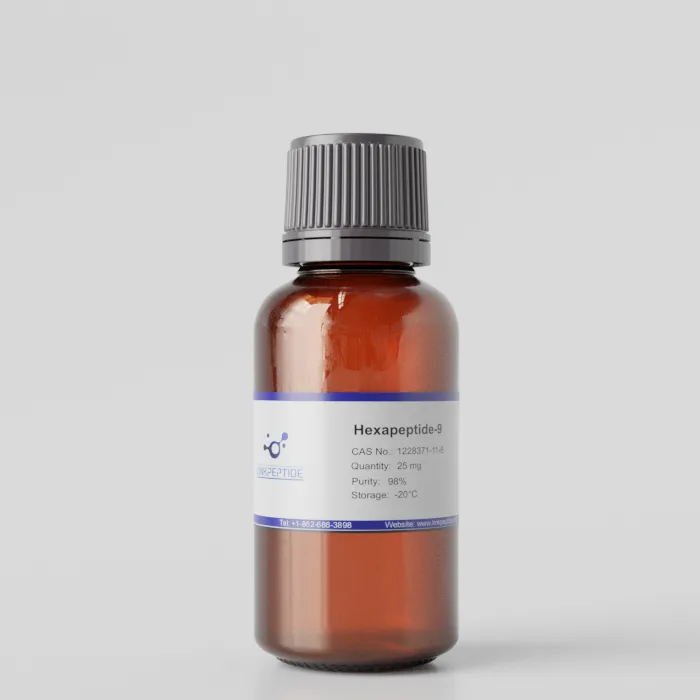
Product Name: Hexapeptide-9
Cas No: 1228371-11-6
Purity: 98%
Form: Acetate Salt
Chemical Formula: C24H38N8O9
Molar Mass: 582.6
Synonyms: Apepbiosix-5; Hexapeptide-9 [INCI]; Gly-Pro-Gln-Gly-Pro-Gln
IUPAC Name: (2S)-5-amino-2-[[(2S)-1-[2-[[(2S)-5-amino-2-[[(2S)-1-(2-aminoacetyl)pyrrolidine-2-carbonyl]amino]-5-oxopentanoyl]amino]acetyl]pyrrolidine-2-carbonyl]amino]-5-oxopentanoic acid
SMILES: C1CC@HCN)C(=O)NC@@HC(=O)NCC(=O)N2CCC[C@H]2C(=O)NC@@HC(=O)O
InChIKey: OGNHOGPWQTWKGQ-VGWMRTNUSA-N
InChI: InChI=1S/C24H38N8O9/c25-11-19(35)31-9-1-3-15(31)22(38)29-13(5-7-17(26)33)21(37)28-12-20(36)32-10-2-4-16(32)23(39)30-14(24(40)41)6-8-18(27)34/h13-16H,1-12,25H2,(H2,26,33)(H2,27,34)(H,28,37)(H,29,38)(H,30,39)(H,40,41)/t13-,14-,15-,16-/m0/s1
Storage: -20 degree Celsius
Sequence: GPQGPQ
Application:
Hexapeptide-9 (GPQGPQ) is a collagen-supporting peptide designed to promote visible skin repair and wrinkle reduction. Known for its role in reinforcing the extracellular matrix, it helps enhance dermal density and smooth the appearance of fine lines. Its sequence mimics natural collagen fragments, providing a targeted signal that encourages skin regeneration and improved firmness over time. Hexapeptide-9 performs well in rejuvenating serums, eye-area treatments, and intensive repair creams. With excellent stability and formulation flexibility, it is valued by developers aiming to deliver gentle yet effective anti-aging performance suitable for all skin types, including sensitive and mature skin.
Current Research:
Hexapeptide-9 (GPQGPQ) – Current Research Overview
Hexapeptide-9 is a synthetic collagen-mimetic peptide widely used in modern anti-aging skincare. Its sequence, Gly-Pro-Gln-Gly-Pro-Gln (GPQGPQ), repeats a fragment found in human collagen types IV and XVII, two key basement-membrane collagens. Because of this structural homology, Hexapeptide-9 is often described as a “collagen fragment signal peptide” that can emulate the skin’s natural wound-healing and remodeling cues. Current research highlights its role in stimulating collagen synthesis, reinforcing the dermal–epidermal junction, promoting epidermal renewal, and delivering clinically visible improvements in wrinkles, firmness, and texture.
Unlike many neuropeptides or neurotransmitter-mimetic cosmetic peptides, Hexapeptide-9 is rooted in collagen biology. Its sequence corresponds to repeated motifs present in collagen IV and XVII, which form an important part of the basement membrane anchoring the epidermis to the dermis. In aging or photo-damaged skin, these structures become fragmented and weakened. By supplying a stable, defined collagen-like fragment, Hexapeptide-9 acts as a biomimetic signal, reminding fibroblasts and keratinocytes to restart matrix repair programs that are dampened with age.
The peptide itself is small, water-soluble, and relatively stable, with a molecular weight around 582 Da. This size is favorable for topical application and helps formulators combine it with other water-phase actives such as humectants, niacinamide, and classic anti-aging agents.
In vitro research on human dermal fibroblasts shows that Hexapeptide-9 can stimulate the synthesis of multiple structural components of the dermal matrix. Reported effects include increases in type I and type IV collagen as well as enhanced production of laminin-5 and certain integrins associated with dermal–epidermal junction integrity. By reinforcing both the bulk collagen network and the basement membrane, the peptide aims to restore better mechanical support to the overlying epidermis.
Some studies also observe a rise in hyaluronic acid production in fibroblast cultures treated with Hexapeptide-9. Hyaluronic acid is a key glycosaminoglycan responsible for water retention and volume in the dermis. The combined increase in collagen and hyaluronic acid provides a mechanistic explanation for the peptide’s ability to improve skin firmness, elasticity, and hydration in cosmetic use.
Beyond fibroblasts, Hexapeptide-9 has been reported to influence epidermal cells. Experimental data suggest it can promote keratinocyte differentiation and accelerate epidermal turnover. This supports faster renewal of the stratum corneum and contributes to smoother texture and a more even skin surface. In the context of compromised or damaged skin, the peptide is often described as supporting repair through better cell–matrix interactions and reinforcement of the dermal–epidermal junction.
Some work also notes improved expression of proteins involved in cell adhesion and basement-membrane integrity. This aligns with the idea that Hexapeptide-9 not only builds “more collagen,” but also helps organize the junction where epidermis and dermis meet, a region that typically flattens and weakens with age.
Multiple cosmetic-industry studies, including company-sponsored clinical trials, report visible anti-aging benefits from formulations containing Hexapeptide-9. Measured outcomes generally include reductions in fine lines and deeper wrinkles, especially on the forehead and around the eyes, along with improvements in skin firmness, elasticity, and perceived smoothness.
A recent clinical trial on a cyclized derivative of Hexapeptide-9 compared its performance to that of topical retinol in a randomized, double-blind, vehicle-controlled design. The cyclic peptide showed strong anti-wrinkle activity, improvement in skin elasticity, better barrier function, and reductions in uneven pigmentation, and in that study setting it performed at least as well as, and in some parameters better than, the retinol benchmark. This work suggests that optimizing the conformation of the Hexapeptide-9 backbone can further enhance clinical efficacy while potentially improving tolerability compared with classic retinoids.
Recent safety assessments classify Hexapeptide-9 as a skin-protecting cosmetic ingredient with a good safety profile at typical leave-on concentrations. It is listed in major cosmetic ingredient inventories and has been used in a wide variety of products, including face creams, eye serums, and high-performance anti-aging treatments. Toxicological end points evaluated include acute toxicity, irritation, sensitization, phototoxicity, and genotoxicity, with no significant safety concerns observed at use levels around 1% or below in leave-on applications.
Current R&D directions focus on two main areas: structural optimization and delivery systems. Cyclized or otherwise conformationally constrained versions of Hexapeptide-9 are being explored to improve receptor binding, resistance to enzymatic degradation, and overall potency. At the same time, formulators are developing more sophisticated carriers—such as liposomes, microemulsions, and hybrid peptide–polymer systems—to enhance penetration and stability in real-world formulations.
As the cosmetic peptide field continues to evolve, Hexapeptide-9 stands out as a well-characterized collagen-mimetic signal peptide with clinically supported anti-wrinkle and firming activity. Its combination of strong mechanistic rationale, promising clinical data, and good safety makes it a central building block for next-generation anti-aging and skin-repair product lines.
Reference:
Get a Quote
 LinkPeptide