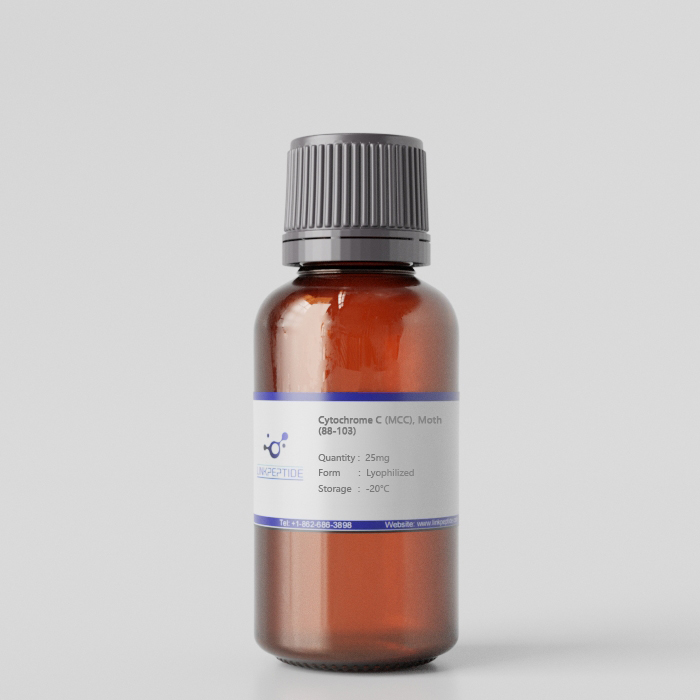
Product Name: Cytochrome C (MCC), Moth (88-103)
Sequence One Letter Code: ANERADLIAYLKQATK
Sequence Three Letter Code: H-Ala-Asn-Glu-Arg-Ala-Asp-Leu-Ile-Ala-Tyr-Leu-Lys-Gln-Ala-Thr-Lys-OH
Chemical Formula:C79H133N23O25
Molecular Weight: 1805.2
Purity: 95%
Form: Lyophilized
Storage Conditions: - 20 °C
Research Area: Inflammation and Immunology Research
Source / Species: moth
Conjugation: Unconjugated
Code Nacres: NA.26
Application: Cytochrome C (MCC), Moth (88–103) is a synthetic peptide corresponding to residues 88–103 of moth cytochrome c and serves as a classical model antigen in immunological research. This peptide has been extensively used in conjunction with pigeon cytochrome c–specific T cell receptors to investigate thymocyte development and T cell selection processes. MCC (88–103) can induce positive selection of TCR transgenic thymocytes, providing a well-defined system for studying T cell receptor signaling thresholds and antigen recognition specificity. The peptide is particularly suited for analyses involving MHC class II–restricted presentation and CD4⁺ T cell activation. It supports mechanistic investigations into central tolerance, thymic selection, and TCR–peptide–MHC interactions. As a reproducible and structurally defined antigenic stimulus, MCC (88–103) remains a valuable tool for dissecting immune recognition mechanisms and signaling pathways that govern adaptive immune development.
Current Research: Cytochrome C (MCC), Moth (88–103) is a synthetic peptide corresponding to amino acid residues 88–103 of moth cytochrome c and represents one of the most extensively characterized model antigens in cellular immunology. Commonly referred to as MCC (88–103), this peptide has played a foundational role in defining mechanisms of T cell development, antigen recognition, and thymic selection. Its use in well-established T cell receptor (TCR) transgenic systems has provided critical insights into how peptide–MHC interactions shape adaptive immunity. MCC (88–103) is presented by MHC class II molecules and is particularly suited for studying CD4⁺ T cell responses. In classical experimental systems, it is recognized by pigeon cytochrome c–specific TCRs, allowing precise examination of TCR–peptide–MHC interactions. Because both the peptide sequence and the TCR specificity are well defined, MCC provides a highly controlled framework for dissecting signaling thresholds and ligand discrimination mechanisms. One of the most significant applications of MCC (88–103) is in the study of thymocyte development and central tolerance. In TCR transgenic mouse models, controlled exposure to this peptide can induce positive selection of developing thymocytes, enabling investigation of the signaling strength and affinity requirements that determine cell fate. By modulating peptide concentration or affinity, researchers can explore how subtle differences in TCR engagement influence positive selection, negative selection, or clonal deletion. The peptide has also been instrumental in elucidating the concept of altered peptide ligands. Variants of MCC (88–103) with single amino acid substitutions have been used to probe how changes in peptide–MHC binding stability or TCR contact residues affect downstream signaling outcomes. These studies have clarified how T cells discriminate between agonists, partial agonists, and antagonists, and how graded signaling translates into distinct functional responses. In mechanistic signaling research, MCC (88–103) supports analysis of proximal TCR signaling events, including phosphorylation of CD3 chains, activation of ZAP-70, and downstream MAPK pathway engagement. Its reproducibility allows detailed kinetic studies of calcium flux, cytokine production, and transcription factor activation in CD4⁺ T cells. This makes it a valuable reagent for dissecting the molecular pathways that govern T cell activation and differentiation. Beyond thymic selection, MCC (88–103) is frequently applied in peripheral immune studies examining helper T cell function, immune memory formation, and tolerance induction. Because it provides a consistent and structurally defined antigenic stimulus, it enables comparison of T cell responses across experimental conditions and genetic backgrounds. The peptide’s defined interaction with specific MHC class II molecules also supports structural investigations of TCR–peptide–MHC complexes. Crystallographic and biophysical analyses using MCC-derived systems have contributed substantially to understanding the structural basis of immune recognition, including how TCR docking geometry influences signaling efficiency. Overall, Cytochrome C (MCC), Moth (88–103) remains a cornerstone reagent in immunological research. Its well-characterized properties, compatibility with TCR transgenic models, and suitability for MHC class II–restricted presentation studies make it an indispensable tool for investigating central tolerance, T cell selection, and adaptive immune signaling mechanisms.
Get a Quote
 LinkPeptide