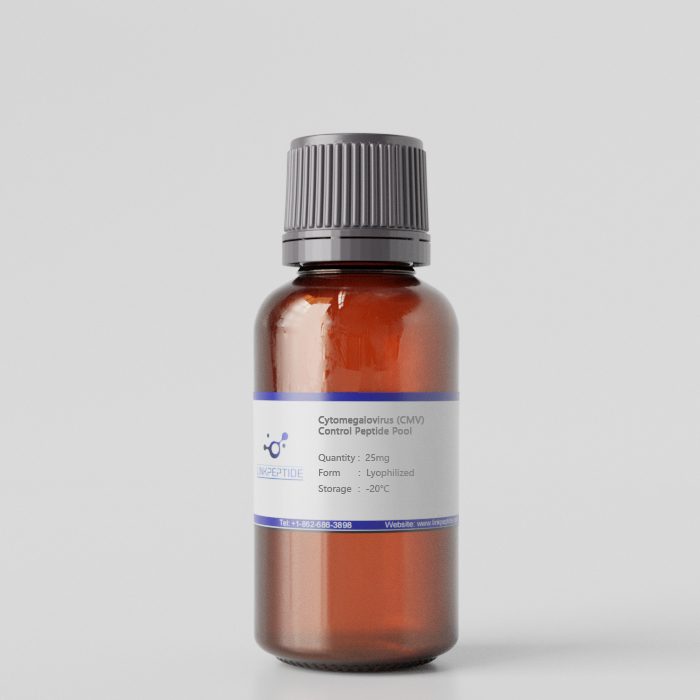
Product Name: Cytomegalovirus (CMV) Control Peptide Pool - 1.25 mg
Purity: 95%
Form: Lyophilized
Storage Conditions: - 20 °C
Research Area: Inflammation and Immunology Research
Source / Species: CMV
Conjugation: Unconjugated
Code Nacres: NA.26
Application: The CMV Control Peptide Pool comprises five well-characterized cytomegalovirus-derived epitopes commonly employed as positive controls in cellular immune assays. These peptides stimulate interferon-γ secretion from CMV-specific CD8⁺ T lymphocytes in individuals expressing compatible HLA alleles. The pool is extensively utilized in ELISPOT, intracellular cytokine staining (ICS), flow cytometry–based activation assays, and cytotoxic T lymphocyte (CTL) assays to verify antigen-specific T cell responsiveness. By providing a robust and reproducible immune stimulus, it serves as a benchmark for evaluating assay sensitivity, sample viability, and overall T cell function. This peptide mixture is particularly valuable in clinical immunomonitoring, vaccine studies, transplantation research, and infectious disease investigations where validation of cellular immune competence is essential.
Current Research: Human cytomegalovirus (CMV) is one of the most extensively studied persistent viral infections due to its strong and long-lasting interaction with the human immune system. CMV infection induces robust cellular immune responses, particularly involving CD8⁺ cytotoxic T lymphocytes, which can persist at high frequencies for decades after primary infection. Because of this durable and antigen-specific immune memory, CMV-derived epitopes are widely used as positive controls in cellular immune assays. The CMV Control Peptide Pool, composed of several well-characterized CMV epitopes, has become an essential reagent in immunological research and clinical immunomonitoring. Recent studies have emphasized the importance of CMV peptide pools in evaluating T cell functionality and immune competence in both research and clinical settings. In many experimental workflows, CMV peptides are used to confirm that peripheral blood mononuclear cells (PBMCs) or isolated T cell populations remain viable and capable of mounting antigen-specific responses. Upon stimulation with CMV peptides, CMV-specific CD8⁺ T cells rapidly produce interferon-γ (IFN-γ) and other effector cytokines, enabling reliable detection through assays such as ELISPOT, intracellular cytokine staining (ICS), and flow cytometry–based activation assays. Because the magnitude and reproducibility of these responses are well documented, CMV peptide pools serve as a benchmark for validating assay sensitivity and performance. One major area of current research involves the use of CMV peptide controls in immune monitoring during vaccine development. Modern vaccine studies often require precise evaluation of antigen-specific T cell responses following immunization. CMV peptide pools are frequently incorporated as internal controls to ensure that immune cells within a sample are responsive and capable of producing cytokines under stimulation conditions. This is particularly important when evaluating new vaccines targeting viral infections, cancer antigens, or emerging pathogens. By confirming that CMV-specific T cells respond appropriately, researchers can distinguish between genuine vaccine non-responsiveness and technical or sample-related issues. Another growing application is in transplantation immunology, where CMV-specific immune responses are closely monitored in transplant recipients. CMV reactivation represents a significant clinical risk after hematopoietic stem cell or solid organ transplantation due to immunosuppressive therapy. Studies have shown that measuring CMV-specific CD8⁺ T cell activity can help predict a patient’s ability to control viral replication. CMV peptide pools are therefore commonly used to stimulate T cells in assays that quantify functional antiviral immunity, assisting clinicians in assessing immune reconstitution and determining the risk of CMV disease. In addition to clinical monitoring, CMV peptide pools are increasingly applied in advanced immune profiling technologies. High-dimensional flow cytometry and single-cell analysis platforms now allow researchers to characterize the phenotype and functional diversity of CMV-specific T cells with unprecedented detail. These studies have revealed that CMV infection drives the expansion of highly differentiated memory T cell populations with unique metabolic and transcriptional features. The use of defined peptide epitopes within CMV control pools enables precise stimulation of these cells, facilitating investigations into T cell exhaustion, memory formation, and long-term immune maintenance. Another important research direction involves the integration of CMV peptide stimulation with cytotoxic T lymphocyte (CTL) assays. These experiments measure the ability of CMV-specific CD8⁺ T cells to recognize and kill target cells presenting viral epitopes. Such assays provide insights into T cell-mediated antiviral defense mechanisms and are frequently used to evaluate the potency of adoptive T cell therapies or engineered immune cell products. Overall, CMV control peptide pools remain indispensable tools in modern immunology. Their ability to reliably stimulate antigen-specific CD8⁺ T cell responses makes them ideal positive controls for validating immune assays and assessing cellular immune competence. As immunological technologies continue to evolve, CMV peptide pools will remain central to studies exploring T cell biology, immune monitoring, vaccine evaluation, and the development of novel immunotherapies.
Get a Quote
 LinkPeptide