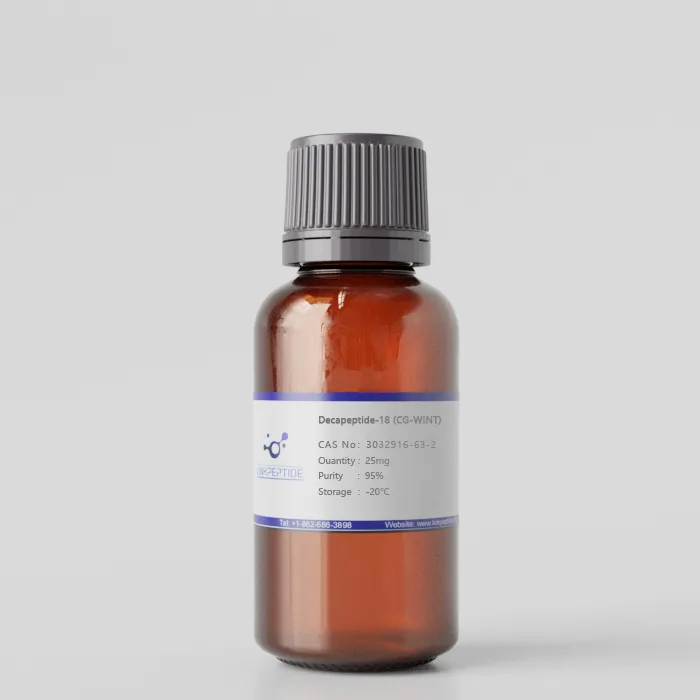
Product Name: Decapeptide-18 (CG-WINT)
Cas No: 3032916-63-2
Purity: 95%
Storage: Keep in dark and cool dry place -5~8 degree Celsius
Molar Mass: 1287.49
Application:
Decapeptide-18 (CG-WINT) is a biomimetic signaling peptide inspired by the WNT pathway, widely used in cosmetic research targeting hair and skin regeneration. Composed of ten amino acids, it supports studies on enhancing follicle vitality, promoting stronger, healthier-looking hair, and improving scalp resilience. In skincare applications, Decapeptide-18 is valued for its role in encouraging a smoother, rejuvenated appearance by supporting natural renewal mechanisms. Its excellent water solubility and formulation flexibility make it suitable for serums, scalp concentrates, and advanced rejuvenating treatments aimed at revitalizing stressed skin and promoting the look of fuller, more resilient hair.
Current Research:
Decapeptide-18 (CG-WINT): Current Cosmetic Research & Positioning
Decapeptide-18, marketed as CG-WINT, is a synthetic ten–amino-acid peptide designed to activate the Wnt/β-catenin pathway, a key signaling route in hair follicle development and regeneration. In cosmetics, it is positioned as a high-performance hair growth and hair-density peptide, frequently used in advanced scalp serums, lash and brow boosters, and anti-hair-loss systems.
Hair follicles rely on tightly regulated signaling to enter the growth (anagen) phase and to form new hair shafts. Among those signals, the Wnt/β-catenin pathway is central to:
Hair follicle morphogenesis and placode formation
Activation of epithelial follicle stem cells
Differentiation of these stem cells into hair keratinocytes
Decapeptide-18 is described as a Wnt10-derived peptide or a β-catenin–mimetic fragment. By mimicking part of this signaling machinery, it helps trigger the same cascade that encourages follicle stem cells to form new hair structures. In cosmetic terms, this is typically translated to:
Stimulating the formation of new hair follicles or hair “substrate”
Helping generate hair de novo in areas of thinning
Supporting thicker, more robust hair shafts over time
Technical and marketing data for Decapeptide-18 consistently frame it as a hair growth promoter:
It encourages follicles to shift from resting (telogen) to growth (anagen) phase.
It supports the formation of hair placodes and the hair basal lamina, both important for new follicle structures.
It is credited with increasing hair count and hair thickness, particularly in thinning-prone areas such as the frontal scalp or crown.
In finished formulas (serums, tonics, ampoules), users are typically promised visible cosmetic results such as:
Fuller-looking hair and improved overall density
Stronger, thicker eyelashes and eyebrows
A healthier-looking, more vital scalp
These claims are framed within the cosmetic domain, emphasizing appearance rather than therapeutic treatment.
Decapeptide-18 is rarely used alone in modern formulations. It is commonly combined with:
Decapeptide-10 (CG-Keramin2) – a DKK-1–modulating peptide that supports hair cell proliferation and migration.
Oligopeptide-54 (CG-Nokkin) – frequently positioned as another Wnt-related or follicle-environment peptide.
Additional hair peptides (biotinoyl tripeptide, copper peptides, acetyl tetrapeptide-3) to target multiple mechanisms such as microcirculation, anchoring proteins, and inflammation.
In this context, Decapeptide-18 is often framed as the “new follicle” or “placode formation” specialist, giving a strong mechanistic story around Wnt/β-catenin activation.
Because of its targeted action, Decapeptide-18 is used in a range of hair and lash products:
Scalp serums and leave-on tonics for thinning hair
Anti-hair-loss shampoos and conditioners as part of a system
Lash and brow serums, where its follicle-activating mechanism supports longer, thicker-looking lashes and brows
For brands, this allows a unified “from scalp to lashes” platform built around follicle neogenesis and Wnt/β-catenin stimulation.
Decapeptide-18 is typically supplied as a white to off-white powder with high purity, intended for cosmetic use:
Water-soluble, suitable for aqueous serums, gels, and emulsions
Usually added in the cool-down phase to preserve peptide structure
Compatible with common hair-care actives (caffeine, niacinamide, panthenol, plant extracts) and with mild surfactant systems
It’s often used at low active levels, which helps maintain good skin and scalp tolerance while still providing a strong marketing and mechanistic story.
Get a Quote
 LinkPeptide