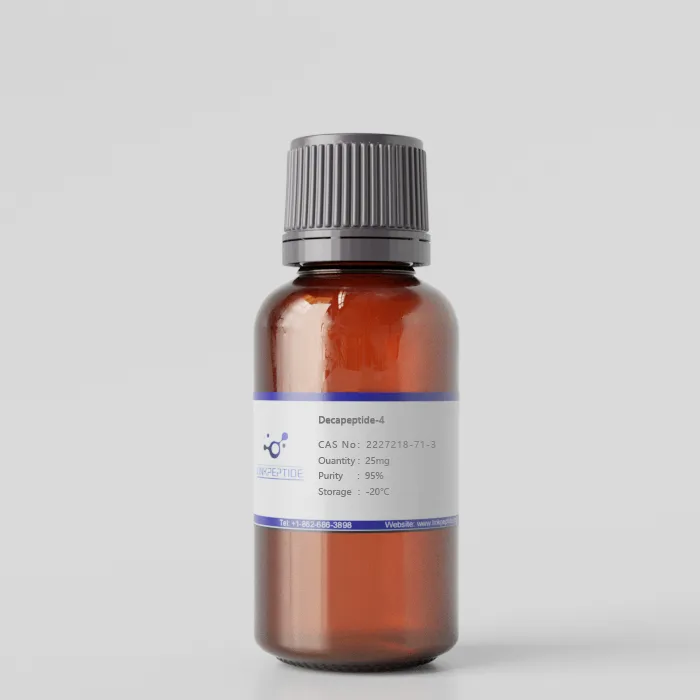
Product Name: Decapeptide-4
Cas No: 2227218-71-3
Purity: 95%
Storage: Keep in dark and cool dry place -5~8 degree Celsius
Sequence: Cys-Asp-Leu-Arg-Arg-Leu-Glu-Met-Tyr-Cys
Application:
Decapeptide-4 is a biomimetic peptide composed of ten amino acids, valued in cosmetic research for its ability to support skin regeneration, firmness, and overall rejuvenation. Known for enhancing cellular communication and promoting key structural components of the extracellular matrix, Decapeptide-4 helps improve elasticity, refine texture, and reduce the appearance of fine lines. It is commonly used in premium anti-aging formulations aimed at restoring vitality and strengthening the skin barrier. With excellent stability and formulation versatility, Decapeptide-4 integrates seamlessly into serums, creams, and advanced treatments designed to deliver a smoother, firmer, and more youthful-looking complexion.
Current Research:
Decapeptide-4: Current Research Overview
Decapeptide-4 (often marketed under trade names such as CG-IDP2) is a synthetic signal peptide positioned as a growth-factor-mimetic ingredient for intensive skin repair and anti-aging. Structurally, it is a decapeptide designed to mimic a short sequence of insulin-like growth factor-1 (IGF-1 / Somatomedin C), a key regulator of skin growth, healing, and matrix renewal.
By reproducing a specific IGF-1 fragment, Decapeptide-4 aims to activate similar cellular pathways to those triggered by endogenous growth factors, but in a more controlled, cosmetic-appropriate way. This makes it attractive for formulas targeting wrinkles, loss of firmness, and impaired skin regeneration, especially in mature or stressed skin.
Mechanism of Action: Growth-Factor-Mimetic Signal Peptide
Current technical and review sources describe Decapeptide-4 as a signal peptide that binds to IGF-1–related receptors on keratinocytes and fibroblasts, promoting cell proliferation and ECM synthesis.
Key mechanistic themes include:
Stimulation of keratinocyte and fibroblast proliferation
In vitro studies from manufacturers show that Decapeptide-4 increases keratinocyte and fibroblast cell counts within ~72 hours, suggesting enhanced epidermal turnover and dermal renewal.
Boosting collagen, elastin, and hyaluronic acid
The peptide is reported to up-regulate synthesis of collagen and elastin, improving dermal density and elasticity, and to support hyaluronic acid production, which enhances hydration and plumpness.
Support for wound repair and barrier recovery
Because IGF-1 family pathways are involved in normal wound healing, Decapeptide-4 is positioned as an ingredient that can support post-procedure recovery and help repair skin damaged by environmental stressors (UV, pollution, irritants).
Collectively, these effects align with the modern concept of “regenerative” cosmetic actives that go beyond simple moisturization and target cellular behavior and ECM architecture.
Role in Contemporary Cosmetic Peptide Research
Decapeptide-4 fits into the “growth-factor-like” subgroup of cosmetic peptides, distinct from classic matrikines or simple collagen-stimulating signal peptides. As a Somatomedin C–mimetic, it sits alongside EGF-like and FGF-like cosmetic actives that seek to harness the benefits of growth factor biology without using actual recombinant proteins.
Recent cosmetic science trends emphasize:
Regeneration over simple anti-wrinkle: supporting epidermal and dermal renewal, not just smoothing lines.
Multi-pathway modulation: stimulating collagen, elastin, and GAGs simultaneously for more global improvement in firmness, texture, and hydration.
Post-procedure and recovery concepts: pairing growth-factor-mimetic peptides with soothing, barrier-supportive ingredients in “intensive repair” serums, ampoules, and masks.
Decapeptide-4 is often highlighted in this context as a versatile peptide that can be used both in daily anti-aging care and in post-procedure recovery products.
In Vitro, Ex Vivo, and Application Data
Most available data for Decapeptide-4 come from supplier studies, technical dossiers, and secondary technical reviews rather than large independent clinical trials.
Reported findings include:
In vitro
Increased proliferation of keratinocytes and fibroblasts.
Enhanced synthesis of collagen and elastin.
Upregulation of components associated with improved hydration (e.g., hyaluronic-acid-related pathways).
Skin model observations
Ex vivo or reconstructed skin models treated with the peptide show denser collagen networks and improved tissue organization, supporting claims for firmness and texture refinement.
Extended uses (beyond facial skincare)
Some suppliers also describe uses in adipose-tissue–targeted formulations (to influence triglyceride formation and fat-pad structure) and hair-growth cocktails (supporting hair papilla stem cell activity). These applications remain largely in the realm of professional or niche products.
For everyday cosmetic marketing, brands typically focus on anti-aging, firming, smoothing, and repair.
Safety and Regulatory Status
Safety assessments in major markets characterize Decapeptide-4 as a permitted cosmetic ingredient when used within standard concentration ranges. For example, recent Chinese safety documents list Decapeptide-4 (十肽-4) in the 2021 used cosmetic ingredient inventory, with typical functions including skin protection and anti-aging, and not classified as a prohibited substance.
Supplier data and ingredient databases report:
High purity material (typically ≥97–98%)
Use levels around 0.01–0.1% in finished products
Good tolerance in standard irritation/sensitization testing at recommended use levels
As always, its role is cosmetic only, aiming to improve the appearance of skin regeneration, texture, and firmness—not to treat medical conditions or replace clinical growth-factor therapies.
Get a Quote
 LinkPeptide