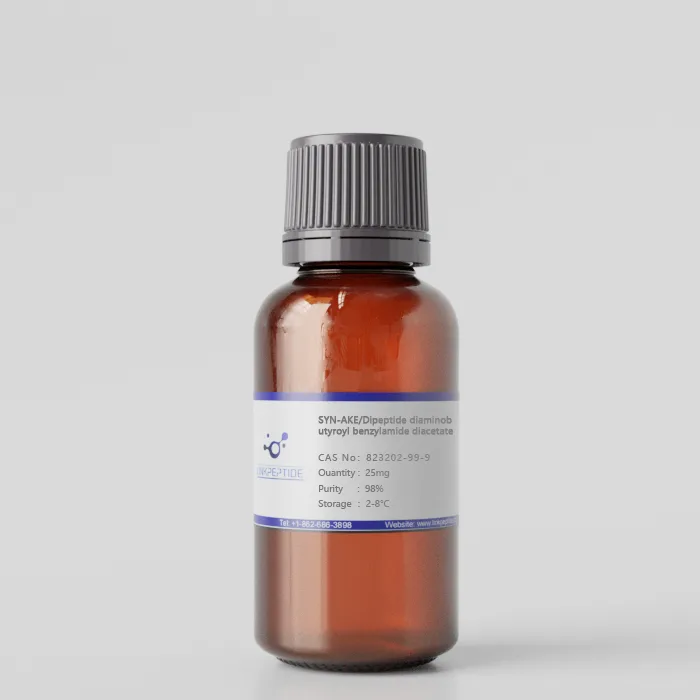
Product Name: Dipeptide-4
Cas No: 24587-41-5
Purity: 95%
Storage: Keep in dark and cool dry place -5~8 degree Celsius
Sequence: Phe-Trp
Molar Mass: 351.4
Chemical Formula: C20H21N3O3
IUPAC Name: (2S)-2-[[(2S)-2-amino-3-phenylpropanoyl]amino]-3-(1H-indol-3-yl)propanoic acid
SMILES: C1=CC=C(C=C1)C[C@@H](C(=O)N[C@@H](CC2=CNC3=CC=CC=C32)C(=O)O)N
InChIKey: JMCOUWKXLXDERB-WMZOPIPTSA-N
InChI: InChI=1S/C20H21N3O3/c21-16(10-13-6-2-1-3-7-13)19(24)23-18(20(25)26)11-14-12-22-17-9-5-4-8-15(14)17/h1-9,12,16,18,22H,10-11,21H2,(H,23,24)(H,25,26)/t16-,18-/m0/s1
Application:
Dipeptide-4 is a bioactive dipeptide recognized for its ability to support skin renewal, firmness, and overall revitalization. Composed of two amino acids with excellent skin affinity, it is widely used in cosmetic research aimed at improving texture, enhancing elasticity, and promoting a smoother, more youthful appearance. Dipeptide-4 helps support cellular communication pathways associated with healthy skin turnover and resilience. Its strong formulation versatility and stability make it ideal for incorporation into serums, moisturizers, and advanced anti-aging treatments designed to refine the complexion, improve suppleness, and restore a fresher, more radiant look.
Current Research:
Dipeptide-4: Research Overview
Dipeptide-4 is a synthetic dipeptide used in cosmetic science as a skin-protecting and antioxidant active. It is defined in cosmetic ingredient inventories as a peptide composed of cysteine and glycine (cysteinylglycine), a structure that naturally occurs in vivo as an intermediate of glutathione metabolism. Reported molecular formula C?H??N?O?S and molecular weight around 178 Da place Dipeptide-4 well below the usual 500 Da diffusion threshold, supporting its classification as a small-molecule peptide suitable for topical delivery.
Glutathione (γ-Glu-Cys-Gly) is a central intracellular antioxidant. Enzymatic cleavage of glutathione yields cysteinylglycine (Cys-Gly), which retains a redox-active thiol group and the capacity to participate in thiol–disulfide exchange reactions. Dipeptide-4 reproduces this glutathione-biomimetic motif and is described by its supplier as a “glutathione-like antioxidant peptide” designed to boost skin defenses against oxidative and carbonyl stress.
Through its cysteine residue, the dipeptide can interact with reactive oxygen species (ROS) and reactive carbonyl species (RCS). While detailed kinetic data are limited, the structural analogy to glutathione implies participation in reduction of peroxides and conjugation with electrophilic carbonyls, contributing to detoxification of oxidation and glycation by-products. This underlies its use in research focusing on oxidative-stress management in skin models.
A major research theme around Dipeptide-4 is protection against glycation. Glycation is a non-enzymatic reaction between reducing sugars or carbonyl intermediates and amino groups on long-lived proteins such as collagen and elastin. This process leads to advanced glycation end products (AGEs), which stiffen the dermal matrix and alter optical and mechanical properties of the skin.
Technical literature on the peptide complex Quintescine IS, whose main active component is Dipeptide-4, attributes to this dipeptide the ability to protect structural proteins against glycation and to reduce glycation-induced damage in skin models. Mechanistically, this is interpreted as competitive reaction with α-dicarbonyls and other carbonyl intermediates, lowering their availability to modify matrix proteins. Chinese technical sources similarly describe Dipeptide-4 as a small peptide that can “effectively prevent skin cell glycosylation,” reinforcing its placement in the anti-glycation category.
By moderating carbonyl stress, Dipeptide-4 indirectly contributes to preservation of collagen flexibility and prevention of excessive crosslinking, which are key structural aspects of dermal aging.
In addition to anti-glycation activity, Dipeptide-4 is presented as a broad antioxidant and anti-stress peptide. Supplier and secondary overviews characterize it as a biological antioxidant that increases the skin’s antioxidant defenses and provides protection “against all kinds of oxidative stress,” including photo-oxidative and pollution-related challenges.
This protective role is framed at the cellular level: Dipeptide-4 is reported to help protect cells against oxidative stress and environmental damaging factors, preserving the integrity of structural proteins and cellular components in in vitro and ex vivo systems. The glutathione-mimetic design suggests interaction with pathways linked to redox balance, although detailed transcriptional or enzyme-activity profiles remain limited in the public domain.
Because glycation and oxidative stress jointly affect dermal structure, Dipeptide-4 is frequently described as supporting maintenance of skin resiliency. Technical descriptions state that the peptide protects collagen and other structural proteins from glycation-induced stiffening and fragmentation.
By reducing AGE formation and limiting oxidative modification of proteins and lipids, the peptide is expected to support more homogeneous and elastic matrix architecture in experimental models. These effects place Dipeptide-4 in the broader group of matrix-preserving dipeptides that address biochemical drivers of dermal degradation rather than directly stimulating collagen synthesis.
A recent safety assessment in the Chinese cosmetic raw-materials database describes Dipeptide-4 as a skin protectant widely used in personal-care products and listed in the “Used Cosmetic Ingredients Catalogue (2021).” The report summarizes toxicological endpoints including acute oral and dermal toxicity, skin/eye irritation and sensitization, phototoxicity, genotoxicity, and repeated-dose toxicity, and notes no identified intrinsic risk substances.
Historical maximum use levels cited for marketed products are approximately 0.005% in leave-on and 0.00926% in rinse-off applications, with the conclusion that when used at or below these concentrations in conventional products, the ingredient does not pose a health risk under normal and reasonably foreseeable conditions of use.
As a short dipeptide (Cys–Gly), Dipeptide-4 is small, hydrophilic, and water-soluble. Commercial forms often appear either as pure powder for research use or pre-formulated in aqueous butylene glycol solutions (for example, in Quintescine IS). The peptide’s low molecular weight supports diffusion into the upper layers of the stratum corneum and viable epidermis when incorporated into appropriate vehicles.
Formulation guidance typically places Dipeptide-4 in the cool-down phase of emulsions or directly into aqueous serums to limit thermal degradation. It is compatible with standard humectants, emollients, and other antioxidant systems and is used at low concentrations consistent with its classification as a biofunctional antioxidant/anti-glycation micro-peptide.
Ongoing research and technical development around Dipeptide-4 focus on:
Further characterization of its anti-glycation capacity in protein and cell models.
Clarification of its antioxidant mechanisms, particularly in relation to glutathione metabolism and redox signaling.
Evaluation of its role in preserving dermal matrix quality under repetitive oxidative and carbonyl stress.
Taken together, the available data describe Dipeptide-4 as a glutathione-mimetic, cysteinylglycine-based dipeptide that combines anti-glycation and antioxidant functions to help maintain structural protein integrity and cellular resilience in the skin.
Get a Quote
 LinkPeptide