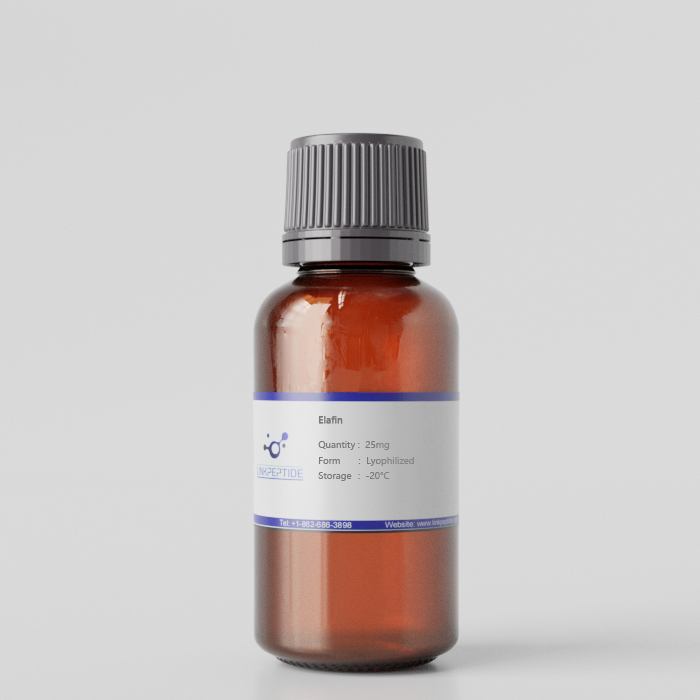
Product Name: Elafin
Sequence One Letter Code: AQEPVKGPVSTKPGSCPIILIRCAMLNPPNRCLKDTDCPGIKKCCEGSCGMACFVPQ (Disufide bonds between Cys16- Cys45, Cys23- Cys49, Cys32- Cys44, Cys38-Cys53)
Sequence Three Letter Code: H-Ala-Gln-Glu-Pro-Val-Lys-Gly-Pro-Val-Ser-Thr-Lys-Pro-Gly-Ser-Cys-Pro-Ile-Ile-Leu-Ile-Arg-Cys-Ala-Met-Leu-Asn-Pro-Pro-Asn-Arg-Cys-Leu-Lys-Asp-Thr-Asp-Cys-Pro-Gly-Ile-Lys-Lys-Cys-Cys-Glu-Gly-Ser-Cys-Gly-Met-Ala-Cys-Phe-Val-Pro-Gln-OH (Disufide bonds between Cys16- Cys45, Cys23- Cys49, Cys32- Cys44, Cys38-Cys53)
Molecular Weight: 5999.5
Purity: 95%
Form: Lyophilized
Storage Conditions: - 20 °C
Research Area: Infection Disease Research
Source / Species: human, chimpanzee
Conjugation: Unconjugated
Code Nacres: NA.26
Application: Elafin is a biologically active peptide derived from an elastase-specific inhibitor expressed primarily at epithelial surfaces. It serves a dual function as both an antiproteinase and an antimicrobial agent, contributing to frontline defense in barrier tissues such as the skin and respiratory tract. Elafin potently inhibits human neutrophil elastase (HNE) and proteinase 3, two serine proteases released by activated neutrophils that are closely associated with tissue injury during inflammatory responses. Its expression is rapidly induced by early pro-inflammatory cytokines, including TNF-α and IL-1, highlighting its role in the acute phase of inflammation. Beyond protease inhibition, elafin demonstrates broad-spectrum antimicrobial activity against both Gram-positive and Gram-negative respiratory pathogens. Structurally and functionally related to secretory leukocyte protease inhibitor (SLPI), elafin exhibits defensin-like properties that reinforce epithelial host defense. These combined activities make elafin highly relevant for research into inflammation, innate immunity, and protective mechanisms at mucosal and cutaneous surfaces.
Current Research: Elafin has emerged as a multifunctional effector peptide at the intersection of protease regulation, mucosal immunity, and inflammatory disease. Originally characterized as an elastase-specific inhibitor expressed by epithelial cells, elafin is now recognized as a critical component of the epithelial barrier response in the skin, respiratory tract, and other mucosal surfaces. Its dual activity—potent inhibition of neutrophil-derived serine proteases and intrinsic antimicrobial function—positions it as a key regulator of inflammatory homeostasis. Recent research has focused extensively on elafin’s role in controlling neutrophil elastase (HNE) and proteinase 3, enzymes that contribute to extracellular matrix degradation, epithelial barrier disruption, and amplification of inflammatory cascades. Dysregulated neutrophil protease activity is implicated in chronic inflammatory disorders such as chronic obstructive pulmonary disease (COPD), cystic fibrosis, psoriasis, acute respiratory distress syndrome (ARDS), and severe asthma. In these contexts, reduced elafin expression or imbalance between proteases and antiproteases correlates with disease severity. Experimental models demonstrate that restoring elafin levels attenuates tissue damage, reduces inflammatory cytokine production, and preserves epithelial integrity, highlighting its therapeutic potential. At the transcriptional level, elafin expression is strongly induced by pro-inflammatory cytokines including TNF-α and IL-1β, as well as microbial stimuli acting through Toll-like receptor (TLR) signaling pathways. This inducible expression profile underscores its classification as an innate immune effector molecule. Epigenetic regulation of the PI3 (peptidase inhibitor 3) gene, which encodes elafin, has also gained attention. Altered promoter methylation patterns have been observed in inflammatory skin diseases and certain cancers, suggesting that dysregulation of elafin expression may contribute to pathogenesis beyond infection-driven inflammation. Beyond antiprotease activity, current research increasingly emphasizes elafin’s direct antimicrobial properties. Elafin exhibits activity against a broad spectrum of Gram-positive and Gram-negative bacteria, including clinically relevant respiratory pathogens such as Pseudomonas aeruginosa and Staphylococcus aureus. Mechanistic studies suggest that, similar to defensins and the related secretory leukocyte protease inhibitor (SLPI), elafin can interact with bacterial membranes, contributing to membrane destabilization and inhibition of microbial growth. This antimicrobial capacity is particularly relevant in chronic lung diseases, where persistent infection and neutrophilic inflammation coexist. Elafin has also gained attention in the field of viral immunology. Emerging evidence indicates that elafin may modulate antiviral responses by influencing inflammatory signaling pathways and limiting protease-mediated viral spread in epithelial tissues. While its direct antiviral activity remains under investigation, its capacity to preserve barrier function and regulate inflammatory damage is considered protective during viral infection. In oncology research, elafin expression has shown context-dependent effects. Elevated elafin levels have been reported in certain epithelial cancers, including ovarian and breast cancers, where it may influence tumor-associated inflammation, cell proliferation, and immune cell recruitment. Conversely, loss of elafin expression has been associated with increased protease activity and invasive potential in other tumor types. These findings suggest a complex role in tumor microenvironment regulation that warrants further mechanistic study. Therapeutically, recombinant elafin and elafin-derived peptides are being explored as biologic candidates for inflammatory and protease-driven diseases. Preclinical models demonstrate protective effects in lung injury, transplant rejection, and inflammatory bowel disease. Strategies aimed at enhancing endogenous elafin expression or delivering exogenous elafin to inflamed tissues represent active areas of translational research. Overall, current research positions elafin as more than a simple serine protease inhibitor. It is increasingly recognized as a multifunctional innate immune mediator that integrates protease control, antimicrobial defense, epithelial barrier preservation, and inflammatory signaling modulation. These properties continue to drive investigation into its diagnostic and therapeutic applications across respiratory, dermatological, gastrointestinal, and oncological diseases.
Get a Quote
 LinkPeptide