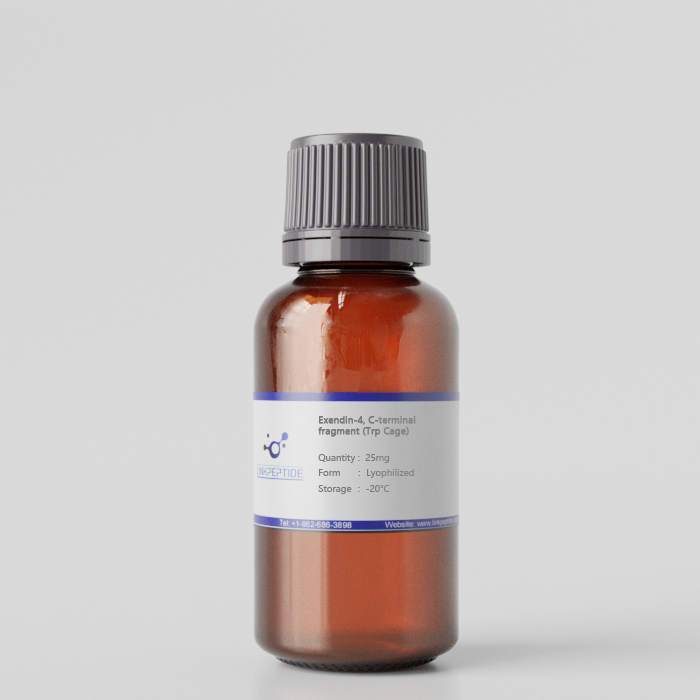
Product Name: Exendin-4, C-terminal fragment (Trp Cage)
Sequence One Letter Code: NLYIQWLKDGGPSSGRPPPS
Sequence Three Letter Code: H-Asn-Leu-Tyr-Ile-Gln-Trp-Leu-Lys-Asp-Gly-
Chemical Formula:C98H149N27O29
Molecular Weight: 2169.5
Purity: 95%
Form: Lyophilized
Storage Conditions: - 20 °C
Research Area: Peptide Series
Source / Species: Gila
Conjugation: Unconjugated
Code Nacres: NA.26
Application: The Exendin-4 C-terminal fragment, commonly known as Trp Cage (TC5b), is a 20-residue miniprotein that adopts one of the smallest stable tertiary folds identified to date. Derived from Exendin-4, TC5b forms a compact structure composed of short α-helical segments and a C-terminal polyproline region tightly packed around a central tryptophan residue. The peptide folds extremely rapidly and is greater than 95% folded in aqueous solution at physiological pH, making it a benchmark system for folding kinetics studies. TC5b is extensively used in protein folding research, molecular dynamics simulations, NMR and CD spectroscopy analyses, and investigations of structure–stability relationships in small proteins.
Current Research: The Exendin-4 C-terminal fragment, widely referred to as Trp Cage (TC5b), is a 20-residue miniprotein that represents one of the smallest polypeptides known to adopt a well-defined, stable tertiary structure under physiological conditions. Originally derived from the C-terminal region of Exendin-4, a glucagon-like peptide-1 (GLP-1) receptor agonist, TC5b has become a model system in structural biology and biophysics due to its compact architecture, rapid folding kinetics, and exceptional thermodynamic stability relative to its size. Structurally, TC5b forms a tightly packed tertiary fold consisting of a short N-terminal α-helix, a 3₁₀-helical turn, and a C-terminal polyproline II helix. These elements converge to encapsulate a central tryptophan residue within a hydrophobic core, giving rise to the “Trp cage” designation. The indole side chain of tryptophan is stabilized by hydrophobic interactions and tertiary contacts with surrounding residues, including proline and leucine side chains. This compact packing arrangement generates a well-defined three-dimensional structure that is highly resistant to unfolding in aqueous solution. One of the most remarkable features of TC5b is its ultrafast folding behavior. Folding occurs on the microsecond timescale, placing it among the fastest-folding proteins characterized to date. At physiological pH in aqueous solution, the peptide is reported to be more than 95% folded at equilibrium. This high folding propensity, combined with its small size, makes TC5b an ideal experimental and computational system for investigating fundamental principles of protein folding. Because it transitions between folded and unfolded states rapidly and reproducibly, it provides a tractable platform for probing kinetic pathways and energy landscapes. TC5b has been extensively studied using nuclear magnetic resonance (NMR) spectroscopy. High-resolution NMR structures have elucidated atomic-level details of its tertiary contacts and hydrogen-bonding networks. Chemical shift perturbation experiments and temperature-dependent analyses have been used to examine folding intermediates and stability profiles. Circular dichroism (CD) spectroscopy further supports characterization of its helical content and thermal denaturation behavior. The cooperative unfolding transition observed in CD and fluorescence experiments highlights the presence of a defined folding nucleus despite the peptide’s minimal length. The peptide’s intrinsic tryptophan fluorescence provides an additional analytical advantage. Changes in fluorescence emission upon unfolding enable sensitive monitoring of conformational transitions. This property has facilitated stopped-flow and temperature-jump experiments aimed at quantifying folding and unfolding rate constants. Because TC5b contains a single central tryptophan, spectroscopic signals can be directly correlated with tertiary structure formation, reducing interpretative complexity. In computational biophysics, TC5b has become a benchmark system for molecular dynamics (MD) simulations and force-field validation. Its small size permits long-timescale simulations with atomistic detail, enabling comparison between simulated and experimentally derived folding kinetics and structural ensembles. Numerous studies have used TC5b to refine solvent models, evaluate enhanced sampling algorithms, and test predictive accuracy of protein-folding simulations. The relatively simple yet fully formed tertiary structure provides a stringent test case for assessing how accurately computational methods capture folding pathways and thermodynamic stability. TC5b is also employed in mutational analyses to explore structure–stability relationships. Single-residue substitutions can significantly alter folding rates or stability, offering insight into the contributions of hydrophobic packing, helix propensity, and electrostatic interactions. These experiments help define minimal requirements for stable tertiary structure formation and clarify how local sequence features influence global folding behavior. Beyond fundamental folding studies, TC5b serves as a model scaffold for peptide engineering and design. Its compact fold demonstrates how a short amino acid sequence can encode stable tertiary structure, informing strategies for designing synthetic miniproteins with defined architectures. In summary, the Exendin-4 C-terminal fragment (Trp Cage, TC5b) is a 20-residue miniprotein characterized by a compact tertiary fold, ultrafast folding kinetics, and high stability in aqueous solution. Its structural simplicity, spectroscopic accessibility, and compatibility with computational modeling have established it as a benchmark system in protein folding research. TC5b continues to provide critical insights into the principles governing protein structure, stability, and folding dynamics.
Get a Quote
 LinkPeptide