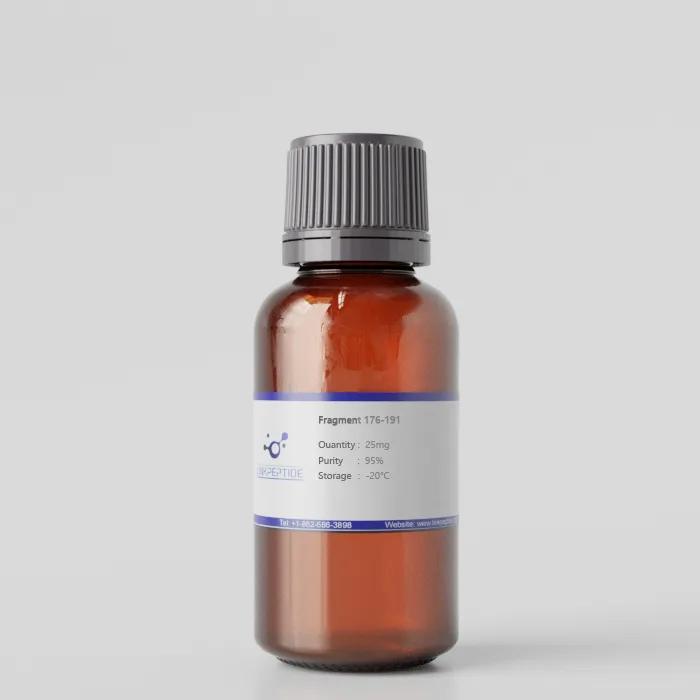
Product Name:Fragment 176-191
Purity:95%
Chemical Formula:C78H125N23O23S2
Molar Mass:1817.12
Synonyms:hGH Fragment 176-191; Lipolytic fragment
Storage:-20 degree Celsius
Application:Fragment 176-191 is a synthetic peptide derived from the C-terminal region of human growth hormone (hGH), specifically amino acids 176 to 191. It is designed to selectively mimic the lipolytic and fat-reducing effects of hGH without influencing blood sugar or promoting growth-related actions. Fragment 176-191 is widely utilized in studies on obesity, adipose tissue regulation, and metabolic syndrome, where it stimulates fat breakdown and inhibits lipogenesis.
Current Research:Introduction to Fragment 176-191 Fragment 176-191 is a modified version of the human growth hormone (hGH), focusing on the amino acid residues at its C-terminal region. Researchers discovered that this specific segment retained the fat-burning (lipolytic) activity of full-length hGH but without its diabetogenic or mitogenic effects. As such, Fragment 176-191 has emerged as a promising research compound in the study of obesity, energy metabolism, and adipocyte function. The peptide acts primarily on adipose tissue, promoting lipolysis (fat breakdown) while preventing lipogenesis (fat accumulation). Unlike hGH, Fragment 176-191 does not increase IGF-1 levels or cause insulin resistance, making it a safer and more targeted alternative in metabolic research. Mechanism of Action Fragment 176-191 binds to specific receptors on adipocytes and initiates signal transduction cascades that lead to: Activation of hormone-sensitive lipase (HSL) Enhanced mobilization of triglycerides Inhibition of fatty acid and triglyceride synthesis The peptide also improves mitochondrial oxidation of fatty acids, further reducing adipose stores and contributing to an overall leaner phenotype in animal models. Importantly, studies have shown that Fragment 176-191 has no significant effect on blood glucose levels, insulin sensitivity, or cell proliferation, distinguishing it from the full-length hGH molecule, which carries several metabolic and oncogenic risks in long-term applications. Applications in Obesity and Adiposity Research The most studied role of Fragment 176-191 is in obesity management. In high-fat diet rodent models, daily administration of the peptide has been shown to: Significantly reduce body fat percentage Lower overall body weight Improve plasma lipid profiles (reducing triglycerides and LDL cholesterol) Reduce abdominal and visceral fat depots Unlike appetite suppressants or stimulants, Fragment 176-191 does not affect food intake, suggesting its primary mechanism is enhanced energy expenditure and lipid mobilization, not caloric restriction. These results have driven increasing interest in its application for metabolic syndrome, type 2 diabetes prevention, and non-alcoholic fatty liver disease (NAFLD). Muscle Preservation and Lean Mass Fragment 176-191 also helps preserve lean muscle mass during fat reduction. In rodent models, while fat mass decreased, lean tissue was maintained or slightly increased, supporting the peptide's role in recomposition studies and anti-sarcopenic strategies. This makes it particularly useful in obesity interventions where muscle loss is a concern, such as elderly populations, post-surgical recovery, or during prolonged caloric deficits. Potential Synergistic Use with Other Compounds Due to its mechanism of action and safety profile, Fragment 176-191 is often studied in combination with: AICAR or AMPK activators, for enhanced fat oxidation Peptides like CJC-1295 or Ipamorelin, to complement GH-release strategies Metformin, for improved glucose control alongside fat loss These combinations may yield additive or synergistic metabolic effects in laboratory settings, making Fragment 176-191 a key component in multi-modal research on fat metabolism. Safety Profile and Pharmacokinetics Fragment 176-191 has been shown in animal studies to have minimal toxicity, no tumorigenic activity, and no significant immunogenicity. Its short half-life (approximately 30 minutes) makes it ideal for pulse-dose regimens and acute metabolic studies. The peptide is well tolerated when administered subcutaneously in preclinical settings. Conclusion Fragment 176-191 is a highly targeted and specialized peptide that allows researchers to explore fat metabolism, lipolysis, and energy balance without triggering the broader effects of full-length growth hormone. With proven efficacy in reducing fat mass and maintaining lean tissue, it serves as a versatile and powerful tool in metabolic, obesity, and anti-aging research. As the scientific community continues to explore non-hormonal fat loss strategies, Fragment 176-191 remains at the forefront of innovation in peptide-based metabolic modulation.
Reference:
Get a Quote
 LinkPeptide